



Question: 1. What is the clinics current weekly workload? What you can do is to think the weekly workload as the required capacity, and you may
1. What is the clinics current weekly workload? What you can do is to think the weekly workload as the required capacity, and you may want to calculate it based on the demand of surgery.
2. Should the clinic hire more surgeons, and if so, how many? The decision should be based on the analysis of workload, available capacity, etc. If to reduce setup time is your team's strategy, what will be the potential benefits of reducing setup time. Specific examples will be very helpful to support your comments.
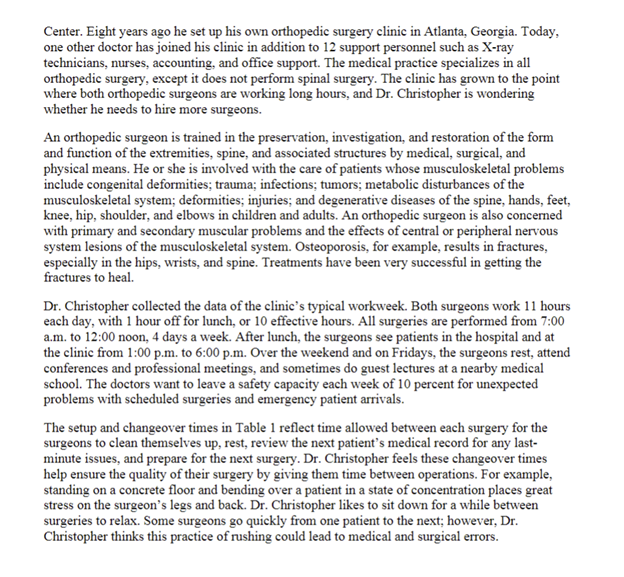
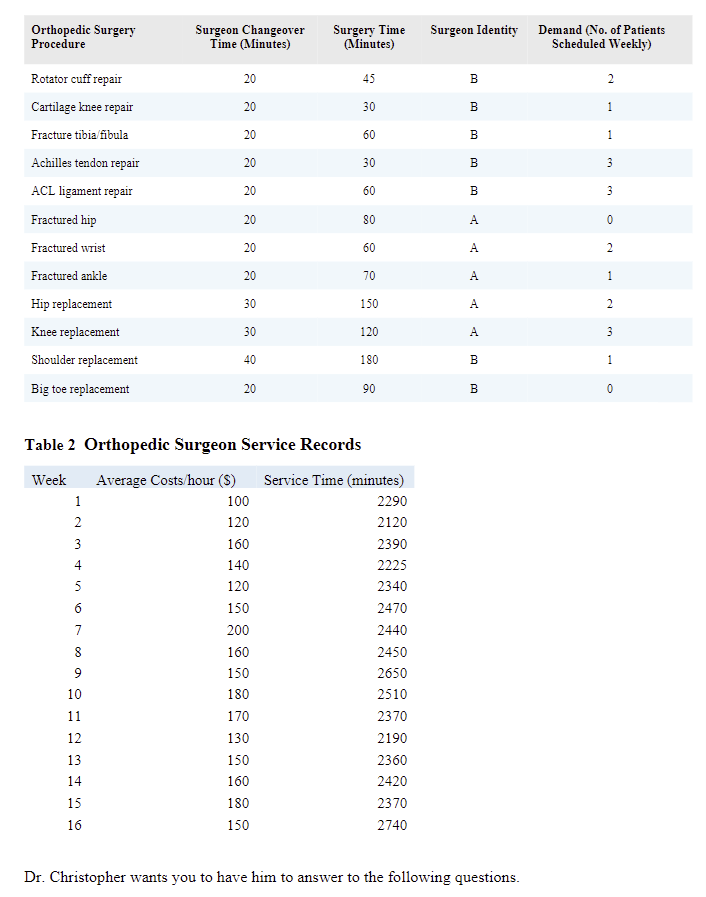
Center. Eight years ago he set up his own orthopedic surgery clinic in Atlanta, Georgia. Today, one other doctor has joined his clinic in addition to 12 support personnel such as X-ray technicians, nurses, accounting, and office support. The medical practice specializes in all orthopedic surgery, except it does not perform spinal surgery. The clinic has grown to the point where both orthopedic surgeons are working long hours, and Dr. Christopher is wondering whether he needs to hire more surgeons. An orthopedic surgeon is trained in the preservation, investigation, and restoration of the form and function of the extremities, spine, and associated structures by medical, surgical, and physical means. He or she is involved with the care of patients whose musculoskeletal problems include congenital deformities; trauma; infections; tumors; metabolic disturbances of the musculoskeletal system; deformities; injuries; and degenerative diseases of the spine, hands, feet, knee, hip, shoulder, and elbows in children and adults. An orthopedic surgeon is also concerned with primary and secondary muscular problems and the effects of central or peripheral nervous system lesions of the musculoskeletal system. Osteoporosis, for example, results in fractures, especially in the hips, wrists, and spine. Treatments have been very successful in getting the fractures to heal. Dr. Christopher collected the data of the clinic's typical workweek. Both surgeons work 11 hours each day, with 1 hour off for lunch, or 10 effective hours. All surgeries are performed from 7:00 a.m. to 12:00 noon, 4 days a week. After lunch, the surgeons see patients in the hospital and at the clinic from 1:00 p.m. to 6:00 p.m. Over the weekend and on Fridays, the surgeons rest, attend conferences and professional meetings, and sometimes do guest lectures at a nearby medical school. The doctors want to leave a safety capacity each week of 10 percent for unexpected problems with scheduled surgeries and emergency patient arrivals. The setup and changeover times in Table 1 reflect time allowed between each surgery for the surgeons to clean themselves up, rest, review the next patient's medical record for any lastminute issues, and prepare for the next surgery. Dr. Christopher feels these changeover times help ensure the quality of their surgery by giving them time between operations. For example, standing on a concrete floor and bending over a patient in a state of concentration places great stress on the surgeon's legs and back. Dr. Christopher likes to sit down for a while between surgeries to relax. Some surgeons go quickly from one patient to the next; however, Dr. Christopher thinks this practice of rushing could lead to medical and surgical errors. Table 2 Orthopedic Surgeon Service Records Dr. Christopher wants you to have him to answer to the following questionsStep by Step Solution
There are 3 Steps involved in it
1 Expert Approved Answer
Step: 1 Unlock

Question Has Been Solved by an Expert!
Get step-by-step solutions from verified subject matter experts
Step: 2 Unlock
Step: 3 Unlock