



Question: 1) What is the correct about the image one sees in the plane mirror and the image that forms on the retina? A) both are
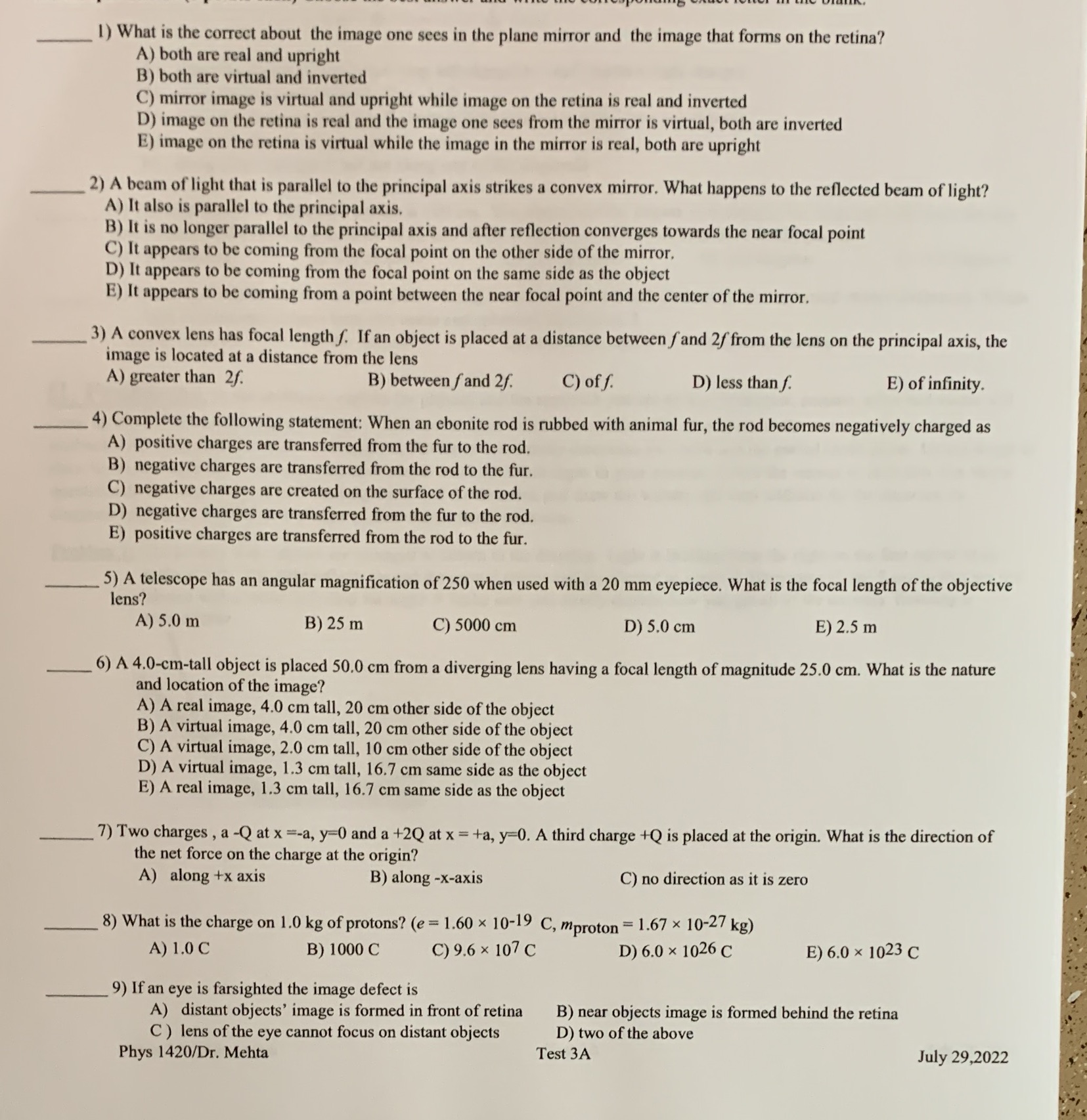
1) What is the correct about the image one sees in the plane mirror and the image that forms on the retina? A) both are real and upright B) both are virtual and inverted C) mirror image is virtual and upright while image on the retina is real and inverted D) image on the retina is real and the image one sees from the mirror is virtual, both are inverted E) image on the retina is virtual while the image in the mirror is real, both are upright 2) A beam of light that is parallel to the principal axis strikes a convex mirror. What happens to the reflected beam of light? A) It also is parallel to the principal axis, B) It is no longer parallel to the principal axis and after reflection converges towards the near focal point C) It appears to be coming from the focal point on the other side of the mirror, D) It appears to be coming from the focal point on the same side as the object E) It appears to be coming from a point between the near focal point and the center of the mirror. 3) A convex lens has focal length f. If an object is placed at a distance between f and 2f from the lens on the principal axis, the image is located at a distance from the lens A) greater than 2f. B) between fand 2f. C) off. D) less than f. E) of infinity. 4) Complete the following statement: When an ebonite rod is rubbed with animal fur, the rod becomes negatively charged as A) positive charges are transferred from the fur to the rod. B) negative charges are transferred from the rod to the fur. C) negative charges are created on the surface of the rod. D) negative charges are transferred from the fur to the rod E) positive charges are transferred from the rod to the fur. 5) A telescope has an angular magnification of 250 when used with a 20 mm eyepiece. What is the focal length of the objective lens? A) 5.0 m B) 25 m C) 5000 cm D) 5.0 cm E) 2.5 m 6) A 4.0-cm-tall object is placed 50.0 cm from a diverging lens having a focal length of magnitude 25.0 cm. What is the nature and location of the image? A) A real image, 4.0 cm tall, 20 cm other side of the object B) A virtual image, 4.0 cm tall, 20 cm other side of the object C) A virtual image, 2.0 cm tall, 10 cm other side of the object D) A virtual image, 1.3 cm tall, 16.7 cm same side as the object E) A real image, 1.3 cm tall, 16.7 cm same side as the object 7) Two charges , a -Q at x =-a, y=0 and a +2Q at x = +a, y=0. A third charge +Q is placed at the origin. What is the direction of the net force on the charge at the origin? A) along +x axis B) along -x-axis C) no direction as it is zero 8) What is the charge on 1.0 kg of protons? (e = 1.60 x 10⁻¹⁹ C, mproton = 1.67 x 10⁻²⁷ kg) A) 1.0 C B) 1000 C C) 9.6 x 10⁷ C D) 6.0 x 1026 C E) 6.0 x 10²³ C 9) If an eye is farsighted the image defect is A) distant objects' image is formed in front of retina B) near objects image is formed behind the retina C ) lens of the eye cannot focus on distant objects D) two of the above Phys 1420/Dr. Mehta Test 3A July 29,2022
Step by Step Solution
There are 3 Steps involved in it

Get step-by-step solutions from verified subject matter experts