







Question: 1. What is the expected current yield for each bond in each year? Round your answers to two decimal places. 2. What is the expected

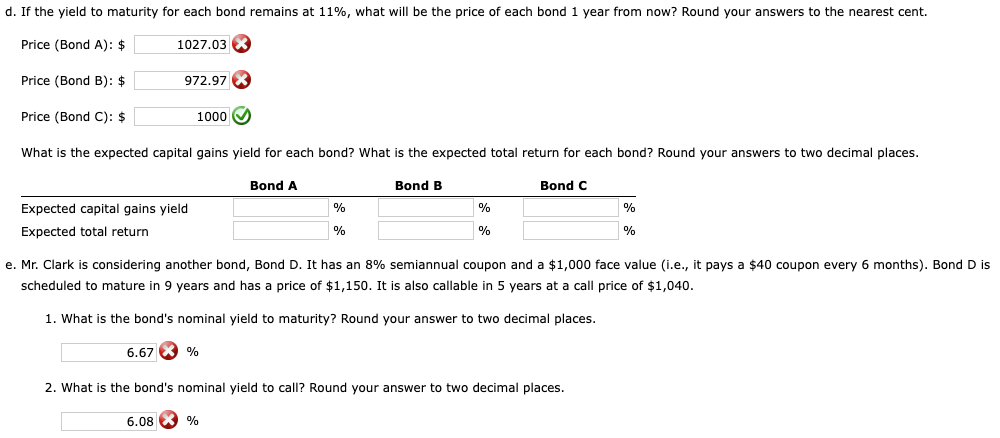
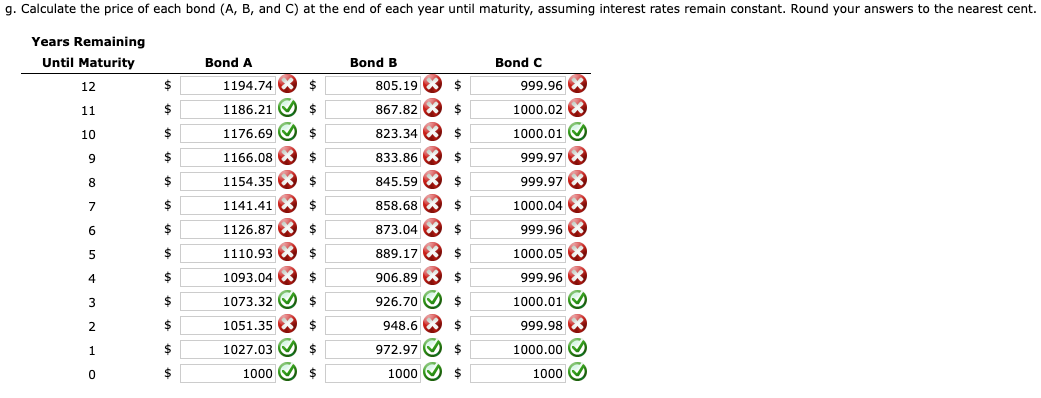
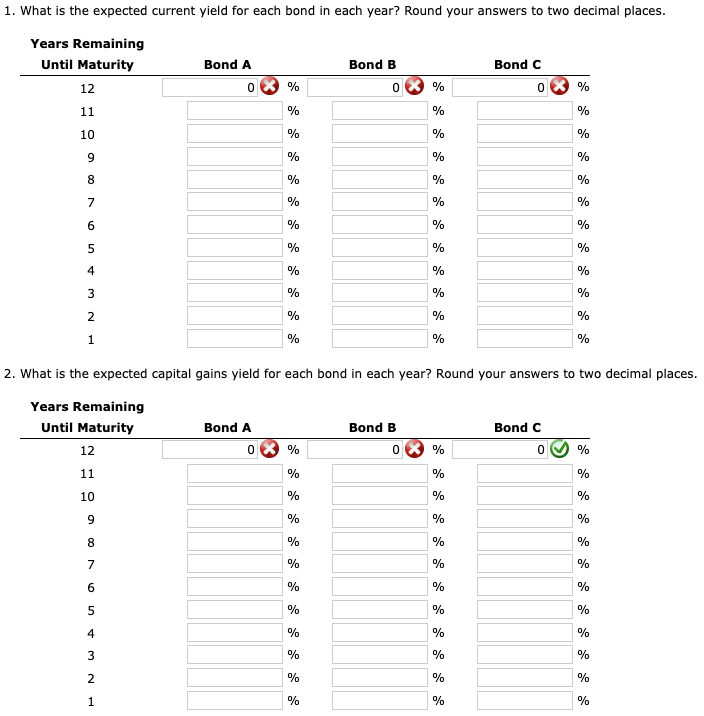
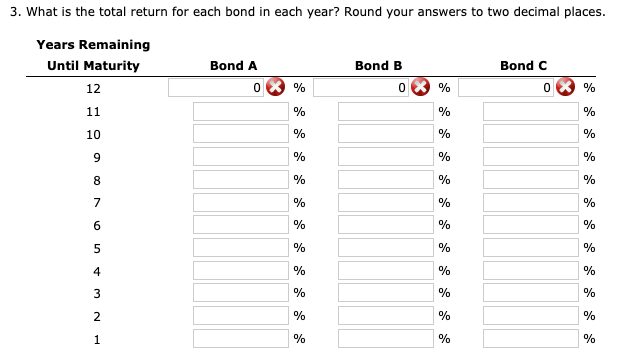
1. What is the expected current yield for each bond in each year? Round your answers to two decimal places. 2. What is the expected capital gains yield for each bond in each year? Round your answers to two decimal places. Clifford Clark is a recent retiree who is interested in investing some of his savings in corporate bonds. His financial planner has suggested the following bonds: - Bond A has a 14% annual coupon, matures in 12 years, and has a $1,000 face value. - Bond B has an 8% annual coupon, matures in 12 years, and has a $1,000 face value. - Bond C has an 11% annual coupon, matures in 12 years, and has a $1,000 face value. Each bond has a yield to maturity of 11%. d. If the yield to maturity for each bond remains at 11%, what will be the price of each bond 1 year from now? Round your answers to the nearest cent. Price (Bond A): \$ Price (Bond B): $ Price (Bond C): $ What is the expected capital gains yield for each bond? What is the expected total return for each bond? Round your answers to two decimal places. e. Mr. Clark is considering another bond, Bond D. It has an 8% semiannual coupon and a $1,000 face value (i.e., it pays a $40 coupon every 6 months). Bond D is scheduled to mature in 9 years and has a price of $1,150. It is also callable in 5 years at a call price of $1,040. 1. What is the bond's nominal yield to maturity? Round your answer to two decimal places. % 2. What is the bond's nominal yield to call? Round your answer to two decimal places. % 3. What is the total return for each bond in each year? Round your answers to two decimal places. g. Calculate the price of each bond (A,B, and C) at the end of each year until maturity, assuming interest rates remain constant. Round your answers to the nearest cent
Step by Step Solution
There are 3 Steps involved in it

Get step-by-step solutions from verified subject matter experts
 Study Help