







Question: 1) What is the general equation for the present value of a single sum? 2) What is the general equation for the future value of
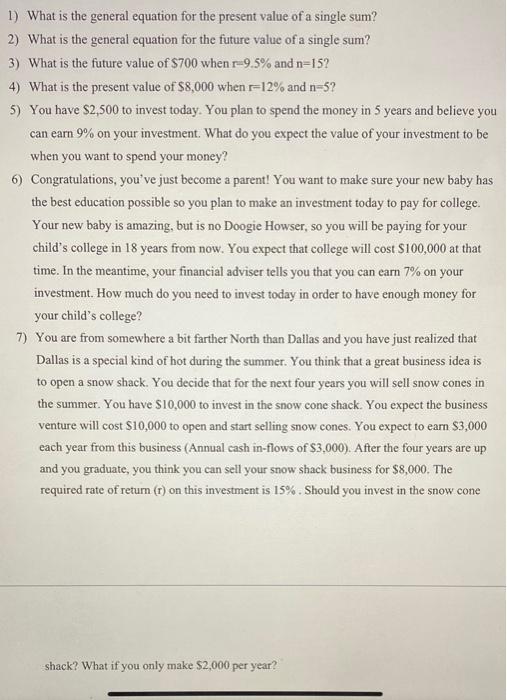
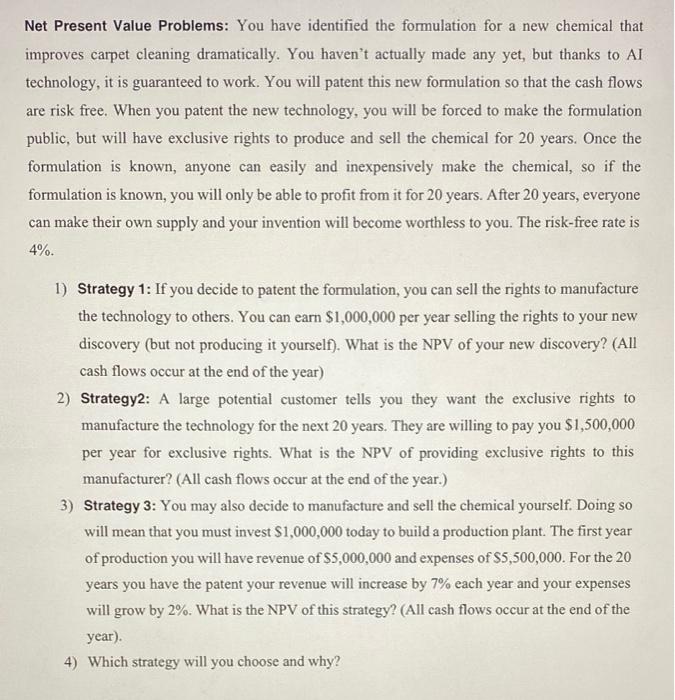
1) What is the general equation for the present value of a single sum? 2) What is the general equation for the future value of a single sum? 3) What is the future value of $700 when r=9.5% and n=15? 4) What is the present value of $8,000 when r=12% and n=5? 5) You have $2,500 to invest today. You plan to spend the money in 5 years and believe you can earn 9% on your investment. What do you expect the value of your investment to be when you want to spend your money? 6) Congratulations, you've just become a parent! You want to make sure your new baby has the best education possible so you plan to make an investment today to pay for college. Your new baby is amazing, but is no Doogie Howser, so you will be paying for your child's college in 18 years from now. You expect that college will cost $100,000 at that time. In the meantime, your financial adviser tells you that you can earn 7% on your investment. How much do you need to invest today in order to have enough money for your child's college? 7) You are from somewhere a bit farther North than Dallas and you have just realized that Dallas is a special kind of hot during the summer. You think that a great business idea is to open a snow shack. You decide that for the next four years you will sell snow cones in the summer. You have $10,000 to invest in the snow cone shack. You expect the business venture will cost $10,000 to open and start selling snow cones. You expect to earn $3,000 each year from this business (Annual cash in-flows of $3,000). After the four years are up and you graduate, you think you can sell your snow shack business for $8,000. The required rate of retum (t) on this investment is 15% Should you invest in the snow cone shack? What if you only make $2,000 per year? Net Present Value Problems: You have identified the formulation for a new chemical that improves carpet cleaning dramatically. You haven't actually made any yet, but thanks to AI technology, it is guaranteed to work. You will patent this new formulation so that the cash flows are risk free. When you patent the new technology, you will be forced to make the formulation public, but will have exclusive rights to produce and sell the chemical for 20 years. Once the formulation is known, anyone can easily and inexpensively make the chemical, so if the formulation is known, you will only be able to profit from it for 20 years. After 20 years, everyone can make their own supply and your invention will become worthless to you. The risk-free rate is 4%. 1) Strategy 1: If you decide to patent the formulation, you can sell the rights to manufacture the technology to others. You can earn $1,000,000 per year selling the rights to your new discovery (but not producing it yourself). What is the NPV of your new discovery? (All cash flows occur at the end of the year) 2) Strategy2: A large potential customer tells you they want the exclusive rights to manufacture the technology for the next 20 years. They are willing to pay you $1,500,000 per year for exclusive rights. What is the NPV of providing exclusive rights to this manufacturer? (All cash flows occur at the end of the year.) 3) Strategy 3: You may also decide to manufacture and sell the chemical yourself. Doing so will mean that you must invest $1,000,000 today to build a production plant. The first year of production you will have revenue of $5,000,000 and expenses of $5,500,000. For the 20 years you have the patent your revenue will increase by 7% each year and your expenses will grow by 2%. What is the NPV of this strategy? (All cash flows occur at the end of the year). 4) Which strategy will you choose and why
Step by Step Solution
There are 3 Steps involved in it

Get step-by-step solutions from verified subject matter experts
 Study Help