







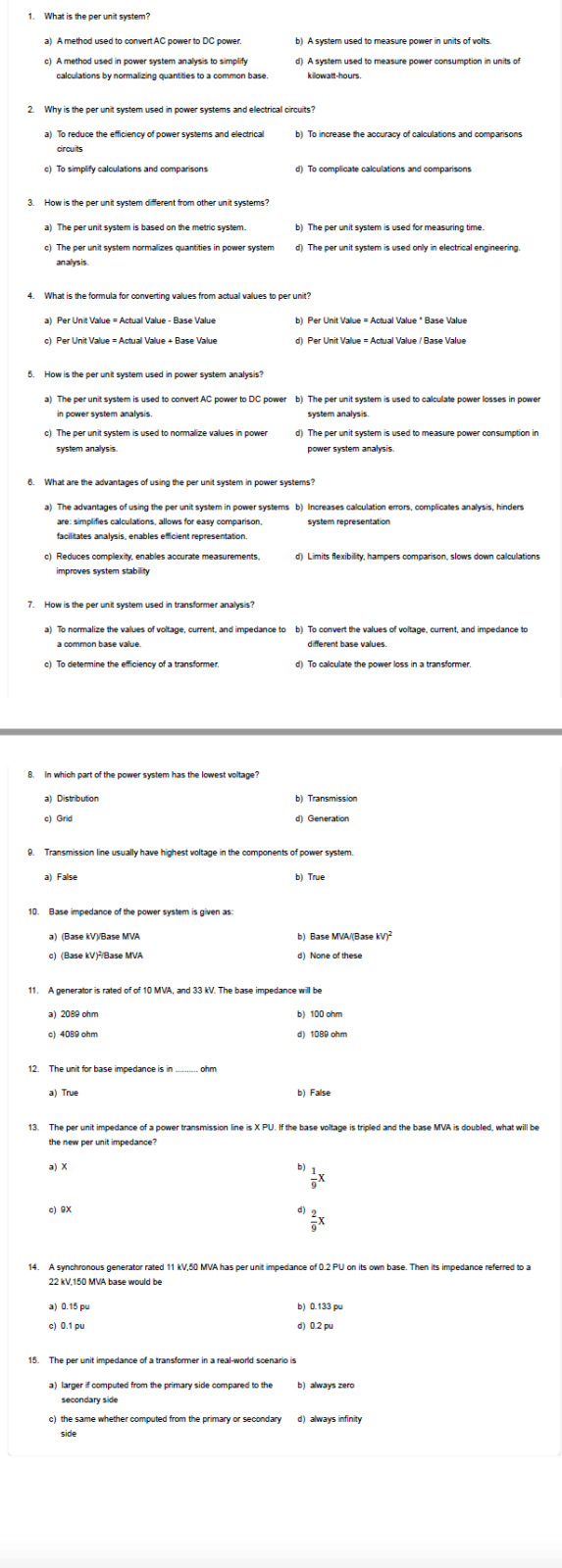
Question: 1 . What is the per unit system? a ) A method used to convert ( A C ) power to (
What is the per unit system?
a A method used to convert A C power to D C power.
b A system used to measure power in units of volts
c A method used in power system analysis to simplify
d A system used to measure power consumption in units of calculations by normalizing quantities to a common base. kilowatthours.
Why is the per unit system used in power systems and electrical cricuits?
a To reduce the efficiency of power systems and electrical
b To increase the accuracy of calculations and comparisons crecuts
c To simplify calculations and comparisons
d To complicate calculations and oomparisons
How is the per unit system diferent from other unit systems?
a The per unit system is based on the metric system
b The per unit system is used for measuring time.
c The per unit system normalizes quantities in power system
d The per unit system is used only in electrical engineering. analysis.
What is the formula for converting values from actual values to per unit?
a Per Unit Value Actual Value Base Value
b Per Unit Value Actual Value Base Value
c Per Unit Value Actual Value Base Value
d Per Unit Value Actual Value Base Value
How is the per unt system used in power system analysis?
a The per unit system is used to convert A C power to D C power b The per unit system is used to calculate power losses in power in power system analysis.
c The per unit system is used to normalize values in power system analysis system analysis.
d The per unit system is used to measure power consumption in power system analysis.
What are the advantages of using the per unit system in power systems?
a The advantages of using the per unit system in power systems b Increases calculation errors, complicates analysis, hinders are: simplifies calculations, allows for easy comparison. system representation facileates analysis, enables effcient representation.
c Reduces complexity, enables accurate measurements,
d Limits flexibitity, hampers comparison, slows down calculations improves system stabitity
How is the per unt system used in transtormer analysis?
a To normalize the values of voltage, current, and impedance to b To convert the values of voltage, current, and impedance to a common base value. different base values
c To determine the efficiency of a transformer.
d To calculate the power loss in a transformer.
In which part of the power system has the lowest voltage?
a Distribution
b Transmission
c Grid
d Generation
Q Transmission line usually have highest voltage in the components of power system.
a False
b True
Base impedanoe of the power system is given as:
aBase kVBase MVA
b Base MVA Base kV
cBase IV Base MVA
d None of these
A generator is rated of of MVA and kV The base impedance will be
a chm
b ohm
c ohm
d ohm
The unit for base impedance is in ohm
a True
b False
The per unit impedance of a power transmission line is X PU If the base voltage is tripled and the base MVA is doubled, what will be the new per unit impedance?
a x
bfracmathrmX
e x
dfracmathrmx
A synchronous generator rated mathrmkVmathrmMVA has per unit impedance of PU on its own base. Then its impedance referred to a mathrmkV MVA base would be
a pu
b pu
c pu
d pu
The per unit impedance of a transtormer in a realword scenario is
a larger computed from the primary side compared to the
b always zero
secondary side
c the same whether computed from the primary or secondary
d always infinity side
Step by Step Solution
There are 3 Steps involved in it
1 Expert Approved Answer
Step: 1 Unlock

Question Has Been Solved by an Expert!
Get step-by-step solutions from verified subject matter experts
Step: 2 Unlock
Step: 3 Unlock
 Study Help