Question: 1. What is the strategic management process at Microsoft under CEO Steve Ballmer (2000-2014)? How are strategic decisions made? What are the strengths and weaknesses
1. What is the strategic management process at Microsoft under CEO Steve Ballmer (2000-2014)? How are strategic decisions made? What are the strengths and weaknesses of this approach?
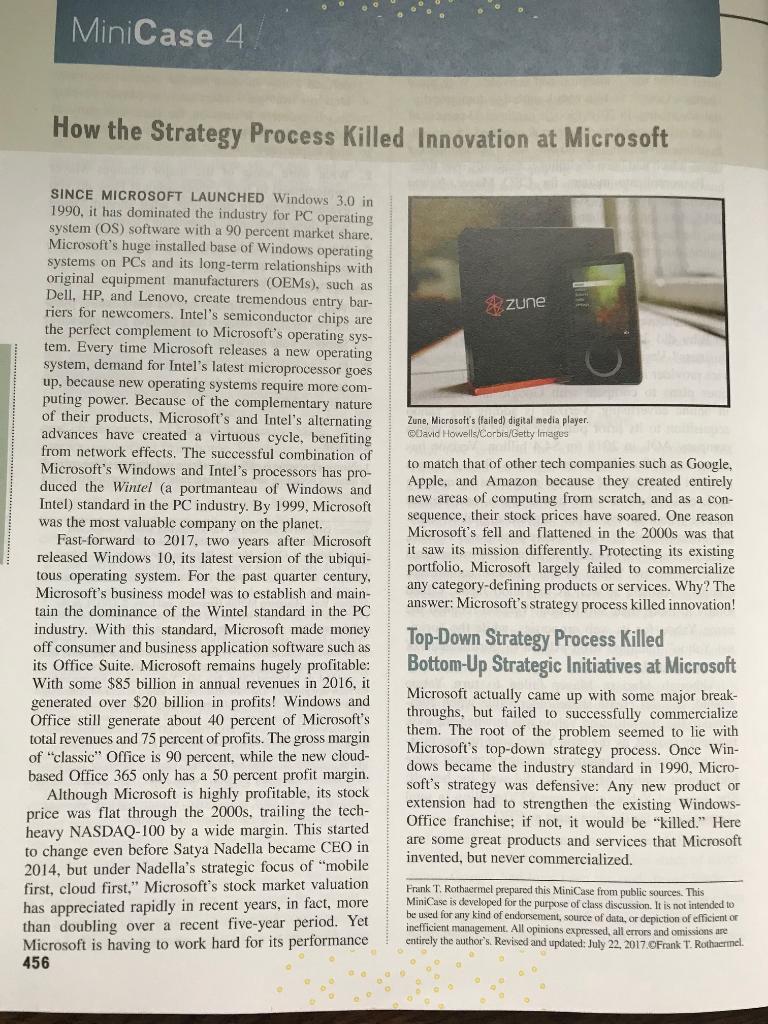
MiniCase 4 How the Strategy Process Killed Innovation at Microsoft Erzune Zune, Microsoft's failed) digital media player, @David Howells/Corbis/Getty Images SINCE MICROSOFT LAUNCHED Windows 3.0 in 1990, it has dominated the industry for PC operating system (OS) software with a 90 percent market share. Microsoft's huge installed base of Windows operating systems on PCs and its long-term relationships with original equipment manufacturers (OEMs), such as Dell, HP, and Lenovo, create tremendous entry bar- riers for newcomers. Intel's semiconductor chips are the perfect complement to Microsoft's operating sys- tem. Every time Microsoft releases a new operating system, demand for Intel's latest microprocessor goes up, because new operating systems require more com- puting power. Because of the complementary nature of their products, Microsoft's and Intel's alternating advances have created a virtuous cycle, benefiting from network effects. The successful combination of Microsoft's Windows and Intel's processors has pro- duced the wintel (a portmanteau of Windows and Intel) standard in the PC industry. By 1999, Microsoft was the most valuable company on the planet. Fast-forward to 2017, two years after Microsoft released Windows 10, its latest version of the ubiqui- tous operating system. For the past quarter century, Microsoft's business model was to establish and main- tain the dominance of the Wintel standard in the PC industry. With this standard, Microsoft made money off consumer and business application software such as its Office Suite. Microsoft remains hugely profitable: With some $85 billion in annual revenues in 2016, it generated over $20 billion in profits! Windows and Office still generate about 40 percent of Microsoft's total revenues and 75 percent of profits. The gross margin of "classic" Office is 90 percent, while the new cloud- based Office 365 only has a 50 percent profit margin. Although Microsoft is highly profitable, its stock price was flat through the 2000s, trailing the tech- heavy NASDAQ-100 by a wide margin. This started to change even before Satya Nadella became CEO in 2014, but under Nadella's strategic focus of "mobile first, cloud first," Microsoft's stock market valuation has appreciated rapidly in recent years, in fact, more than doubling over a recent five-year period. Yet Microsoft is having to work hard for its performance 456 to match that of other tech companies such as Google, Apple, and Amazon because they created entirely new areas of computing from scratch, and as a con- sequence, their stock prices have soared. One reason Microsoft's fell and flattened in the 2000s was that it saw its mission differently. Protecting its existing portfolio, Microsoft largely failed to commercialize any category-defining products or services. Why? The answer: Microsoft's strategy process killed innovation! Top-Down Strategy Process killed Bottom-Up Strategic Initiatives at Microsoft Microsoft actually came up with some major break- throughs, but failed to successfully commercialize them. The root of the problem seemed to lie with Microsoft's top-down strategy process. Once Win- dows became the industry standard in 1990, Micro- soft's strategy was defensive: Any new product or extension had to strengthen the existing Windows- Office franchise; if not, it would be "killed." Here are some great products and services that Microsoft invented, but never commercialized. Frank T. Rothaermel prepared this MiniCase from public sources. This MiniCase is developed for the purpose of class discussion. It is not intended to be used for any kind of endorsement, source of data, or depiction of efficient of inefficient management. All opinions expressed, all errors and omissions are entirely the authors. Revised and updated: July 22, 2017 Frank T. Rothaermel. MINICASE 4 How the Strategy Process killed innovation at ecosystem tightly integrating software, hardware, and services. In 2005, during an employee meeting, one Microsoft engineer asked Steve Ballmer whether Microsoft should compete with Apple's iPod and iTunes. In a sarcastic tone. Ballmer asked the room for a show of hands, "How many people think Micro- soft is in the business of selling music Not surpris- ingly, none of the intimidated Microsoft employees raised their hands. More than a year later, Microsoft introduced its own digital music player, the Zune (see photo above), which flopped. ONLINE SEARCH. Google is now the leading search and online advertising company, with close to $100 billion in annual revenues and a market capitalization of some 5700 billion in 2017, making it one of the most valuable companies globally. What haunts former Microsoft CEO Steve Ballmer is that Microsoft had its own working prototype of a Google forerunner, called Keywords, long before Google's ascent. Scott Banister, then a student at the University of Illi- nois at Urbana-Champaign, had come up with the idea of adding paid advertisements to internet searches. He quit college and drove his Geo hatchback to the San Francisco Bay Area to start Keywords, later joining an online ad company called LinkExchange. In 1998, inci- dentally the year Google was founded, Microsoft bought LinkExchange for some $265 million. The newly formed Microsoft online search team urged top managers to con- tinue to invest in the burgeoning online search technol- ogy. Instead, Microsoft executives shut down the project in 2000 because they did not see a viable business model in it. One team member actually approached Ballmer and explained that he thought Microsoft was making a huge mistake. But Ballmer said he wanted to manage through delegation and would not reverse a decision made by managers three levels below him. This decision put an end to Microsoft's first online advertising venture. In 2003, Microsoft got a second chance to enter the online advertising business when some mid-level engi- neers proposed buying Overture Services, an innovator in combining internet searches with advertisements. This time, Ballmer, joined by Microsoft co-founder Bill Gates, decided not to pursue the idea because they thought Overture was overpriced. Shortly there- after, Yahoo bought Overture for $1.6 billion. In 2008, Ballmer offered to buy Yahoo for close to $50 billion to help his company gain a foothold in the paid-search business where Google rules. Fortunately for Micro- soft, the offer was turned down by Yahoo, which was sold for $4.5 billion to Verizon in 2017. Having missed two huge opportunities to pur- sue promising strategic initiatives that emerged from lower levels within the firm, Microsoft has been play- ing catch-up in online search and advertising ever since. In the summer of 2009, after spending billions of dollars and being about a decade late, it launched its own search engine, Bing. Industry pundits joked that Bing is an acronym for "Because It's Not Google." TABLET COMPUTERS. Long before Apple launched the iPad in early 2010, the inventor of Microsoft's highly successful Xbox gaming console had developed a tablet computer called the Courier. The Courier was a fully functioning tablet that folded like a book and allowed users to draw on a touchscreen, among other features. Rather than compete against Apple, Ballmer informed the Courier team that he was pulling the plug on the tab- let to redirect resources to the next version of Windows, the launch for which was more than two years away. To add insult to injury, it was Windows 8, Microsoft's failed attempt to straddle desktop and mobile computing, In the meantime, Apple had sold more than 250 million iPads, which have been instrumental in strengthening Apple's ecosystem. This ecosystem allows Apple to be the world's leader in mobile com- puting. One other mobile computing invention that Microsoft killed was wearable devices such as smart watches.) OFFICE FOR IPHONE. As soon as Apple released the iPhone in 2007, Microsoft engineers tweaked the company's PC-based Office Suite to run on the Apple mobile device. Ballmer shut the project down-he had a visceral disdain for Apple, once stomping on an iPhone in an all-employee meeting when he saw a sub- ordinate using the popular Apple device-telling the group that Microsoft needed to focus its resources on Windows 8 In the meantime, Apple has garnered over $1.2 billion in iPhone sales since it was launched in 2007, making it one of the most successful products ever. In 2017, the average price for an iPhone was close to $700. Apple's 10th anniversary phone, the iPhone X, is the first smartphone to cross the $1,000 price threshold. Although Apple holds some 15 percent market share in the smartphone industry, it captures more than 90 percent of the profits. A whopping two- thirds of Apple's annual revenues of some $220 billion is from iPhone sales, surely sufficient to have paid a handsome licensing fee for a Microsoft Office Suite for the iPhone. PORTABLE MUSIC PLAYER. In 2001, Apple launched the iPod, a portable music player, with which the floun- dering company's resurgence began. This was fol- lowed up in 2003 by the launch of iTunes Music Store with 200,000 songs at 99 cents each. The iPod and iTunes laid the foundation of Apple's hugely successful CLOUD-BASED OFFICE SOFTWARE. Long before cloud- based computing took off, Microsoft in 2000 devel- oped a fully functioning suite of software applications for the web including an Office-type word-processing software called NetDocs. This project was discontin ued in 2001 because Ballmer feared it would canni- balize sales of the "classic" Office suite. This opened the door for Google to offer cloud-based computing applications such as Google Docs, Google Slides, and Google Sheets, which with Google Drive and Gmail make up the core of Google's cloud-based computing services. These in turn established Google Chrome as the dominant web browser and helped Google's Android become the leading mobile operating system with some 80 percent market share. In contrast, Microsoft's Win- dows has less than 1 percent market share in mobile computing CAR SOFTWARE. In the early 2000s, dozens of Micro- soft engineers developed on their own time-car software that allowed drivers to use online maps, have e-mails translated to voice and read to them, as well as play digital music. Ballmer shut the project down, arguing that Microsoft one of the most cash-rich companies on the planet-could not afford another big bet at the moment. Today, Tesla is as much a software and sustainable energy company as it is a car company, with a market cap of more than $60 billion. Both Tesla and Google are proving that driverless cars (all based on software and sensors) are viable within a few years and promise to be a multibillion-dollar industry. While still CEO, Ballmer admitted problems in Microsoft's strategic management process to a degree: "The biggest mistakes I claim I've been involved with are where I was impatient-because we didn't have a business yet in something, we should have stayed patient."2 Ballmer, who became Micro- soft's CEO in 2000, was replaced in 2014 by Satya Nadella. Under Nadella, Microsoft has made strides in reinventing itself with a "mobile first, cloud first strat- egy. Can Microsoft once again innovate successfully? Microsoft's strategy often gets its most critical look when it holds its developers' conference and announces new initiatives. Even though the jury may still be out for the long term, in recent years Microsoft has been getting much better press, even as its stock evalua- tions rise. Pundits applaud how Microsoft is releas- ing, fixing, and refining products like a modern cloud company. The company has broken free of Windows platforms and gone to universal availability, some times jumping from device to device. And it has even found new ways to provide iOS and Android apps. In short, it appears its cloud first, mobile first approach is allowing Microsoft to offer competitively matched experiences across consumers' platform of choice. Moreover, Nadella has created a culture in which the company manages a full stack of hardware, software, and data centers, and where bottom-up innova- tion appears to be embraced. In fact, failure is accepted as part of that process. Microsoft has created prototype labs so new ideas can be developed and tested, and if necessary, "to fail faster." In 2017, The Economist proclaimed that Microsoft has indeed transformed its culture for the better, but that getting cloud computing right remains a hard thing to do. DISCUSSION QUESTIONS 1. Describe the strategic management process at Microsoft under CEO Steve Ballmer (2000-2014). How were strategic decisions made? What were the strengths and weaknesses of this approach? Explain in detail 2. Although Microsoft invented some promising com- puting breakthroughs, and often before competitors, why did Microsoft fail to successfully commercialize them? 3. Why is it so difficult for CEOs of large and suc- cessful companies such as Microsoft to balance exploitation applying current knowledge to enhance firm performance in the short term-with exploration---searching for new knowledge that may enhance a firm's future performance? What are the trade-offs? How could they be reconciled? 4. In contrast, what can you infer from information in the case about the current design of Micro- soft's strategy process under Microsoft CEO Satya Nadella, who started in 2014? 5. What advice would you give Nadella in his current efforts? Endnotes 1. Quote drawn from "Next CEO's biggest job: Fixing Microsoft's culture," The Wall Street Journal, August 25, 2013. 2. Quote drawn from: "Microsoft bid to beat Google builds on his tory of misses," The Wall Street Journal, January 16, 2009 3. Welch, C. (2017). "The biggest announcements from Microsoft's Build event." The Verge May 11: Warren, T. (2017). "Microsoft's next mobile strategy is to make iOS and Android better, " The Verge. May 11:Lopez, M. (2016). "7 reasons to give Microsoft's strategy other look." Forbes, April 16. Sources"Among the iPhone's biggest transformation Apple self. The Wall Street Journal, June 20, 2017, "What Satya Nadella didat Microsoft." The Economist, March 16, 2017, "Opening Windows, The Economist, April 4.2015, "Next CEO's biggest job: Fixing Microso's culture. The Wall Street Journal August 25, 2013. "Microsoft bid to beat Google builds on history of miss The Wall Street Journal, January 16, 2007, Micro annual reports as years




