







Question: 1. What is this case name? ____________________________________________________ 2. What is this case citation? __________________________________________________ 3. Who originally sued whom? ________________________________________________ 4. Under what legal theory?
1. What is this case name? ____________________________________________________
2. What is this case citation? __________________________________________________
3. Who originally sued whom? ________________________________________________
4. Under what legal theory? ___________________________________________________
5. What are the four most important facts about this case? a. __________________________________________________________________
b. __________________________________________________________________
c. __________________________________________________________________
d. __________________________________________________________________
6. What did the trial court decide? ________________________________________________________________________
7. What did the intermediate appellate court decide? ________________________________________________________________________
8. What is the main issue that this court had to tackle? ______________________________ ________________________________________________________________________
9. What did this court (the one deciding the case you are reading) decide? ______________ ________________________________________________________________________
10. What is the one main reason this court decided that way? ________________________ ________________________________________________________________________ ___________________________________________________________________
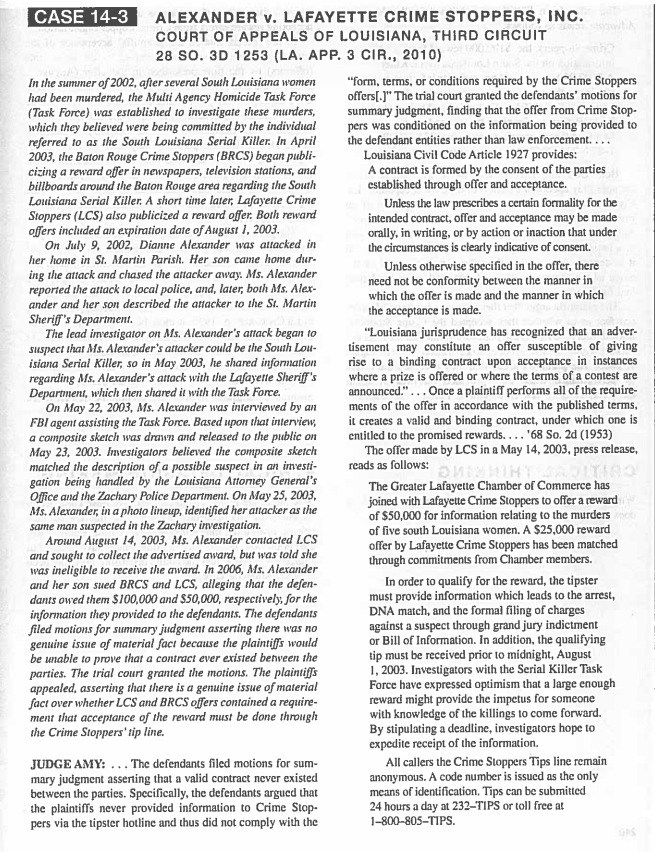
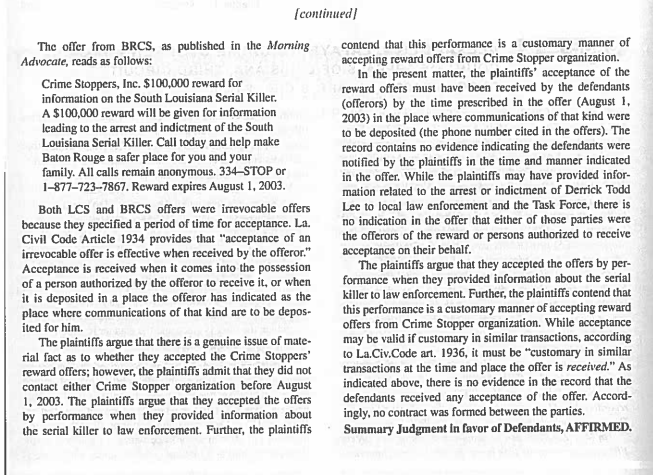
CASE 14-3 ALEXANDER v. LAFAYETTE CRIME STOPPERS, INC. COURT OF APPEALS OF LOUISIANA, THIRD CIRCUIT 28 SO. 3D 1253 (LA. APP. 3 CIR., 2010) In the summer of 2002, after several South Louisiana women "form, terms, or conditions required by the Crime Stoppers had been murdered, the Multi Agency Homicide Task Force offers[.]" The trial court granted the defendants' motions for (Task Force) was established to investigate these murders, summary judgment, finding that the offer from Crime Stop- which they believed were being committed by the individual pers was conditioned on the information being provided to referred to as the South Louisiana Serial Killer: In April the defendant entities rather than law enforcement.... 2003, the Baton Rouge Crime Stoppers (BRCS) began public Louisiana Civil Code Article 1927 provides: cizing a reward offer in newspapers, television stations, and A contract is formed by the consent of the parties billboards around the Baton Rouge area regarding the South established through offer and acceptance. Louisiana Serial killer. A short time later, Lafayette Crime Unless the law prescribes a certain formality for the Stoppers (LCS) also publicized a reward offer. Both reward intended contract, offer and acceptance may be made offers included an expiration date of August, 2003. orally, in writing, or by action or inaction that under On July 9, 2002, Dianne Alexander was attacked in the circumstances is clearly indicative of consent. her home in St. Martin Parish. Her son came home dur- ing the attack and chased the attacker away. Ms. Alexander Unless otherwise specified in the offer, there reported the attack to local police, and, later, both Ms. Aler- need not be conformity between the manner in ander and her son described the attacker to the St. Martin which the offer is made and the manner in which Sheriff's Department the acceptance is made The lead investigator on Ms. Alexander's attack began to "Louisiana jurisprudence has recognized that an adver- suspect that Ms. Alexander's attacker could be the South Lou- tisement may constitute an offer susceptible of giving isiana Serial Killer, so in May 2003, he shared information risc to a binding contract upon acceptance in instances regarding Ms. Alexander's attack with the Lafayette Sheriff's where a prize is offered or where the terms of a contest are Department, which then shared it with the Task Force announced."...Once a plaintiff performs all of the require- On May 22, 2003, Ms. Alexander was interviewed by an ments of the offer in accordance with the published terms, FBI agent assisting the Task Force. Based upon that interview, it creates a valid and binding contract, under which one is a composite sketch was drawn and released to the public on cntitled to the promised rewards.... '68 So. 20 (1953) May 23, 2003. Investigators believed the composite sketch The offer made by LCS in a May 14, 2003, press release, matched the description of a possible suspect in an inesti- reads as follows: gation being handled by the Louisiana Attomey General's Office and the Zachary Police Department. On May 25, 2003, The Greater Lafayette Chamber of Commerce has Ms. Alexander, in a photo lineup, identified her attacker as the joined with Lafayette Crime Stoppers to offer a reward same man suspected in the Zachary investigation. of $50,000 for information relating to the murders Around August 14, 2003, Ms. Alexander contacted LCS of five south Louisiana women. A $25,000 reward offer by Lafayette Crime Stoppers has been matched and sought to collect the advertised award, but was told she was ineligible to receive the award. In 2006, Ms. Alexander through commitments from Chamber members. and her son sued BRCS and LCS, alleging that the defen- In order to qualify for the reward, the tipster dants owed them $100,000 and $50,000, respectively, for the must provide information which leads to the arrest, information they provided to the defendants. The defendants DNA match, and the formal filing of charges filed motions for summary judgment asserting there was no against a suspect through grand jury indictment genuine issue of material fact because the plaintiffs would or Bill of Information. In addition, the qualifying be unable to prove that a contract ever existed between the tip must be received prior to midnight, August parties. The trial court granted the motions. The plaintiff's 1, 2003. Investigators with the Serial Killer Task appealed, asserting that there is a genuine issue of material Force have expressed optimism that a large enough fact over whether LCS and BRCS offers contained a require- reward might provide the impetus for someone ment that acceptance of the reward must be done through with knowledge of the killings to come forward. the Crime Stoppers' tip line. By stipulating a deadline, investigators hope to expedite receipt of the information JUDGE AMY: ... The defendants filed motions for sum- All callers the Crime Stoppers Tips line remain mary judgment asserting that a valid contract never existed anonymous. A code number is issued as the only between the parties. Specifically, the defendants argued that means of identification. Tips can be submitted the plaintiffs never provided information to Crime Stop- 24 hours a day at 232-TIPS or toll free at pers via the tipster hotline and thus did not comply with the 1-800-805-TIPS [continued) The offer from BRCS, as published in the Morning Advocate, reads as follows: Crime Stoppers, Inc. $100,000 reward for information on the South Louisiana Serial Killer. A $100,000 reward will be given for information leading to the arrest and indictment of the South Louisiana Serial Killer. Call today and help make Baton Rouge a safer place for you and your family. All calls remain anonymous, 334-STOP or 1-877-723-7867. Reward expires August 1, 2003. Both LCS and BRCS offers were irrevocable offers because they specified a period of time for acceptance. La. Civil Code Article 1934 provides that "acceptance of an irrevocable offer is effective when received by the offeror." Acceptance is received when it comes into the possession of a person authorized by the offeror to receive it, or when it is deposited in a place the offeror has indicated as the place where communications of that kind are to be depos- ited for him. The plaintiffs arguc that there is a genuine issue of mate- rial fact as to whether they accepted the Crime Stoppers' reward offers; however, the plaintiffs admit that they did not contact either Crime Stopper organization before August 1. 2003. The plaintiffs argue that they accepted the offers by performance when they provided information about the serial killer to law enforcement. Further, the plaintiffs contend that this performance is a customary manner of accepting reward offers from Crime Stopper organization. In the present matter, the plaintiffs' acceptance of the reward offers must have been received by the defendants (offerors) by the time prescribed in the offer (August 1, 2003) in the place where communications of that kind were to be deposited (the phone number cited in the offers). The record contains no evidence indicating the defendants were notified by the plaintiffs in the time and manner indicated in the offer. While the plaintiffs may have provided infor- mation related to the arrest or indictment of Derrick Todd Lec to local law enforcement and the Task Force, there is no indication in the offer that either of those parties were the offerors of the reward or persons authorized to receive acceptance on their behalf. The plaintiffs argue that they accepted the offers by per- formance when they provided information about the serial killer to law enforcement. Further, the plaintiffs contend that this performance is a customary manner of accepting reward offers from Crime Stopper organization. While acceptance may be valid if customary in similar transactions, according to La.Civ.Code art. 1936, it must be "customary in similar transactions at the time and place the offer is received." As indicated above, there is no evidence in the record that the defendants received any acceptance of the offer. Accord- ingly, no contract was formed between the parties, Summary Judgment in favor of Defendants, AFFIRMEDStep by Step Solution
There are 3 Steps involved in it

Get step-by-step solutions from verified subject matter experts
 Study Help