



Question: 1) What is your financial analysis for the make or buy decision for mustard? (perform all calculations on a per liter basis) 2) What benefits
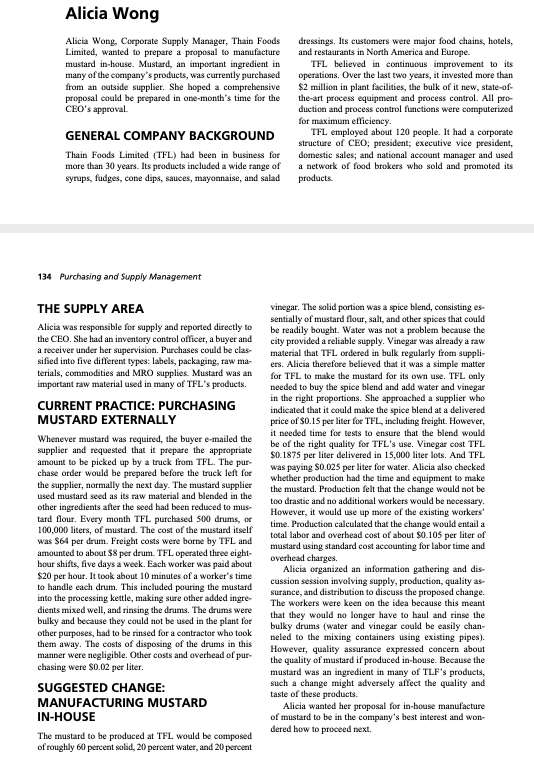
1) What is your financial analysis for the make or buy decision for mustard? (perform all calculations on a per liter basis)
2) What benefits would accrue to TFL from making mustard in-house?
3) What risks would there be for TFL?
4) Are there other alternatives to consider?
5) What should Alicia emphasize to the CEO?
Alicia Wong, Corporate Supply Manager, Thain Foods dressings. Its customers were major food chains, hotels, Limited, wanted to prepare a proposal to manufacture and restaurants in North America and Europe. mustard in-house. Mustard, an important ingredient in TFL believed in continuous improvement to its many of the company's products, was currently purchased operations. Over the last two years, it invested more than from an outside supplier. She hoped a comprebensive $2 million in plant facilities, the bulk of it new, state-ofproposal could be prepared in one-month's time for the the-art process equipment and process control. All proCEO's approval. duction and process control functions were computerized for maximum efficiency. GENERAL COMPANY BACKGROUND TFL employed about 120 people. It had a corporate Thain Foods Limited (TFL) had been in business for domestic sales; and national account manager and used more than 30 years. Its products included a wide range of a network of food brokers who sold and promoted its syrups, fudges, cone dips, sauces, mayonnaise, and salad products. 134 Purchasing and Supply Management THE SUPPLY AREA vinegar. The solid portion was a spice blend, consisting esAlicia was responsible for supply and reported directly to sentially of mustard flour, salt, and other spices that could the CEO. She had an inventory control officer, a buyer and be readily bought. Water was not a problem because the a receiver under her supervision. Purchases could be clas-_ city provided a reliable supply. Vinegar was already a raw sified into five different types: labels, packaging, raw ma- material that TFL ordered in bulk regularly from suppliers. Alicia therefore believed that it was a simple matter important raw material used in many of TFL's products for TFL to make the mustard for its own use. TFL only CURRENT PRAeded to buy the spice blend and add water and vinegar CURRENT PRACTICE: PURCHASING indicated that it could make the spice blend at a delivered MUSTARD EXTERNALLY price of $0.15 per liter for TFL, including freight. However, Whenever mustard was required, the buyer e-mailed the it needed time for tests to ensure that the blend would supplier and requested that it prepare the appropriate be of the right quality for TFL's use. Vinegar cost TFL amount to be picked up by a truck from TFL. The pur- $0.1875 per liter delivered in 15,000 liter lots. And TFL chase order would be prepared before the truck left for was paying $0.025 per liter for water. Alicia also checked the supplier, normally the next day. The mustard supplier whether production had the time and equipment to make used mustard seed as its raw material and blended in the the mustard. Production felt that the change would not be other ingredients after the seed had been reduced to mus- too drastic and no additional workers would be necessary. tard flour. Every month TFL purchased 500 drums, or However, it would use up more of the existing workers' 100,000 liters, of mustard. The cost of the mustard itself time. Production calculated that the change would entail a was $64 per drum. Freight costs were borne by TFL and total labor and overhead cost of about $0.105 per liter of amounted to about $8 per drum. TFL operated three eight- mustard using standard cost accounting for labor time and hour shifts, five days a week. Each worker was paid about overhead charges. $20 per hour. It took about 10 minutes of a worker's time Alicia organized an information gathering and disto handle each drum. This included pouring the mustard cussion session involving supply, production, quality asinto the processing kettle, making sure other added ingre- surance, and distribution to discuss the proposed change. dients mixed well, and rinsing the drums. The drums were The workers were keen on the idea because this meant bulky and because they could not be used in the plant for that they would no longer have to haul and rinse the other purposes, had to be rinsed for a contractor who took bulky drums (water and vinegar could be easily chanthem away. The costs of disposing of the drums in this neled to the mixing containers using existing pipes). manner were negligible. Other costs and overhead of pur- However, quality assurance expressed concern about chasing were $0.02 per liter. the quality of mustard if produced in-house. Because the mustard was an ingredient in many of TLF's products, SUGGESTED CHANGE: _ such a change might adversely affect the quality and MANUFACTURING MUSTARD taste of these products. IN-HOUSE SAlicia wanted her proposal for in-house manufacture IN-HOUSE of mustard to be in the company's best interest and won- The mustard to be produced at TFL would be composed of roughly 60 percent solid, 20 percent water, and 20 percent
Step by Step Solution
There are 3 Steps involved in it

Get step-by-step solutions from verified subject matter experts