



Question: 1. What modifications would you make to the current CER approval system described above? Develop some specific proposals and explain how they would address the
1. What modifications would you make to the current CER approval system described above? Develop some specific proposals and explain how they would address the problems that occurred when put into practice in 2007.
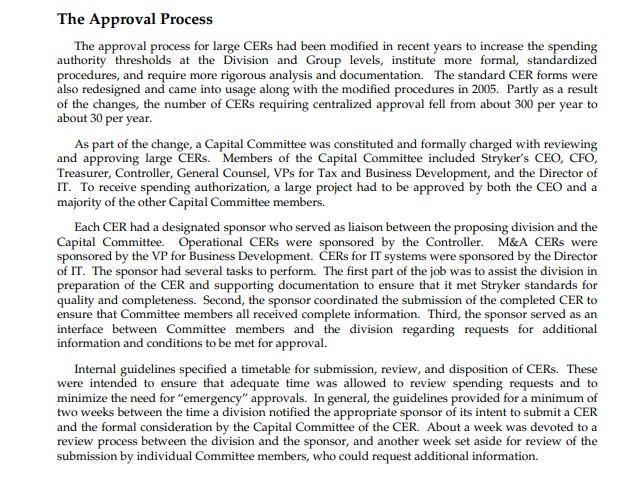
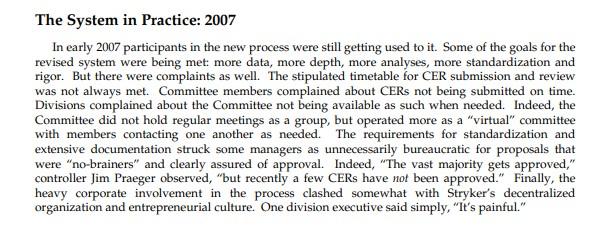
The Approval Process The approval process for large CERs had been modified in recent years to increase the spending authority thresholds at the Division and Group levels, institute more formal, standardized procedures, and require more rigorous analysis and documentation. The standard CER forms were also redesigned and came into usage along with the modified procedures in 2005. Partly as a result of the changes, the number of CERs requiring centralized approval fell from about 300 per year to about 30 per year. As part of the change, a Capital Committee was constituted and formally charged with reviewing and approving large CERs. Members of the Capital Committee included Stryker's CEO, CFO, Treasurer, Controller, General Counsel, VPs for Tax and Business Development, and the Director of IT. To receive spending authorization, a large project had to be approved by both the CEO and a majority of the other Capital Committee members. Each CER had a designated sponsor who served as liaison between the proposing division and the Capital Committee Operational CERs were sponsored by the Controller. M&A CERs were sponsored by the VP for Business Development. CERs for IT systems were sponsored by the Director of IT. The sponsor had several tasks to perform. The first part of the job was to assist the division in preparation of the CER and supporting documentation to ensure that it met Stryker standards for quality and completeness. Second, the sponsor coordinated the submission of the completed CER to ensure that Committee members all received complete information. Third, the sponsor served as an interface between Committee members and the division regarding requests for additional information and conditions to be met for approval. Internal guidelines specified a timetable for submission, review, and disposition of CERs. These were intended to ensure that adequate time was allowed to review spending requests and to minimize the need for "emergency" approvals. In general, the guidelines provided for a minimum of two weeks between the time a division notified the appropriate sponsor of its intent to submit a CER and the formal consideration by the Capital Committee of the CER. About a week was devoted to a review process between the division and the sponsor, and another week set aside for review of the submission by individual Committee members, who could request additional information. The System in Practice: 2007 In early 2007 participants in the new process were still getting used to it. Some of the goals for the revised system were being met: more data, more depth, more analyses, more standardization and rigor. But there were complaints as well. The stipulated timetable for CER submission and review was not always met. Committee members complained about CERs not being submitted on time. Divisions complained about the Committee not being available as such when needed. Indeed, the Committee did not hold regular meetings as a group, but operated more as a "virtual" committee with members contacting one another as needed. The requirements for standardization and extensive documentation struck some managers as unnecessarily bureaucratic for proposals that were "no-brainers" and clearly assured of approval. Indeed, "The vast majority gets approved," controller Jim Praeger observed, "but recently a few CERs have not been approved." Finally, the heavy corporate involvement in the process clashed somewhat with Stryker's decentralized organization and entrepreneurial culture. One division executive said simply, "It's painful
Step by Step Solution
There are 3 Steps involved in it
1 Expert Approved Answer
Step: 1 Unlock

Question Has Been Solved by an Expert!
Get step-by-step solutions from verified subject matter experts
Step: 2 Unlock
Step: 3 Unlock