







Question: 1. When is the company's interaction with its customer typically the strongest? A. When selling a service B. When selling a product C. Customer interaction
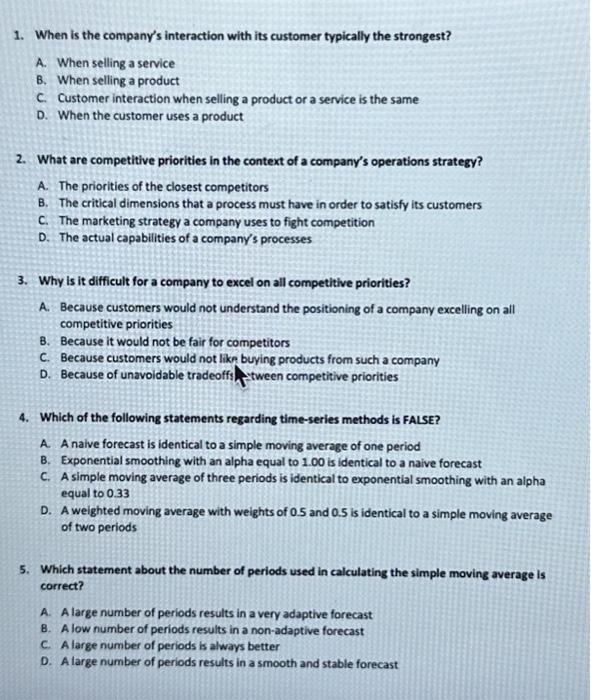
1. When is the company's interaction with its customer typically the strongest? A. When selling a service B. When selling a product C. Customer interaction when selling a product or a service is the same D. When the customer uses a product 2. What are competitive priorities in the context of a company's operations strategy? A. The priorities of the closest competitors B. The critical dimensions that a process must have in order to satisfy its customers C. The marketing strategy a company uses to fight competition D. The actual capabilities of a company's processes 3. Why is it difficult for a company to excel on all competitive priorities? A. Because customers would not understand the positioning of a company excelling on all competitive priorities B. Because it would not be fair for competitors C. Because customers would not likg buying products from such a company D. Because of unavoidable tradeoff: tween competitive priorities 4. Which of the following statements regarding time-series methods is FALSE? A. A naive forecast is identical to a simple moving average of one period B. Exponential smoothing with an alpha equal to 1.00 is identical to a naive forecast C. A simple moving average of three periods is identical to exponential smoothing with an alpha equal to 0.33 D. A weighted moving average with weights of 0.5 and 0.5 is identical to a simple moving average of two periods 5. Which statement about the number of periods used in calculating the simple moving average is correct? A. A large number of periods results in a very adaptive forecast B. A low number of periods results in a non-adaptive forecast C. A large number of periods is always better D. A large number of periods results in a smooth and stable forecast
Step by Step Solution
There are 3 Steps involved in it

Get step-by-step solutions from verified subject matter experts
 Study Help