







Question: 1. When testing with jMeter we primarily used the thread count to increase load on the system. What other factors could we use to increase
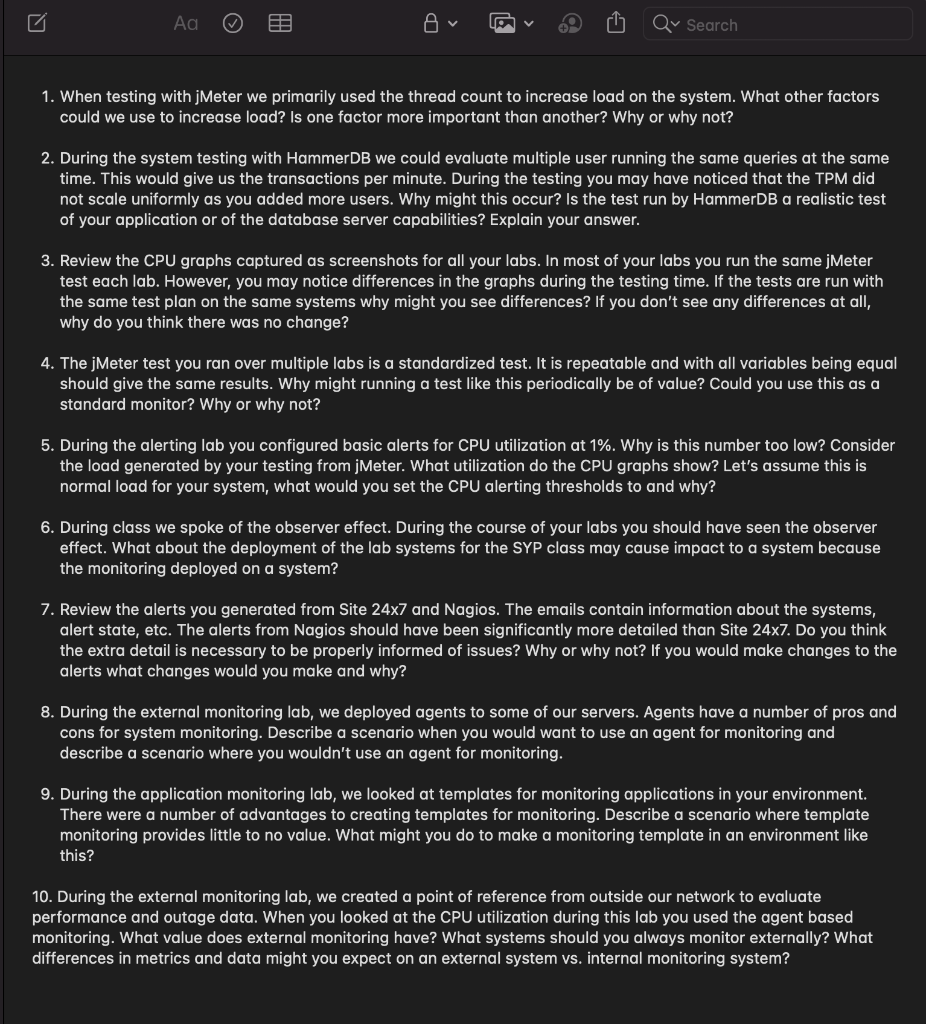
1. When testing with jMeter we primarily used the thread count to increase load on the system. What other factors could we use to increase load? Is one factor more important than another? Why or why not? 2. During the system testing with HammerDB we could evaluate multiple user running the same queries at the same time. This would give us the transactions per minute. During the testing you may have noticed that the TPM did not scale uniformly as you added more users. Why might this occur? Is the test run by HammerDB a realistic test of your application or of the database server capabilities? Explain your answer. 3. Review the CPU graphs captured as screenshots for all your labs. In most of your labs you run the same jMeter test each lab. However, you may notice differences in the graphs during the testing time. If the tests are run with the same test plan on the same systems why might you see differences? If you don't see any differences at all, why do you think there was no change? 4. The jMeter test you ran over multiple labs is a standardized test. It is repeatable and with all variables being equal should give the same results. Why might running a test like this periodically be of value? Could you use this as a standard monitor? Why or why not? 5. During the alerting lab you configured basic alerts for CPU utilization at 1%. Why is this number too low? Consider the load generated by your testing from jMeter. What utilization do the CPU graphs show? Let's assume this is normal load for your system, what would you set the CPU alerting thresholds to and why? 6. During class we spoke of the observer effect. During the course of your labs you should have seen the observer effect. What about the deployment of the lab systems for the SYP class may cause impact to a system because the monitoring deployed on a system? 7. Review the alerts you generated from Site 247 and Nagios. The emails contain information about the systems, alert state, etc. The alerts from Nagios should have been significantly more detailed than Site 247. Do you think the extra detail is necessary to be properly informed of issues? Why or why not? If you would make changes to the alerts what changes would you make and why? 8. During the external monitoring lab, we deployed agents to some of our servers. Agents have a number of pros and cons for system monitoring. Describe a scenario when you would want to use an agent for monitoring and describe a scenario where you wouldn't use an agent for monitoring. 9. During the application monitoring lab, we looked at templates for monitoring applications in your environment. There were a number of advantages to creating templates for monitoring. Describe a scenario where template monitoring provides little to no value. What might you do to make a monitoring template in an environment like this? 10. During the external monitoring lab, we created a point of reference from outside our network to evaluate performance and outage data. When you looked at the CPU utilization during this lab you used the agent based monitoring. What value does external monitoring have? What systems should you always monitor externally? What differences in metrics and data might you expect on an external system vs. internal monitoring system
Step by Step Solution
There are 3 Steps involved in it

Get step-by-step solutions from verified subject matter experts
 Study Help