







Question: 1. Which statement about std::array and std:: vector is incorrect? 2. Which statement about iterating over arrays is incorrect? Question 3 Which statement about std::array
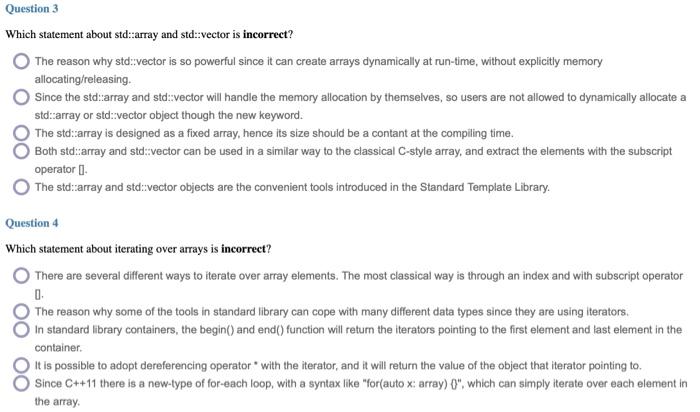
Question 3 Which statement about std::array and std::vector is incorrect? The reason why std:vector is so powerful since it can create arrays dynamically at run-time, without explicitly memory allocating/releasing. Since the std::array and std::vector will handle the memory allocation by themselves, so users are not allowed to dynamically allocate a stdurarray or std::vector object though the new keyword. The std:array is designed as a fixed array, hence its size should be a contant at the compiling time. Both std:array and std::vector can be used in a similar way to the classical C-style array, and extract the elements with the subscript operator 1. The std::array and std::vector objects are the convenient tools introduced in the Standard Template Library. Question 4 Which statement about iterating over arrays is incorrect? There are several different ways to iterate over array elements. The most classical way is through an index and with subscript operator 0. The reason why some of the tools in standard library can cope with many different data types since they are using iterators. In standard library containers, the begin() and end() function will return the iterators pointing to the first element and last element in the container It is possible to adopt dereferencing operator with the iterator, and it will return the value of the object that iterator pointing to Since C++11 there is a new type of for-each loop, with a syntax like "for(auto x: array) 0", which can simply iterate over each element in the array
Step by Step Solution
There are 3 Steps involved in it

Get step-by-step solutions from verified subject matter experts
 Study Help