







Question: 1. WHILEL uses the same datatype of binary trees as WHILE does. Consider now the following trees in D: (a) ({{nil.nil).nil).nil) (b) ({{nil.nil). nil).> (c)
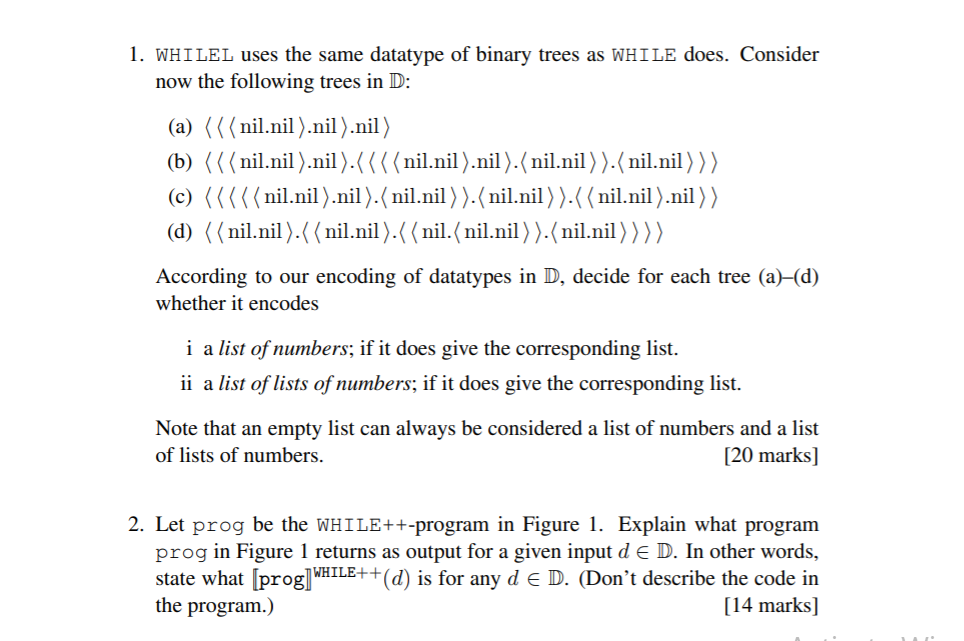
1. WHILEL uses the same datatype of binary trees as WHILE does. Consider now the following trees in D: (a) ({{nil.nil).nil).nil) (b) ({{nil.nil). nil).> (c) .> (d) ((nil.nil). {{nil.nil). {{nil. (nil.nil)). (nil.nil>>>> According to our encoding of datatypes in D, decide for each tree (a)-(d) whether it encodes i a list of numbers; if it does give the corresponding list. ii a list of lists of numbers; if it does give the corresponding list. Note that an empty list can always be considered a list of numbers and a list of lists of numbers. [20 marks] 2. Let prog be the WHILE++-program in Figure 1. Explain what program prog in Figure 1 returns as output for a given input de D. In other words, state what (prog]WHILE++(d) is for any d e D. (Don't describe the code in the program.) [14 marks]
Step by Step Solution
There are 3 Steps involved in it

Get step-by-step solutions from verified subject matter experts
 Study Help