







Question: 1) Why do multiple programming languages exist? a. Old languages did not support the features found in modern languages. b. Languages do not change over
1) Why do multiple programming languages exist?
a. Old languages did not support the features found in modern languages.
b. Languages do not change over time. The only way to have features added is to make a new language.
c. Different languages express different ideas well resulting in languages suited for different tasks.
d. New languages support all of the previous paradigms in addition to new features.
2) Why is C typically considered to be a faster language than Java?
a. Java typically requires a virtual machine to execute its byte code.
b. The Java libraries are not well implemented.
c. Java is a higher level language that requires more processing time to provide the higher level
abstractions.
d. All of the above.
3?what are the advantages to using a strictly typed language? (Circle all that apply)
a. The compiler can check the value before it is used. b. Function calling conventions can be checked before execution. c. The type of input data to a function can be guaranteed.
d. The amount of memory to be allocated on the stack is known before hand.
4) Given a text processing problem should we always use a shell language like bash? (Circle all that apply)
a. Yes, It is always worth it to learn how to solve a problem in a new language. b. No, not if you dont know how to solve it in bash, but you know a quick solution in another.
c. No, bash does not handle strings very well. d. Yes, bash handles strings well and will always solve the problem better than you could.
5) Which of the following are true statements? (Circle all that apply)
a. C and C++ provide the same abstractions.
b. C++ and Java provide the same abstractions.
c. C and C++ are essentially the same language, C++ just adds OOP.
d. Being a good C programmer means I will create good C++ abstractions.
6) Which of the following statements is true about an Object?
a. An Object defines only the methods that you can call on it.
b. An Object is a collection of data specific to that object.
c. The size of the object must be known before compilation so you can correctly malloc space for it.
d. Objects must be built from classes.
7). Which best describes declarative programming?
a. Languages where the programmer specifies how to solve problems.
b. Languages where the programmer specifies which problem to solve.
c. Languages that have control structures like if/else and for.
d. Languages that allow for calling other portions of code.
8) When writing programs in large teams which language paradigm helps keep humans organized:
a. Imperative Programming
b. Declarative Programming
c. Procedural Programming
d. Object Oriented Programming
9) Why do we want to allocate memory on the heap? (Circle all that apply)
a. Memory allocated on the stack has a lifetime limited to the function that declares it.
b. Pointers to memory on the stack cannot be passed to other functions.
c. Memory on the heap doesnt require additional memory management.
d. Memory on the stack doesnt require additional memory management.
10) How are large projects (such as Operating Systems) written in C?
a. The project isnt actually very large and is easily written.
b. Large numbers of programmers are hired (or volunteer) and their collective brain power is sufficient.
c. Most of the project is broken up into individual programs with well-defined behaviors.
d. Large projects are never implemented in C.
11)What is the difference between malloc and new? (Circle all that apply)
a. malloc cannot be used in C++.
b. new calls a member function on the memory after it has been allocated.
c. new is faster than malloc.
d. new is only used to allocate memory on the stack.
12) Why would a shell language not be appropriate for a large project? (Circle all that apply)
a. No OOP protection mechanisms.
b. Lacks a compiler that can check typing information during compilation.
c. Variables cannot have types.
d. All of the above.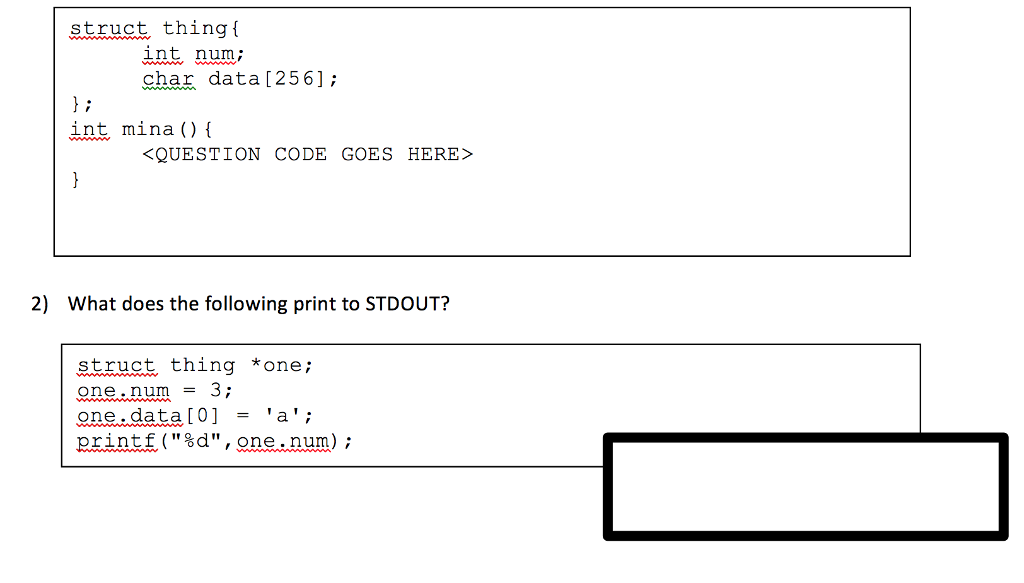
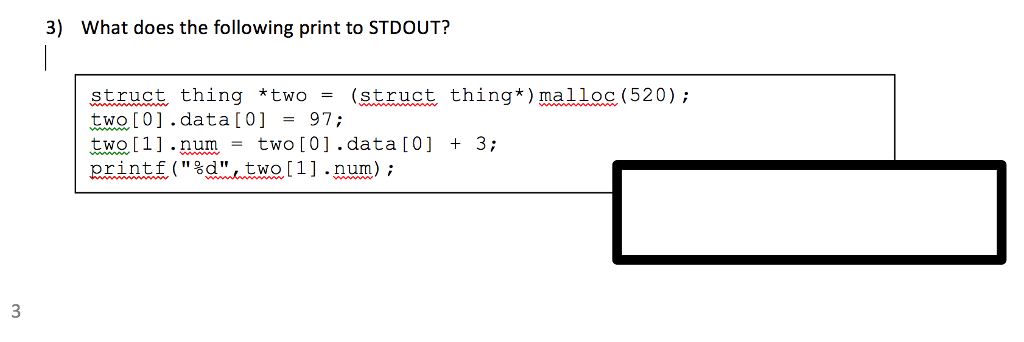
struct thingl int num; char data [256]: li int mina )
Step by Step Solution
There are 3 Steps involved in it

Get step-by-step solutions from verified subject matter experts
 Study Help