


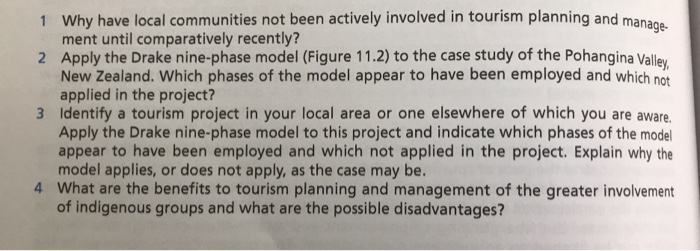
Question: 1 Why have local communities not been actively involved in tourism planning and man ment until comparatively recently? 2 Apply the Drake nine-phase model (Figure
1 Why have local communities not been actively
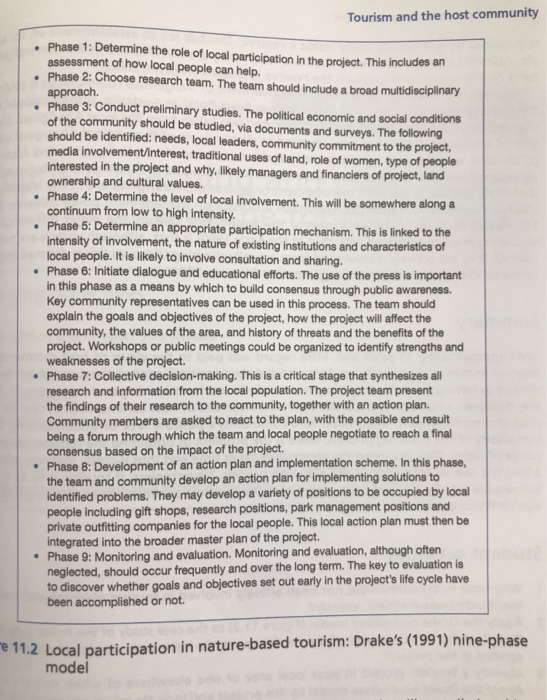
1 Why have local communities not been actively involved in tourism planning and man ment until comparatively recently? 2 Apply the Drake nine-phase model (Figure 11.2) to the case study of the Pohangina Valle New Zealand. Which phases of the model appear to have been employed and which not applied in the project? 3 Identify a tourism project in your local area or one elsewhere of which you are aware. Apply the Drake nine-phase model to this project and indicate which phases of the model appear to have been employed and which not applied in the project. Explain why the model applies, or does not apply, as the case may be. 4 What are the benefits to tourism planning and management of the greater involvement of indigenous groups and what are the possible disadvantages? Tourism and the host community Phase 1: Determine the role of local participation in the project. This includes an assessment of how local people can help. Phase 2: Choose research team. The team should include a broad multidiscipunary approach. Phase 3: Conduct preliminary studies. The political economic and social conditions of the community should be studied, via documents and surveys. The following should be identified: needs, local leaders, community commitment to the project, media involvement interest, traditional uses of land, role of women, type of people Interested in the project and why, likely managers and financiers of project, land ownership and cultural values. Phase 4: Determine the level of local involvement. This will be somewhere along a continuum from low to high intensity Phase 5: Determine an appropriate participation mechanism. This is linked to the Intensity of involvement, the nature of existing institutions and characteristics of local people. It is likely to involve consultation and sharing. Phase 6: Initiate dialogue and educational efforts. The use of the press is important in this phase as a means by which to build consensus through public awareness. Key community representatives can be used in this process. The team should explain the goals and objectives of the project, how the project will affect the community, the values of the area, and history of threats and the benefits of the project. Workshops or public meetings could be organized to identify strengths and weaknesses of the project. Phase 7: Collective decision-making. This is a critical stage that synthesizes all research and information from the local population. The project team present the findings of their research to the community, together with an action plan. Community members are asked to react to the plan, with the possible end result being a forum through which the team and local people negotiate to reach a final consensus based on the impact of the project. Phase 8: Development of an action plan and implementation scheme. In this phase, the team and community develop an action plan for implementing solutions to identified problems. They may develop a variety of positions to be occupied by local people including gift shops, research positions, park management positions and private outfitting companies for the local people. This local action plan must then be integrated into the broader master plan of the project. Phase 9: Monitoring and evaluation. Monitoring and evaluation, although often neglected, should occur frequently and over the long term. The key to evaluation is to discover whether goals and objectives set out early in the project's life cycle have been accomplished or not. e 11.2 Local participation in nature-based tourism: Drake's (1991) nine-phase model

Step by Step Solution

There are 3 Steps involved in it

1 Expert Approved Answer
Step: 1 Unlock blur-text-image

Question Has Been Solved by an Expert!

Get step-by-step solutions from verified subject matter experts

Step: 2 Unlock
Step: 3 Unlock

Students Have Also Explored These Related General Management Questions!