





Question: 1. Why is a constitution considered as the highest expression of the law? a. Because it is more powerful than the government b. Because the
1. Why is a constitution considered as "the
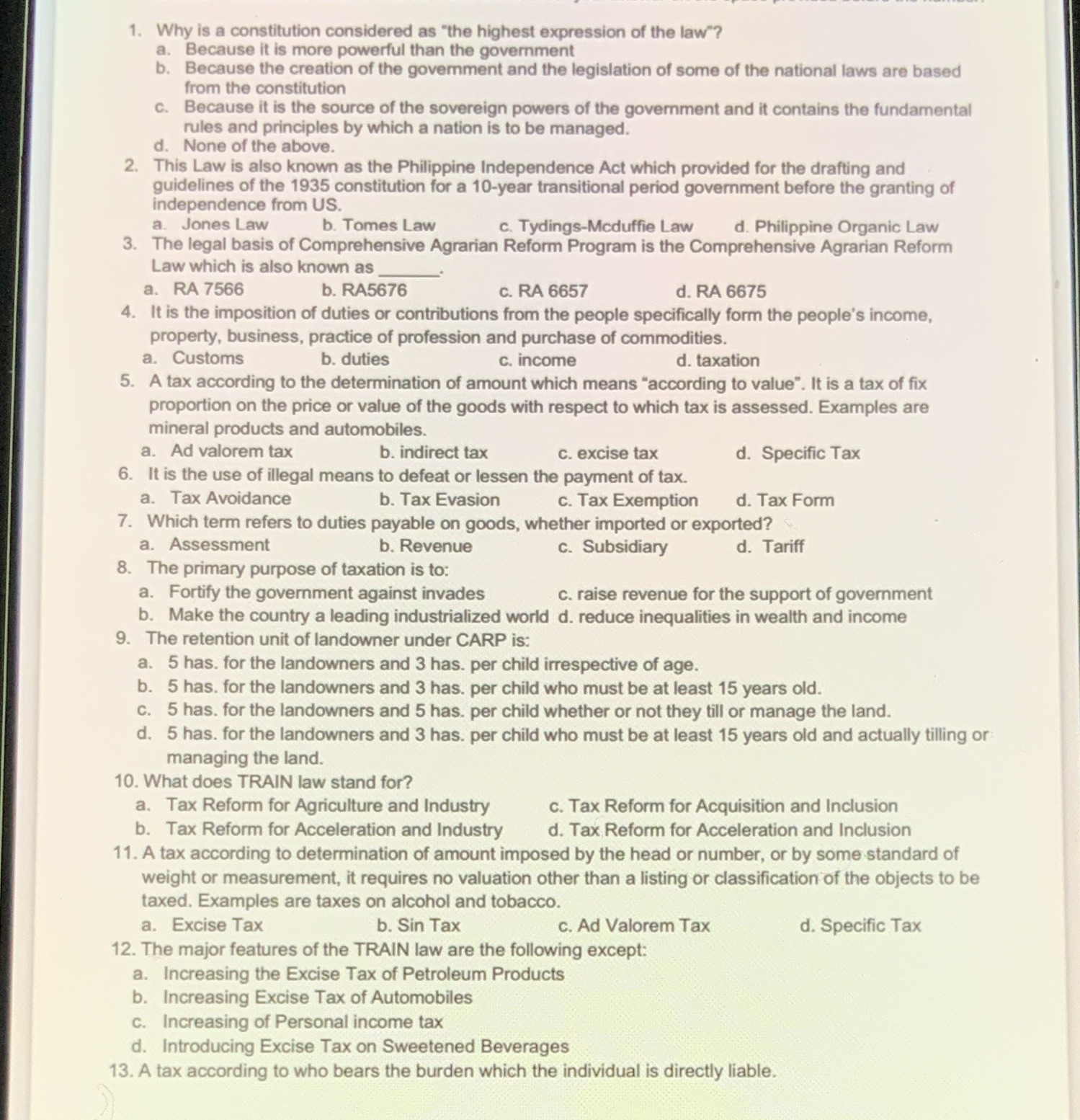
1. Why is a constitution considered as "the highest expression of the law"? a. Because it is more powerful than the government b. Because the creation of the government and the legislation of some of the national laws are based from the constitution c. Because it is the source of the sovereign powers of the government and it contains the fundamental rules and principles by which a nation is to be managed. d. None of the above. . This Law is also known as the Philippine Independence Act which provided for the drafting and guidelines of the 1935 constitution for a 10-year transitional period government before the granting of independence from US. a. Jones Law b. Tomes Law c. Tydings-Mcduffie Law d. Philippine Organic Law 3. The legal basis of Comprehensive Agrarian Reform Program is the Comprehensive Agrarian Reform Law which is also known as a. RA 7566 b. RA5676 C. RA 6657 d. RA 6675 4. It is the imposition of duties or contributions from the people specifically form the people's income, property, business, practice of profession and purchase of commodities. a. Customs b. duties c. income d. taxation 5. A tax according to the determination of amount which means "according to value". It is a tax of fix proportion on the price or value of the goods with respect to which tax is assessed. Examples are mineral products and automobiles. a. Ad valorem tax b. indirect tax c. excise tax d. Specific Tax 6. It is the use of illegal means to defeat or lessen the payment of tax. a. Tax Avoidance b. Tax Evasion c. Tax Exemption d. Tax Form 7. Which term refers to duties payable on goods, whether imported or exported? a. Assessment b. Revenue c. Subsidiary d. Tariff 8. The primary purpose of taxation is to: a. Fortify the government against invades c. raise revenue for the support of government b. Make the country a leading industrialized world d. reduce inequalities in wealth and income 9. The retention unit of landowner under CARP is: a. 5 has. for the landowners and 3 has. per child irrespective of age. b. 5 has. for the landowners and 3 has. per child who must be at least 15 years old. c. 5 has. for the landowners and 5 has. per child whether or not they till or manage the land. d. 5 has. for the landowners and 3 has. per child who must be at least 15 years old and actually tilling or managing the land. 10. What does TRAIN law stand for? a. Tax Reform for Agriculture and Industry c. Tax Reform for Acquisition and Inclusion b. Tax Reform for Acceleration and Industry d. Tax Reform for Acceleration and Inclusion 11. A tax according to determination of amount imposed by the head or number, or by some standard of weight or measurement, it requires no valuation other than a listing or classification of the objects to be taxed. Examples are taxes on alcohol and tobacco. a. Excise Tax b. Sin Tax c. Ad Valorem Tax d. Specific Tax 12. The major features of the TRAIN law are the following except: a. Increasing the Excise Tax of Petroleum Products b. Increasing Excise Tax of Automobiles C. Increasing of Personal income tax d. Introducing Excise Tax on Sweetened Beverages 13. A tax according to who bears the burden which the individual is directly liable

Step by Step Solution

There are 3 Steps involved in it

1 Expert Approved Answer
Step: 1 Unlock blur-text-image

Question Has Been Solved by an Expert!

Get step-by-step solutions from verified subject matter experts

Step: 2 Unlock
Step: 3 Unlock

Students Have Also Explored These Related Mathematics Questions!