







Question: 1. Why is a Decoupler controller more difficult to use than a standard controller? (2) a. The Decoupled controller is not connected to the process
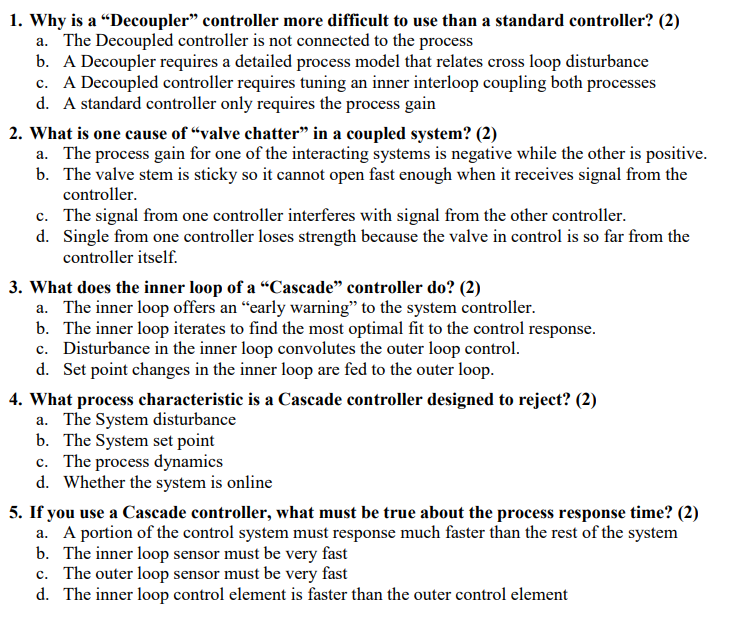
1. Why is a "Decoupler" controller more difficult to use than a standard controller? (2) a. The Decoupled controller is not connected to the process b. A Decoupler requires a detailed process model that relates cross loop disturbance c. A Decoupled controller requires tuning an inner interloop coupling both processes d. A standard controller only requires the process gain 2. What is one cause of "valve chatter" in a coupled system? (2) a. The process gain for one of the interacting systems is negative while the other is positive. b. The valve stem is sticky so it cannot open fast enough when it receives signal from the controller. c. The signal from one controller interferes with signal from the other controller. d. Single from one controller loses strength because the valve in control is so far from the controller itself. 3. What does the inner loop of a "Cascade" controller do? (2) a. The inner loop offers an "early warning" to the system controller. b. The inner loop iterates to find the most optimal fit to the control response. c. Disturbance in the inner loop convolutes the outer loop control. d. Set point changes in the inner loop are fed to the outer loop. 4. What process characteristic is a Cascade controller designed to reject? (2) a. The System disturbance b. The System set point c. The process dynamics d. Whether the system is online 5. If you use a Cascade controller, what must be true about the process response time? (2) a. A portion of the control system must response much faster than the rest of the system b. The inner loop sensor must be very fast c. The outer loop sensor must be very fast d. The inner loop control element is faster than the outer control element 1. Why is a "Decoupler" controller more difficult to use than a standard controller? (2) a. The Decoupled controller is not connected to the process b. A Decoupler requires a detailed process model that relates cross loop disturbance c. A Decoupled controller requires tuning an inner interloop coupling both processes d. A standard controller only requires the process gain 2. What is one cause of "valve chatter" in a coupled system? (2) a. The process gain for one of the interacting systems is negative while the other is positive. b. The valve stem is sticky so it cannot open fast enough when it receives signal from the controller. c. The signal from one controller interferes with signal from the other controller. d. Single from one controller loses strength because the valve in control is so far from the controller itself. 3. What does the inner loop of a "Cascade" controller do? (2) a. The inner loop offers an "early warning" to the system controller. b. The inner loop iterates to find the most optimal fit to the control response. c. Disturbance in the inner loop convolutes the outer loop control. d. Set point changes in the inner loop are fed to the outer loop. 4. What process characteristic is a Cascade controller designed to reject? (2) a. The System disturbance b. The System set point c. The process dynamics d. Whether the system is online 5. If you use a Cascade controller, what must be true about the process response time? (2) a. A portion of the control system must response much faster than the rest of the system b. The inner loop sensor must be very fast c. The outer loop sensor must be very fast d. The inner loop control element is faster than the outer control element
Step by Step Solution
There are 3 Steps involved in it

Get step-by-step solutions from verified subject matter experts
 Study Help