







Question: 1. Why is it that the statement all rhombuses are squares is false, but the statement all squares are rhombuses is true? Use an
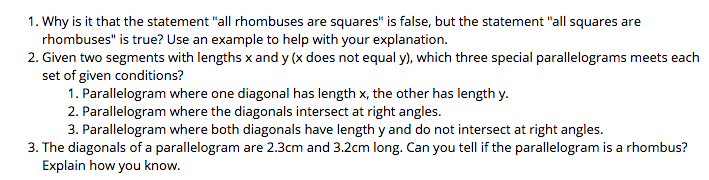
1. Why is it that the statement "all rhombuses are squares" is false, but the statement "all squares are rhombuses" is true? Use an example to help with your explanation. 2. Given two segments with lengths x and y (x does not equal y), which three special parallelograms meets each set of given conditions? 1. Parallelogram where one diagonal has length x, the other has length y. 2. Parallelogram where the diagonals intersect at right angles. 3. Parallelogram where both diagonals have length y and do not intersect at right angles. 3. The diagonals of a parallelogram are 2.3cm and 3.2cm long. Can you tell if the parallelogram is a rhombus? Explain how you know.
Step by Step Solution
There are 3 Steps involved in it
1 The statement all rhombuses are squares is false because it implies that every rhombus must also b... View full answer

Get step-by-step solutions from verified subject matter experts
 Study Help