







Question: 1) Why would a bond with a yield higher than the coupon rate sell at a discount? Why would a bond with a yield lower
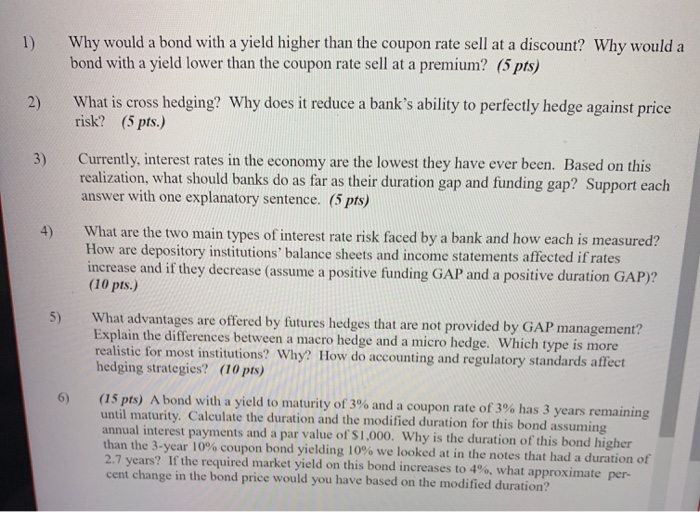
1) Why would a bond with a yield higher than the coupon rate sell at a discount? Why would a bond with a yield lower than the coupon rate sell at a premium? (5 pts) 2) What is cross hedging? Why does it reduce a bank's ability to perfectly hedge against price risk? (5 pts.) 3) Currently, interest rates in the economy are the lowest they have ever been. Based on this realization, what should banks do as far as their duration gap and funding gap? Support each answer with one explanatory sentence. (5 pts) 4) 5) What are the two main types of interest rate risk faced by a bank and how each is measured? How are depository institutions' balance sheets and income statements affected if rates increase and if they decrease (assume a positive funding GAP and a positive duration GAP)? (10 pts.) What advantages are offered by futures hedges that are not provided by GAP management? Explain the differences between a macro hedge and a micro hedge. Which type is more realistic for most institutions? Why? How do accounting and regulatory standards affect hedging strategies? (10 pts) (15 pts) A bond with a yield to maturity of 3% and a coupon rate of 3% has 3 years remaining until maturity. Calculate the duration and the modified duration for this bond assuming annual interest payments and a par value of $1,000. Why is the duration of this bond higher than the 3-year 10% coupon bond yielding 10% we looked at in the notes that had a duration of 2.7 years? If the required market yield on this bond increases to 4%, what approximate per cent change in the bond price would you have based on the modified duration? 6)
Step by Step Solution
There are 3 Steps involved in it

Get step-by-step solutions from verified subject matter experts
 Study Help