







Question: 1. Write a function get_factors(n) that accepts an integer number and returns a list of its positive factors. As a helpful mind refresher, other than
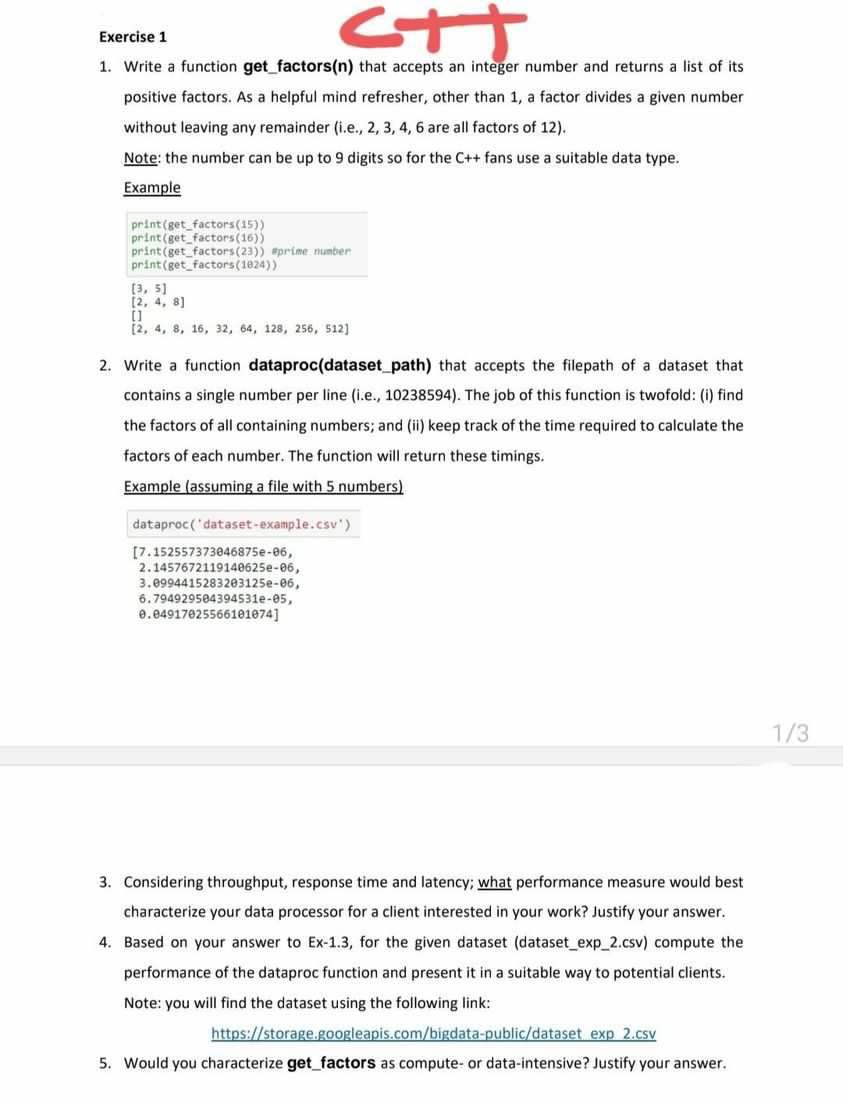
1. Write a function get_factors(n) that accepts an integer number and returns a list of its positive factors. As a helpful mind refresher, other than 1 , a factor divides a given number without leaving any remainder (i.e., 2, 3, 4, 6 are all factors of 12). Note: the number can be up to 9 digits so for the C++fans use a suitable data type. Example 2. Write a function dataproc(dataset_path) that accepts the filepath of a dataset that contains a single number per line (i.e., 10238594). The job of this function is twofold: (i) find the factors of all containing numbers; and (ii) keep track of the time required to calculate the factors of each number. The function will return these timings. Example (assuming a file with 5 numbers) 3. Considering throughput, response time and latency; what performance measure would best characterize your data processor for a client interested in your work? Justify your answer. 4. Based on your answer to Ex-1.3, for the given dataset (dataset_exp_2.csv) compute the performance of the dataproc function and present it in a suitable way to potential clients. Note: you will find the dataset using the following link: https://storage.googleapis.com/bigdata-public/dataset exp 2.csv 5. Would you characterize get_factors as compute-or data-intensive? Justify your
Step by Step Solution
There are 3 Steps involved in it

Get step-by-step solutions from verified subject matter experts
 Study Help