







Question: 1. Write a function hello() that:takes a name (i.e., a string) as inputprints a personalized welcome messageNote that the function does not return anything. 2.
1. Write a function hello() that:takes a name (i.e., a string) as inputprints a personalized welcome messageNote that the function does not return anything.
2. Write function rng() that:takes a list of numbers as inputreturns the range of the numbers in the listThe range is the difference between the largest and smallest numberin the list.
3. The indexing operator can also be used to obtain slices of a list aswell. Let list lst refer to list
['a', 'b', 'c', 'd', 'e', 'f', 'g', 'h]
4. Write Python expressions using list lst and the indexing operator thatevaluate to:
1. ['a', 'b', 'c', 'd']
2. ['d', 'e', 'f']
3. ['d']
4. ['f', 'g']
5. ['d', 'e', 'f', 'g', 'h']
6. ['f', 'g', 'h'] 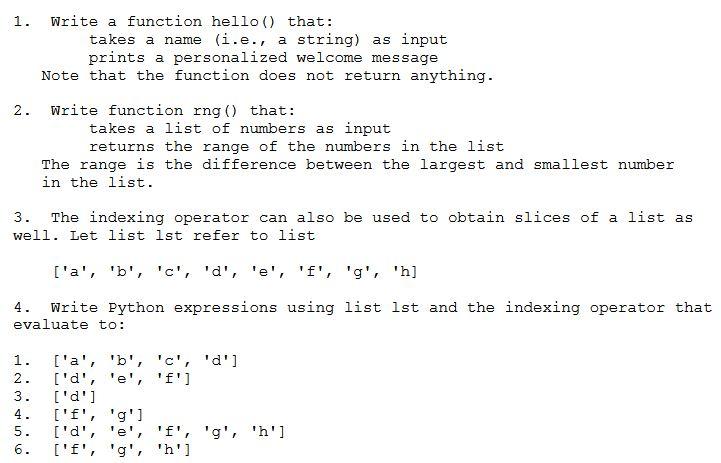
1. Write a function hello () that: takes a name (i.e., a string) as input prints a personalized welcome message Note that the function does not return anything. 2. Write function rng() that: takes a list of numbers as input returns the range of the numbers in the list The range is the difference between the largest and smallest number in the list. 3. The indexing operator can also be used to obtain slices of a list as well. Let list lst refer to list ['a', 'b', 'c','d', 'e', 'f', 'g', 'h] 4. Write Python expressions using list 1st and the indexing operator that evaluate to: 1. 3. 4. 5. 6. ['a', 'b', 'c','d'] ['d', 'e','f'] ['d'] ['f', 'g'] ['d', 'e', 'f', 'g', 'h'] ['f','g', 'h'l
Step by Step Solution
There are 3 Steps involved in it

Get step-by-step solutions from verified subject matter experts
 Study Help