







Question: 1. Write a regular expression for the set of strings using the alphabet {a,b,c} that have each b immediately preceded by an a. Note that
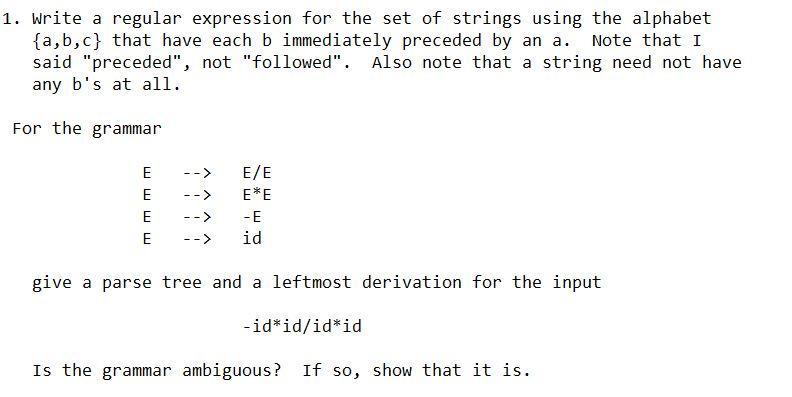
1. Write a regular expression for the set of strings using the alphabet {a,b,c} that have each b immediately preceded by an a. Note that I said "preceded", not "followed". Also note that a string need not have any b's at all. For the grammar --> --> E E E E E/E EE -E LU --> id give a parse tree and a leftmost derivation for the input -id*id/id*id Is the grammar ambiguous? If so, show that it is
Step by Step Solution
There are 3 Steps involved in it
1 Expert Approved Answer
Step: 1 Unlock

Question Has Been Solved by an Expert!
Get step-by-step solutions from verified subject matter experts
Step: 2 Unlock
Step: 3 Unlock
 Study Help