Question: 1) You are trying to decide whether to approve a development budget for a new ERP system. If you are not convinced, you could always
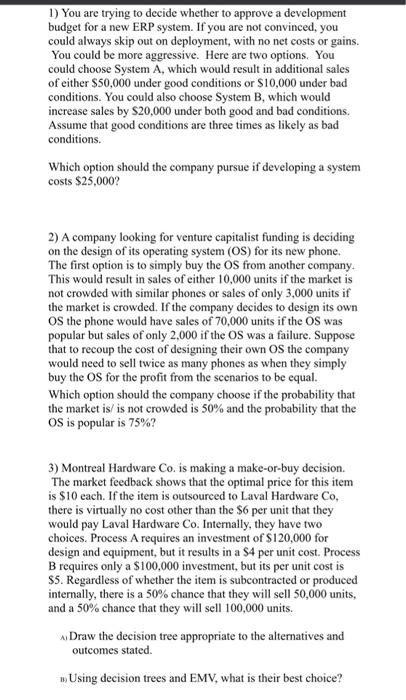
1) You are trying to decide whether to approve a development budget for a new ERP system. If you are not convinced, you could always skip out on deployment, with no net costs or gains. You could be more aggressive. Here are two options. You could choose System A, which would result in additional sales of either $50,000 under good conditions or $10,000 under bad conditions. You could also choose System B, which would increase sales by S20,000 under both good and bad conditions. Assume that good conditions are three times as likely as bad conditions. Which option should the company pursue if developing a system costs $25,000? 2) A company looking for venture capitalist funding is deciding on the design of its operating system (OS) for its new phone. The first option is to simply buy the OS from another company. This would result in sales of either 10,000 units if the market is not crowded with similar phones or sales of only 3,000 units if the market is crowded. If the company decides to design its own Os the phone would have sales of 70,000 units if the OS was popular but sales of only 2,000 if the OS was a failure. Suppose that to recoup the cost of designing their own OS the company would need to sell twice as many phones as when they simply buy the OS for the profit from the scenarios to be equal . Which option should the company choose if the probability that the market is/ is not crowded is 50% and the probability that the Os is popular is 75%? 3) Montreal Hardware Co. is making a make-or-buy decision. The market feedback shows that the optimal price for this item is $10 each. If the item is outsourced to Laval Hardware Co. there is virtually no cost other than the $6 per unit that they would pay Laval Hardware Co. Internally, they have two choices. Process A requires an investment of $120,000 for design and equipment, but it results in a $4 per unit cost. Process B requires only a $100,000 investment, but its per unit cost is $5. Regardless of whether the item is subcontracted or produced internally, there is a 50% chance that they will sell 50,000 units, and a 50% chance that they will sell 100,000 units. Draw the decision tree appropriate to the alternatives and outcomes stated. Using decision trees and EMV, what is their best choice? 1) You are trying to decide whether to approve a development budget for a new ERP system. If you are not convinced, you could always skip out on deployment, with no net costs or gains. You could be more aggressive. Here are two options. You could choose System A, which would result in additional sales of either $50,000 under good conditions or $10,000 under bad conditions. You could also choose System B, which would increase sales by S20,000 under both good and bad conditions. Assume that good conditions are three times as likely as bad conditions. Which option should the company pursue if developing a system costs $25,000? 2) A company looking for venture capitalist funding is deciding on the design of its operating system (OS) for its new phone. The first option is to simply buy the OS from another company. This would result in sales of either 10,000 units if the market is not crowded with similar phones or sales of only 3,000 units if the market is crowded. If the company decides to design its own Os the phone would have sales of 70,000 units if the OS was popular but sales of only 2,000 if the OS was a failure. Suppose that to recoup the cost of designing their own OS the company would need to sell twice as many phones as when they simply buy the OS for the profit from the scenarios to be equal . Which option should the company choose if the probability that the market is/ is not crowded is 50% and the probability that the Os is popular is 75%? 3) Montreal Hardware Co. is making a make-or-buy decision. The market feedback shows that the optimal price for this item is $10 each. If the item is outsourced to Laval Hardware Co. there is virtually no cost other than the $6 per unit that they would pay Laval Hardware Co. Internally, they have two choices. Process A requires an investment of $120,000 for design and equipment, but it results in a $4 per unit cost. Process B requires only a $100,000 investment, but its per unit cost is $5. Regardless of whether the item is subcontracted or produced internally, there is a 50% chance that they will sell 50,000 units, and a 50% chance that they will sell 100,000 units. Draw the decision tree appropriate to the alternatives and outcomes stated. Using decision trees and EMV, what is their best choice