







Question: 1. You draw one card randomly from a standard deck of 52 playing cards (no jokers) Event A: You draw a heart card. Event B:
1. You draw one card randomly from a standard deck of 52 playing cards (no jokers)
Event A: You draw a heart card.
Event B: You draw a card that is not a face card.
Event C: You draw a non-face card that is divisible by 3.
What is the probability that Event A, B, or C will occur?
2. Empirically verify the probability you calculated in Problem 1 with a Python program that simulates drawing randomly from a deck of cards. Initialize a list of cards, each card with a suit and a value. Generate a random number 0 through 51 to pick a card from the list. Check for Events A, B, and C. Repeat this a million times and count how many times Event A, B, or C occurred. After a million card picks, print your count divided by a million. How well does this simulation probability match the probability you calculated in Problem 9? Also print the simulation probabilities after 100; 1,000; 10,000; and 100,000 card picks. Determine how many simulated card picks are needed for the simulation probability to match your calculated probability to 3 decimal places.
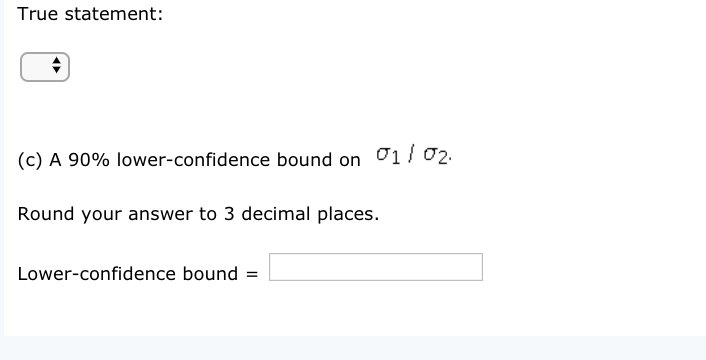
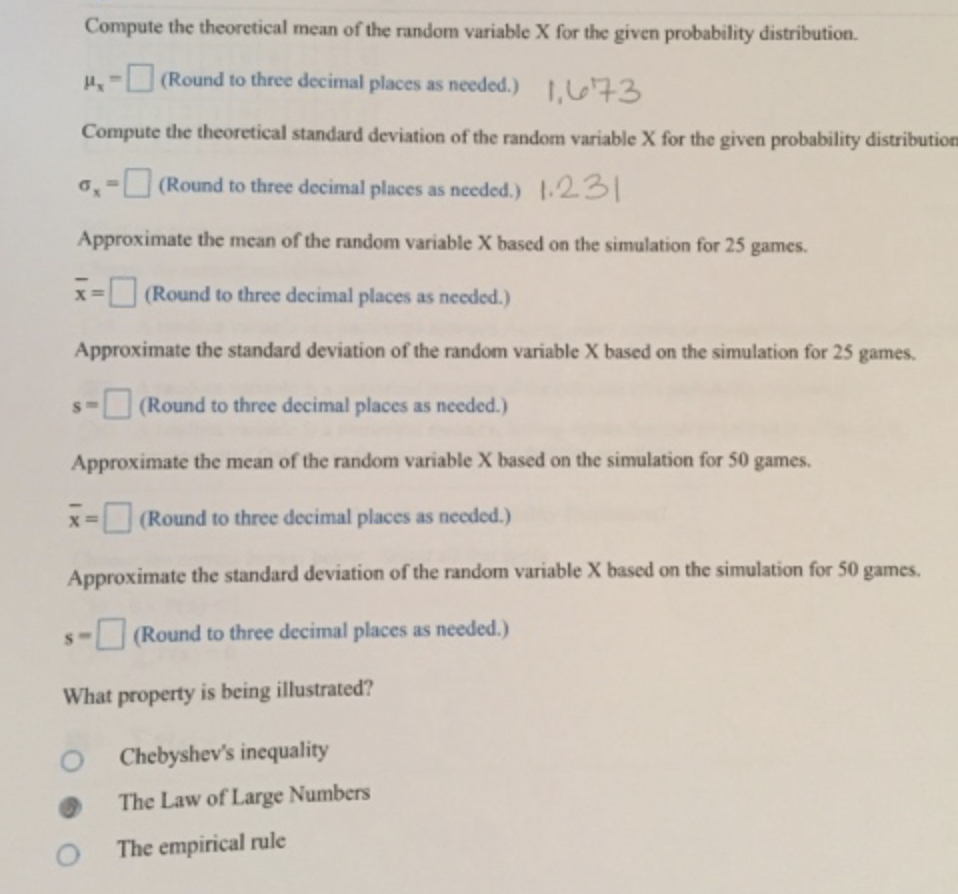
True statement: (c) A 90% lower-confidence bound on 1 / 02. Round your answer to 3 decimal places. Lower-confidence bound =Compute the theoretical mean of the random variable X for the given probability distribution. My -(Round to three decimal places as needed.) 1,673 Compute the theoretical standard deviation of the random variable X for the given probability distribution 6, -(Round to three decimal places as needed.) 1.23| Approximate the mean of the random variable X based on the simulation for 25 games. x =(Round to three decimal places as needed.) Approximate the standard deviation of the random variable X based on the simulation for 25 games. s-(Round to three decimal places as needed.) Approximate the mean of the random variable X based on the simulation for 50 games. x =(Round to three decimal places as needed.) Approximate the standard deviation of the random variable X based on the simulation for 50 games. s-(Round to three decimal places as needed.) What property is being illustrated? Chebyshev's inequality The Law of Large Numbers O The empirical rule
Step by Step Solution
There are 3 Steps involved in it

Get step-by-step solutions from verified subject matter experts
 Study Help