







Question: 1) You will be numerically solving the following PDE discussed in class that describes diffusion through a stagnant gas film: xA=1xA1(xA)2+22xA Inserting the finite difference
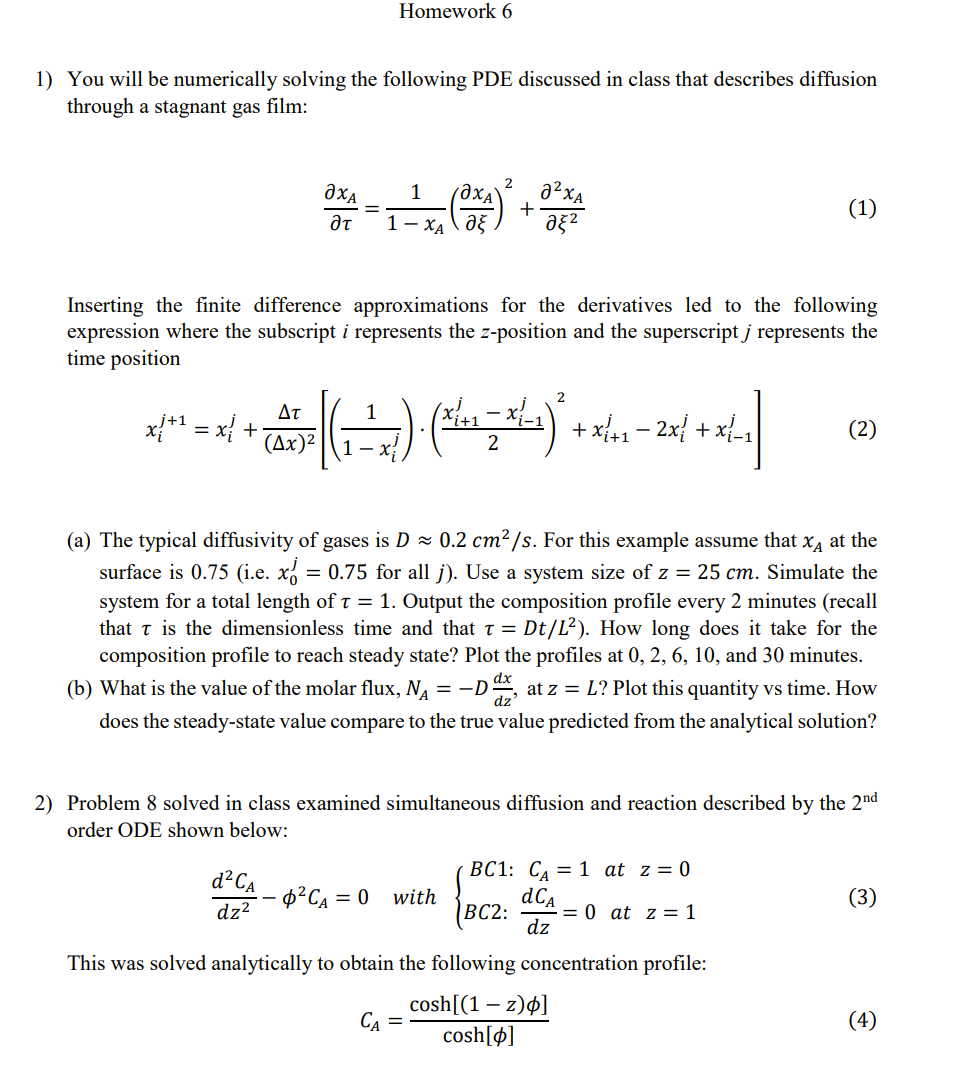
1) You will be numerically solving the following PDE discussed in class that describes diffusion through a stagnant gas film: xA=1xA1(xA)2+22xA Inserting the finite difference approximations for the derivatives led to the following expression where the subscript i represents the z-position and the superscript j represents the time position xij+1=xij+(x)2[(1xij1)(2xi+1jxi1j)2+xi+1j2xij+xi1j] (a) The typical diffusivity of gases is D0.2cm2/s. For this example assume that xA at the surface is 0.75 (i.e. x0j=0.75 for all j ). Use a system size of z=25cm. Simulate the system for a total length of =1. Output the composition profile every 2 minutes (recall that is the dimensionless time and that =Dt/L2 ). How long does it take for the composition profile to reach steady state? Plot the profiles at 0,2,6,10, and 30 minutes. (b) What is the value of the molar flux, NA=Ddzdx, at z=L ? Plot this quantity vs time. How does the steady-state value compare to the true value predicted from the analytical solution? 2) Problem 8 solved in class examined simultaneous diffusion and reaction described by the 2nd order ODE shown below: dz2d2CA2CA=0with{BC1:CA=1atz=0BC2:dzdCA=0atz=1 This was solved analytically to obtain the following concentration profile: CA=cosh[]cosh[(1z)]
Step by Step Solution
There are 3 Steps involved in it

Get step-by-step solutions from verified subject matter experts
 Study Help