







Question: 1. You work for an international consultancy implementing communication solutions for governments all over the world. The government of Molvania wishes to establish a radio-based


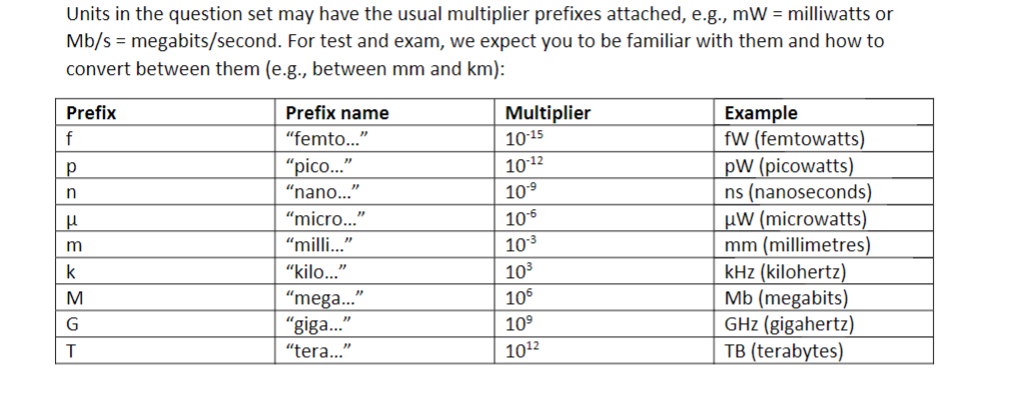
1. You work for an international consultancy implementing communication solutions for governments all over the world. The government of Molvania wishes to establish a radio-based data link between two of its police bases. It has invited your company to tender of the implementation of a coding and modulation scheme for the link. In its tender documents, the Molvanian Communications Commission has assigned the frequency band between 1.4 GHz and 1.4000386 GHz for the project.
Based on the specifications for the transmitter and antennas to be used, as well as the distance between the bases, you calculate that the received power will be around 20 pW.
You submit a tender and the government offers you the contract. The small print of the project says that contractors will have to stay in a secure guest room in one of the police bases until the project is finished to specification and handed over in working order. Also, the government states that the noise power measured in the band at the receiving sites is 0.15 fW. The bit rate to be achieved is 1 Mbps. You estimate that your company's technology will be able to achieve half of the capacity given by the Shannon-Hartley theorem. Should you sign the contract? Justify your answer.
2. The government of Molvania has bought equipment from your company that operates a data link at 100 kb/s in a band from 322 MHz to 322.0272 MHz. The goverment is happy and reports that it is operating quite satisfactorily. Given that your equipment can only use half the channel capacity, can you give an estimate for the signal-to-noise ratio (SNR) that is achieved or exceeded at the receiver (to the closest whole dB)? Show your working.
3. A measurement of the actual SNR at the receiver in question 2 reveals that it is 29 dB. Embez Elment, the brother-in-law of the Molvanian prime minister, would like run a private 500 kb/s data link for his game server between the same sites and using the same transmitter equipment, but using twice the bandwidth of the existing link. You know that this means that its receiver would receive approximately the same power from the transmitter, but that the SNR would decrease by the same factor by which the bandwidth would increase, i.e. by half, because you are now capturing twice as much noise. Would this work? Explain why (or why not). Show your working. Note: Again, assume that your technology will only be able to reach half the channel capacity.
Answer this 3 questions plz. Thanks a lot! thx thx thx
In this part, your task is to apply the Shannon-Hartley capacity theorem. There are two versions of the theorem: 1) C = B log2(S/N+1) (precise version) 2) C B log2(S/N) (approximate version for S/N much larger than 1)
Step by Step Solution
There are 3 Steps involved in it

Get step-by-step solutions from verified subject matter experts
 Study Help