







Question: 1. You've designed a new nanoparticle that can stably encapsulate an influenza vaccine at room temperature. The nanoparticles have an average diameter of 300 nm
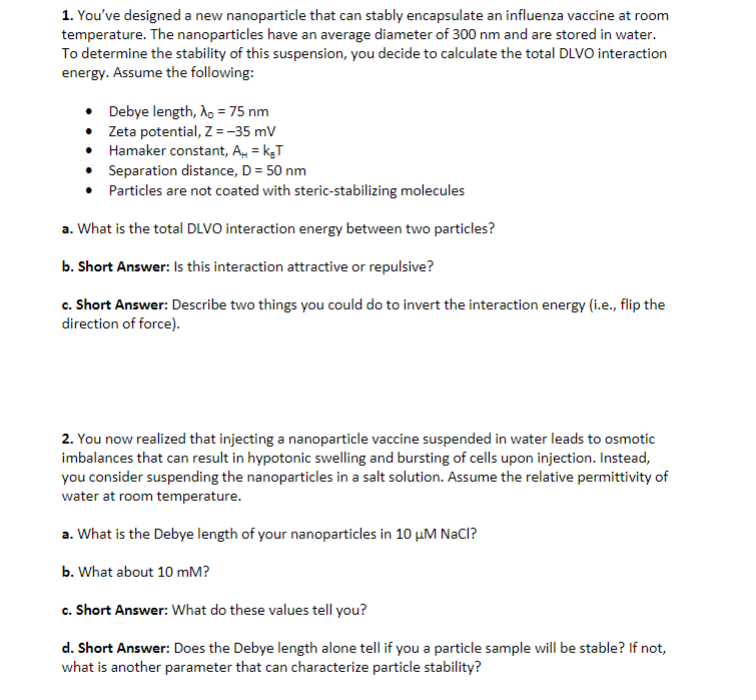
1. You've designed a new nanoparticle that can stably encapsulate an influenza vaccine at room temperature. The nanoparticles have an average diameter of 300 nm and are stored in water. To determine the stability of this suspension, you decide to calculate the total DLVO interaction energy. Assume the following: Debye length, 10 = 75 nm Zeta potential, Z = -35 mV Hamaker constant, A. = kgT Separation distance, D = 50 nm Particles are not coated with steric-stabilizing molecules a. What is the total DLVO interaction energy between two particles? b. Short Answer: Is this interaction attractive or repulsive? c. Short Answer: Describe two things you could do to invert the interaction energy (i.e., flip the direction of force). 2. You now realized that injecting a nanoparticle vaccine suspended in water leads to osmotic imbalances that can result in hypotonic swelling and bursting of cells upon injection. Instead, you consider suspending the nanoparticles in a salt solution. Assume the relative permittivity of water at room temperature. a. What is the Debye length of your nanoparticles in 10 um Nac? b. What about 10 mM? c. Short Answer: What do these values tell you? d. Short Answer: Does the Debye length alone tell if you a particle sample will be stable? If not, what is another parameter that can characterize particle stability
Step by Step Solution
There are 3 Steps involved in it

Get step-by-step solutions from verified subject matter experts
 Study Help