







Question: - 1 z 0 1 v2 0 210 211 21-1 1) a) Show that the hydrogenic 2p, and 2p, orbitals are obtained by the linear
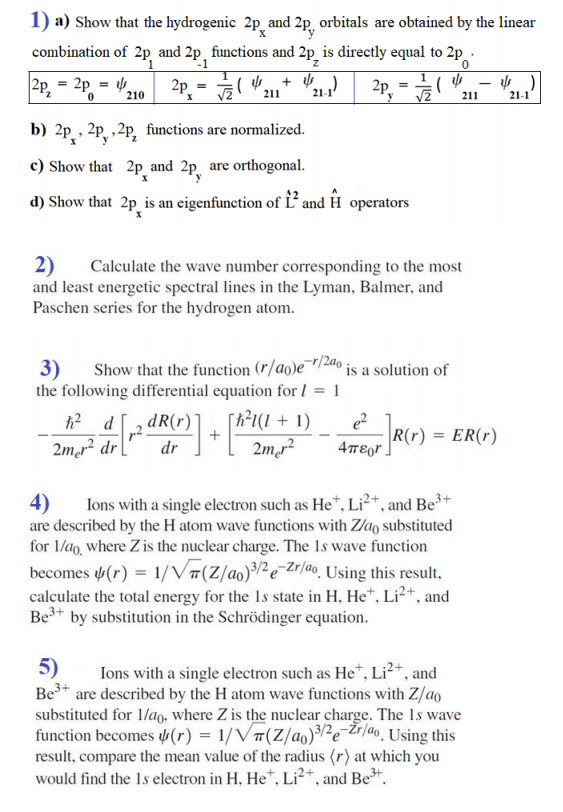
- 1 z 0 1 v2 0 210 211 21-1 1) a) Show that the hydrogenic 2p, and 2p, orbitals are obtained by the linear combination of 2p, and 2p, functions and 2p, is directly equal to 2p 2p, = 2p = 2p = Tz1 V 21+ 2 2p. (- b) 2p, 2p, 2p, functions are normalized. c) Show that 2p, and 2p, are orthogonal. a) Show that 2p, is an eigenfunction of land operators 2) Calculate the wave number corresponding to the most and least energetic spectral lines in the Lyman, Balmer, and Paschen series for the hydrogen atom. 3) Show that the function (r/ao)e =/240; is a solution of the following differential equation for = 1 k d dR(r) (121(1 + 1) e? R(r) = ER(r) 2mcr2 dr 2mer? 4TT&or 2 ) + dr Ions with a single electron such as He+, Li2+, and Be3+ are described by the H atom wave functions with Zao substituted for 1/10, where Z is the nuclear charge. The Is wave function becomes y(r) = 1/V7(2/ao)3/2e-Zr/ao. Using this result, calculate the total energy for the Is state in H, He+, Li2+, and Be3+ by substitution in the Schrdinger equation. 5) Ions with a single electron such as He+, Li2+, and Be + are described by the H atom wave functions with Z/ao substituted for 1/ao, where Z is the nuclear charge. The Is wave function becomes 4 (r) = 1/V (Z/ao)3/2e=r/40. Using this result, compare the mean value of the radius (r) at which you would find the Is electron in H, He+, Li2+, and Be3+
Step by Step Solution
There are 3 Steps involved in it

Get step-by-step solutions from verified subject matter experts
 Study Help