



Question: 10. 1). When compounding occurs more than once a year, divide the by the number of times compounding occurs and multiply the years by the
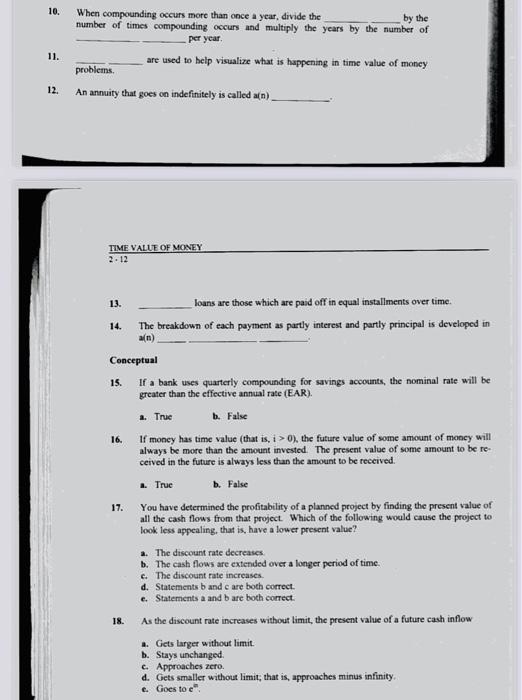
10. 1). When compounding occurs more than once a year, divide the by the number of times compounding occurs and multiply the years by the number of per year are used to help visualize what is happening in time value of money problems An annuity that goes on indefinitely is called a(n) 12. TIME VALUE OF MONEY 2.12 13. loans are those which are paid off in equal installments over time. The breakdown of each payment as partly interest and partly principal is developed in 14. a(n) Conceptual 15. If a bank uses quarterly compounding for savings accounts, the nominal rate will be greater than the effective annual rate (EAR). a. True b. False 16. If money has time value (that is, i>0), the future value of some amount of money will always be more than the amount invested. The present value of some amount to be re- ceived in the future is always less than the amount to be received 3. True b. False 17. You have determined the profitability of a planned project by finding the present value of all the cash flows from that project. Which of the following would cause the project to look less appealing, that is, have a lower present value? a. The discount rate decreases . The cash flows are extended over a longer period of time. c. The discount rate increases d. Statements band e are both correct. e. Statements a and are both correct. 18. As the discount rate increases without limit, the present value of a future cash inflow a. Gets larger without limit. b. Stays unchanged c. Approaches zero d. Gets smaller without limit, that is approaches minus infinity e. Goes to c
Step by Step Solution
There are 3 Steps involved in it

Get step-by-step solutions from verified subject matter experts