



Question: 10 11 12 tou are considering two mutually exclusive, equally risky, projects. Both have IRRs that exceed the WACC. Which of the following statements is
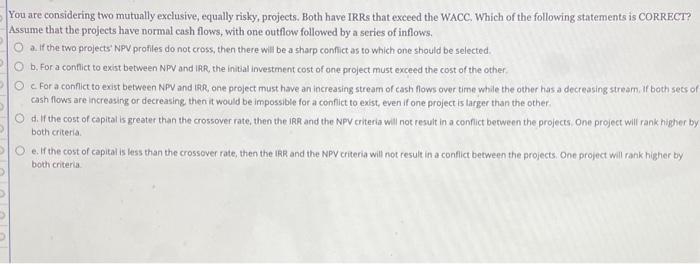
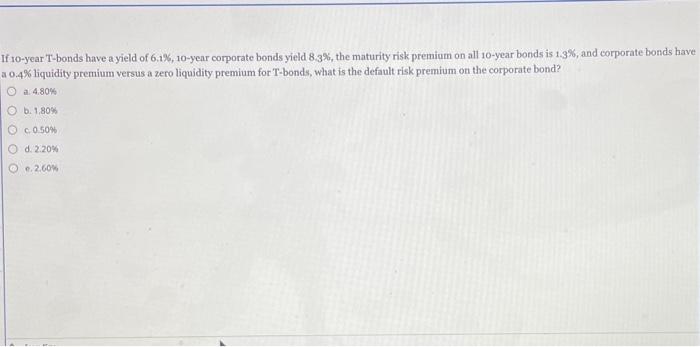
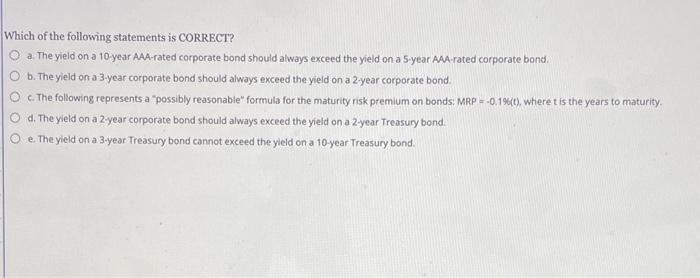
tou are considering two mutually exclusive, equally risky, projects. Both have IRRs that exceed the WACC. Which of the following statements is CORRECT? Issume that the projects have normal cash flows, with one outflow followed by a series of inflows. a. If the two projects' NPV profiles do not cross, then there will be a sharp confict as to which one should be selected. b. For a conflict to exist between NPV and IRR, the initial investment cost of one project must exceed the cost of the other. c. For a confict to exist between NPV and IrR, one project must have an increasing stream of cash flows over time while the other has a decreasing stream, if both secs of cash flows are increasing or decreasing then it would be impossible for a conflict to exist, even if one project is larger than the other. d. If the cost of capital is greater than the crossover rate, then the IRA and the NPV criteria will noc result in a confict between the projects, One project will rank higher by both criteria. e. If the cost of capitai is less than the crossover rate, then the IRR and the NPV criteria will not result in a conflict between the projects. One project will rank higher by both criteria. If ro-year T-bonds have a yield of 6.1%,10-year corporate bonds yield 8.3%, the maturity risk premium on all 10-year bonds is 1.3%, and corporate bonds have a 0.4% liquidity premium versus a zero liquidity premium for T-bonds, what is the defiult risk premium on the corporate bond? a. 4.80% b. 1.80% c. 0.50% d. 2.20% 0.260cos Which of the following statements is CORRECT? a. The yield on a 10-year AAA-rated corporate bond should always exceed the yield on a 5-year AAA-rated corporate bond. b. The yield on a 3-year corporate bond should always exceed the yield on a 2 -year corporate bond. c. The following represents a "possibly reasonable" formula for the maturity risk premium on bonds: MRP =0.1%(t), where t is the years to maturity. d. The yield on a 2-year corporate bond should always exceed the yield on a 2-year Treasury bond. e. The yield on a 3 -year Treasury bond cannot exceed the yield on a 10-year Treasury bond
Step by Step Solution
There are 3 Steps involved in it

Get step-by-step solutions from verified subject matter experts