







Question: 10. (2p) In the following questions assume that P.(x), T.(x) and H2n+1(*) denote Lagrange, Taylor and Hermite polynomials respectively of a function f(x) with some
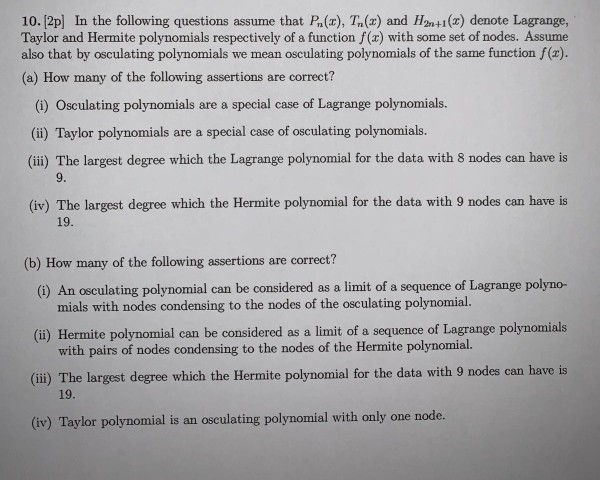
10. (2p) In the following questions assume that P.(x), T.(x) and H2n+1(*) denote Lagrange, Taylor and Hermite polynomials respectively of a function f(x) with some set of nodes. Assume also that by osculating polynomials we mean osculating polynomials of the same function f(x). (a) How many of the following assertions are correct? (1) Osculating polynomials are a special case of Lagrange polynomials. (ii) Taylor polynomials are a special case of osculating polynomials. (iii) The largest degree which the Lagrange polynomial for the data with 8 nodes can have is 9. (iv) The largest degree which the Hermite polynomial for the data with 9 nodes can have is 19. (b) How many of the following assertions are correct? (i) An osculating polynomial can be considered as a limit of a sequence of Lagrange polyno mials with nodes condensing to the nodes of the osculating polynomial. (ii) Hermite polynomial can be considered as a limit of a sequence of Lagrange polynomials with pairs of nodes condensing to the nodes of the Hermite polynomial. (iii) The largest degree which the Hermite polynomial for the data with 9 nodes can have is 19. (iv) Taylor polynomial is an osculating polynomial with only one node. 10. (2p) In the following questions assume that P.(x), T.(x) and H2n+1(*) denote Lagrange, Taylor and Hermite polynomials respectively of a function f(x) with some set of nodes. Assume also that by osculating polynomials we mean osculating polynomials of the same function f(x). (a) How many of the following assertions are correct? (1) Osculating polynomials are a special case of Lagrange polynomials. (ii) Taylor polynomials are a special case of osculating polynomials. (iii) The largest degree which the Lagrange polynomial for the data with 8 nodes can have is 9. (iv) The largest degree which the Hermite polynomial for the data with 9 nodes can have is 19. (b) How many of the following assertions are correct? (i) An osculating polynomial can be considered as a limit of a sequence of Lagrange polyno mials with nodes condensing to the nodes of the osculating polynomial. (ii) Hermite polynomial can be considered as a limit of a sequence of Lagrange polynomials with pairs of nodes condensing to the nodes of the Hermite polynomial. (iii) The largest degree which the Hermite polynomial for the data with 9 nodes can have is 19. (iv) Taylor polynomial is an osculating polynomial with only one node
Step by Step Solution
There are 3 Steps involved in it

Get step-by-step solutions from verified subject matter experts
 Study Help