







Question: 1/0- -4 1.0 a) Use the graph to identify the sets on which this function is increasing or decreasing and concave up or concave down.
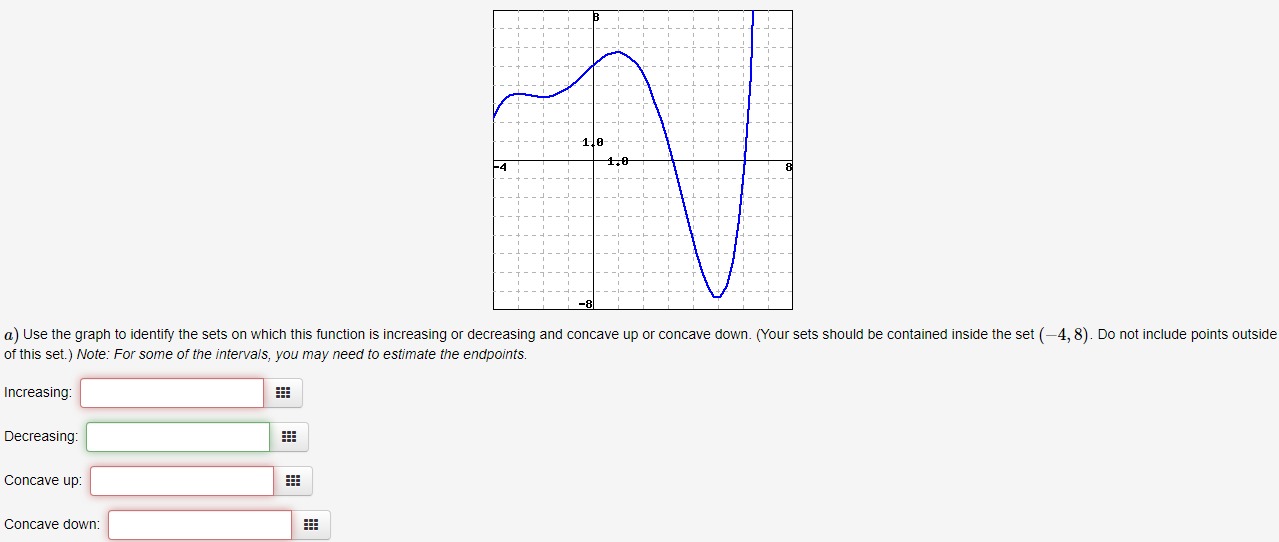
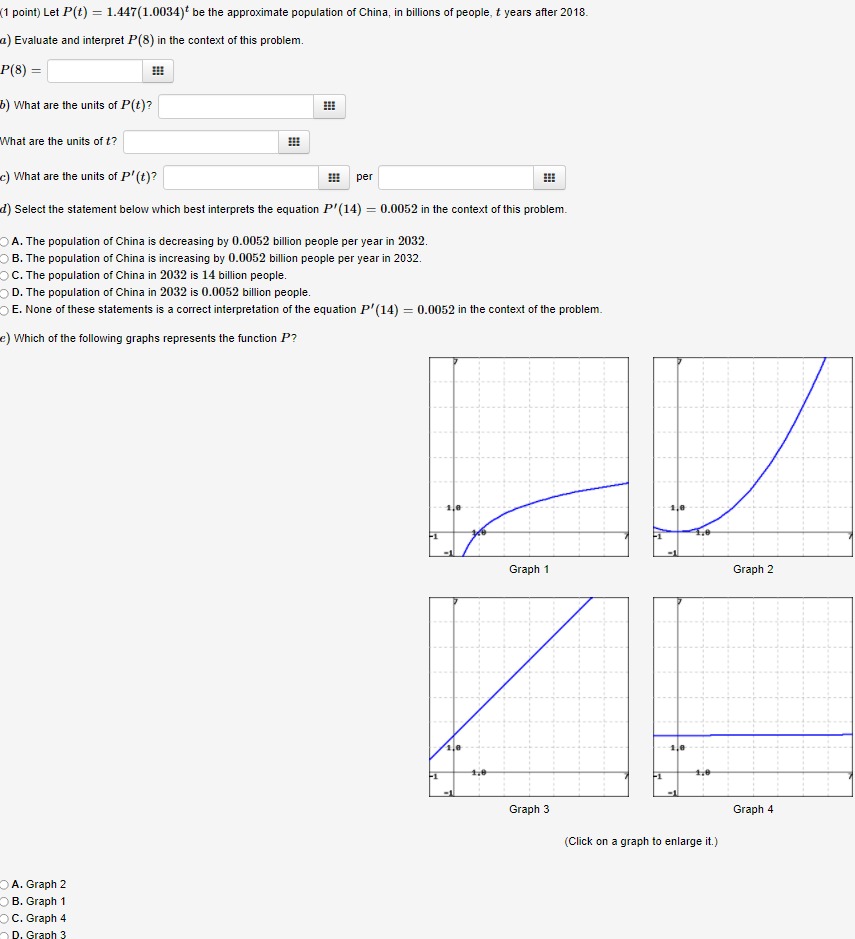
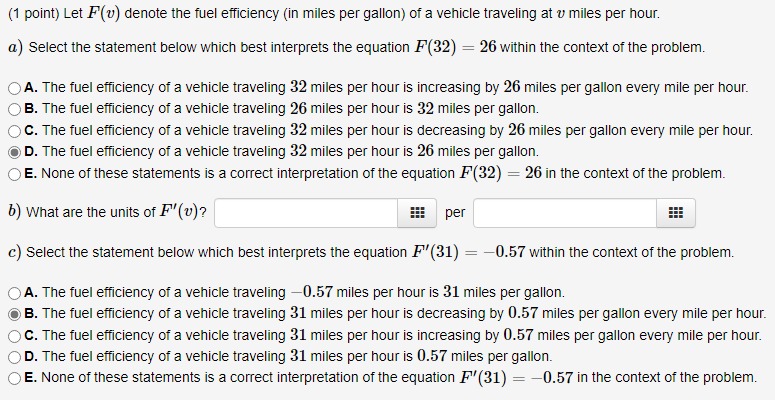
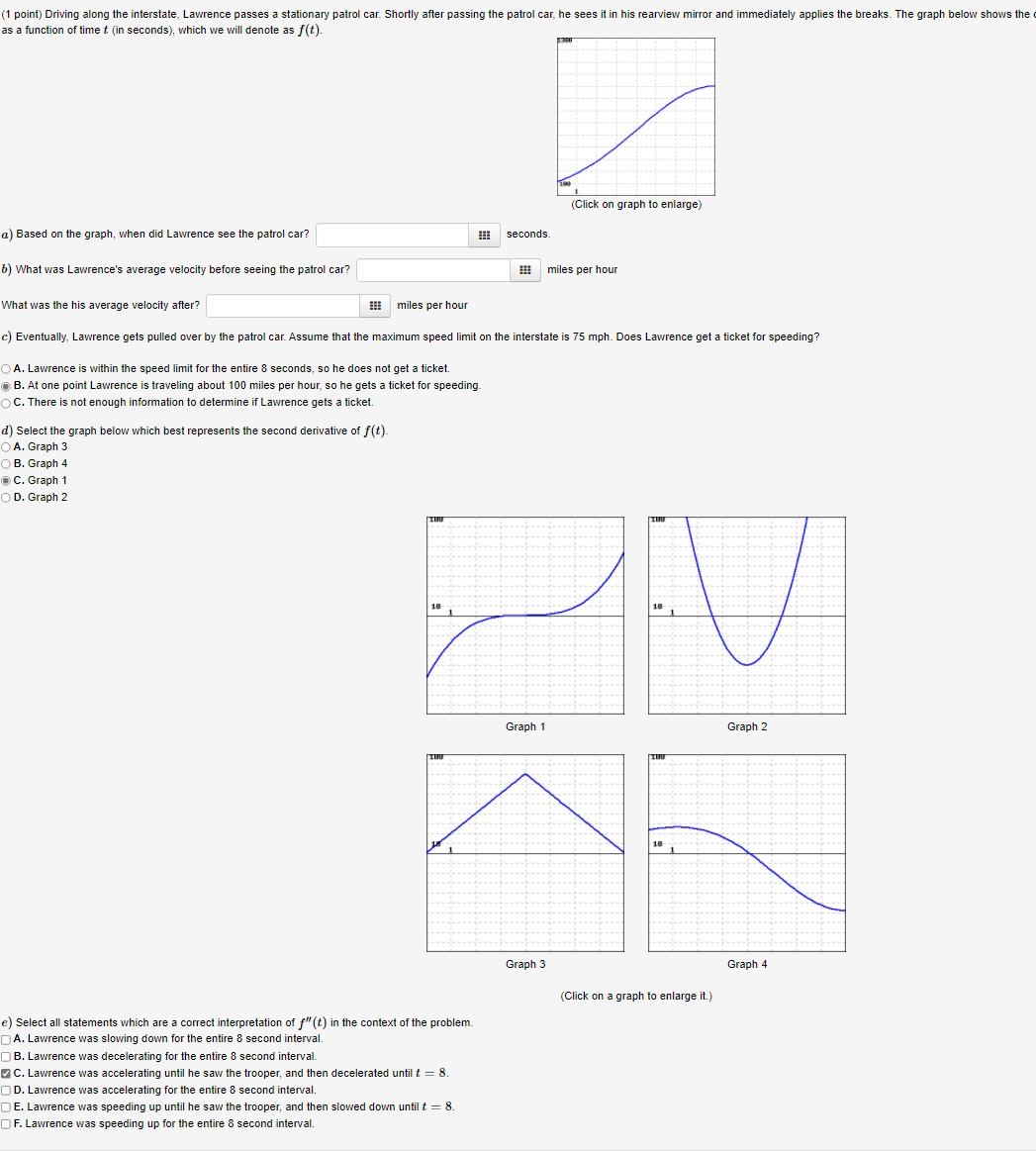
1/0- -4 1.0 a) Use the graph to identify the sets on which this function is increasing or decreasing and concave up or concave down. (Your sets should be contained inside the set (-4, 8). Do not include points outside of this set.) Note: For some of the intervals, you may need to estimate the endpoints. Increasing: Decreasing: Concave up: Concave down:1 point) Let P(t) = 1.447(1.0034)* be the approximate population of China, in billions of people, t years after 2018. a) Evaluate and interpret P(8) in the context of this problem. P(8) = b) What are the units of P(t)? What are the units of t? :) What are the units of P'(t)? ! ! per d) Select the statement below which best interprets the equation P'(14) = 0.0052 in the context of this problem. ) A. The population of China is decreasing by 0.0052 billion people per year in 2032. B. The population of China is increasing by 0.0052 billion people per year in 2032. C. The population of China in 2032 is 14 billion people. D. The population of China in 2032 is 0.0052 billion people. E. None of these statements is a correct interpretation of the equation P'(14) = 0.0052 in the context of the problem. e) Which of the following graphs represents the function P? Graph 1 Graph 2 Graph 3 Graph 4 (Click on a graph to enlarge it.) O A. Graph 2 O B. Graph 1 O C. Graph 4(1 point) Let F(v) denote the fuel efficiency (in miles per gallon) of a vehicle traveling at v miles per hour. a) Select the statement below which best interprets the equation F(32) = 26 within the context of the problem. OA. The fuel efficiency of a vehicle traveling 32 miles per hour is increasing by 26 miles per gallon every mile per hour. OB. The fuel efficiency of a vehicle traveling 26 miles per hour is 32 miles per gallon. O C. The fuel efficiency of a vehicle traveling 32 miles per hour is decreasing by 26 miles per gallon every mile per hour. OD. The fuel efficiency of a vehicle traveling 32 miles per hour is 26 miles per gallon. O E. None of these statements is a correct interpretation of the equation F(32) = 26 in the context of the problem. b) What are the units of F'(v)? per c) Select the statement below which best interprets the equation F(31) = -0.57 within the context of the problem. OA. The fuel efficiency of a vehicle traveling -0.57 miles per hour is 31 miles per gallon. O B. The fuel efficiency of a vehicle traveling 31 miles per hour is decreasing by 0.57 miles per gallon every mile per hour. C. The fuel efficiency of a vehicle traveling 31 miles per hour is increasing by 0.57 miles per gallon every mile per hour. OD. The fuel efficiency of a vehicle traveling 31 miles per hour is 0.57 miles per gallon. O E. None of these statements is a correct interpretation of the equation F'(31) = -0.57 in the context of the problem.(1 point) Driving along the interstate, Lawrence passes a stationary patrol car. Shortly after passing the patrol car, he sees it in his rearview mirror and immediately applies the breaks. The graph below shows the as a function of time t (in seconds), which we will denote as f (t). (Click on graph to enlarge) a) Based on the graph, when did Lawrence see the patrol car? !! seconds. ) What was Lawrence's average velocity before seeing the patrol car? ! ! miles per hour What was the his average velocity after? 18 miles per hour ) Eventually, Lawrence gets pulled over by the patrol car. Assume that the maximum speed limit on the interstate is 75 mph. Does Lawrence get a ticket for speeding? A. Lawrence is within the speed limit for the entire $ seconds, so he does not get a ticket. B. At one point Lawrence is traveling about 100 miles per hour, so he gets a ticket for speeding C. There is not enough information to determine if Lawrence gets a ticket. d) Select the graph below which best represents the second derivative of f (t). A. Graph 3 B. Graph 4 C. Graph 1 O D. Graph 2 Graph 1 Graph 2 Graph 3 Graph 4 (Click on a graph to enlarge it.) e) Select all statements which are a correct interpretation of f"(t) in the context of the problem. A. Lawrence was slowing down for the entire 8 second interval. B. Lawrence was decelerating for the entire 8 second interval. C. Lawrence was accelerating until he saw the trooper, and then decelerated until t = 8 D. Lawrence was accelerating for the entire 8 second interval. E. Lawrence was speeding up until he saw the trooper, and then slowed down until t = 8. F. Lawrence was speeding up for the entire & second interval
Step by Step Solution
There are 3 Steps involved in it

Get step-by-step solutions from verified subject matter experts
 Study Help