







Question: 10 4. a) Create a neural network with only one hidden layer (of any number of units) that implements (AV-B )(CVD). Draw your network, and
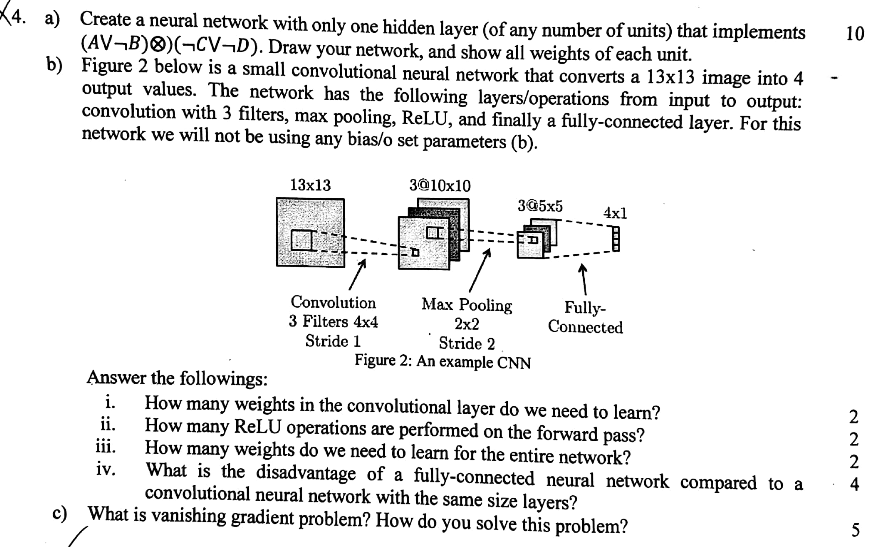
10 4. a) Create a neural network with only one hidden layer (of any number of units) that implements (AV-B )(CVD). Draw your network, and show all weights of each unit. b) Figure 2 below is a small convolutional neural network that converts a 13x13 image into 4 output values. The network has the following layers/operations from input to output: convolution with 3 filters, max pooling, ReLU, and finally a fully-connected layer. For this network we will not be using any bias/o set parameters (b). - 13x13 3010x10 365x5 4x1 PP ! ---- D Convolution Max Pooling Fully- 3 Filters 4x4 Connected Stride 1 Stride 2 Figure 2: An example CNN Answer the followings: i. How many weights in the convolutional layer do we need to learn? ii. How many ReLU operations are performed on the forward pass? iii. How many weights do we need to learn for the entire network? iv. What is the disadvantage of a fully-connected neural network compared to a convolutional neural network with the same size layers? c) What is vanishing gradient problem? How do you solve this
Step by Step Solution
There are 3 Steps involved in it

Get step-by-step solutions from verified subject matter experts
 Study Help