







Question: (10) 4. Answer the following: (5) a) (5) b) Differentiate between descriptive and inferential statistics with an example for each. State the Central Limit
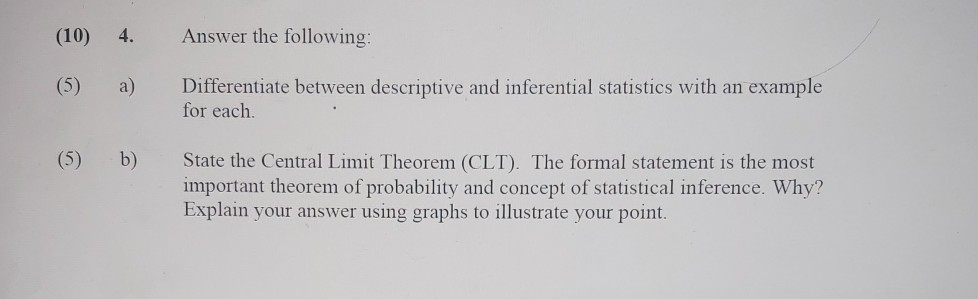
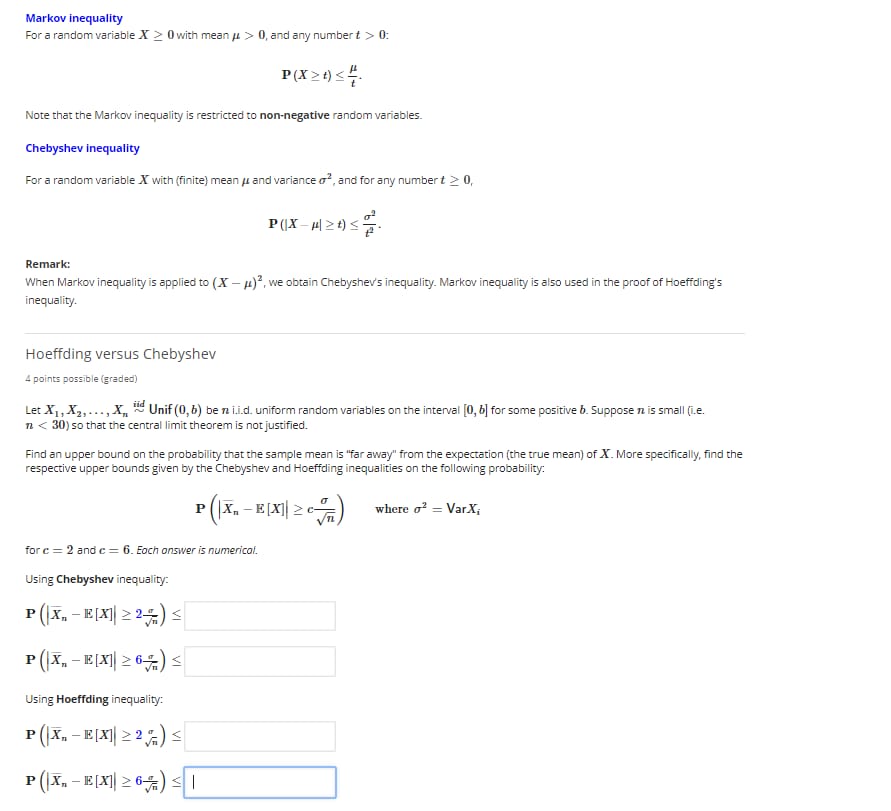
(10) 4. Answer the following: (5) a) (5) b) Differentiate between descriptive and inferential statistics with an example for each. State the Central Limit Theorem (CLT). The formal statement is the most important theorem of probability and concept of statistical inference. Why? Explain your answer using graphs to illustrate your point. Markov inequality For a random variable X>0 with mean > 0, and any number t > 0: P(X4) Note that the Markov inequality is restricted to non-negative random variables. Chebyshev inequality For a random variable X with (finite) mean and variance 2, and for any number t 0, P(X->) Remark: When Markov inequality is applied to (X-)2, we obtain Chebyshev's inequality. Markov inequality is also used in the proof of Hoeffding's inequality. Hoeffding versus Chebyshev 4 points possible (graded) Let X1, X2,..., X, id Unif (0,6) benzi.i.d. uniform random variables on the interval [0,6] for some positive b. Suppose is small (i.e. n
Step by Step Solution
There are 3 Steps involved in it

Get step-by-step solutions from verified subject matter experts
 Study Help