







Question: 10. An engineer uses an analytical procedure for measuring reliability. This procedure produces results that exhibit a standard deviation of 0.04. It is desired
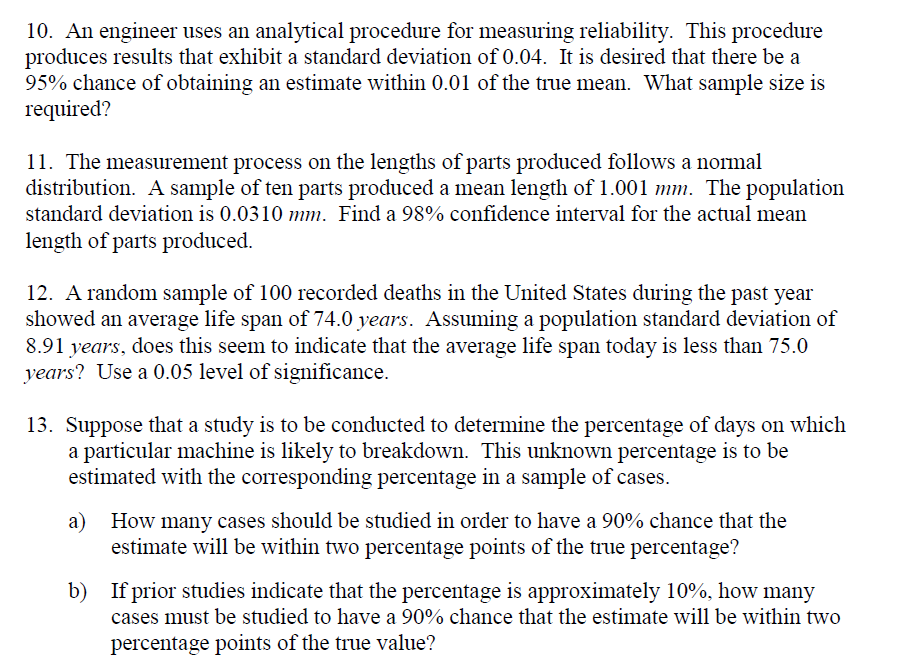
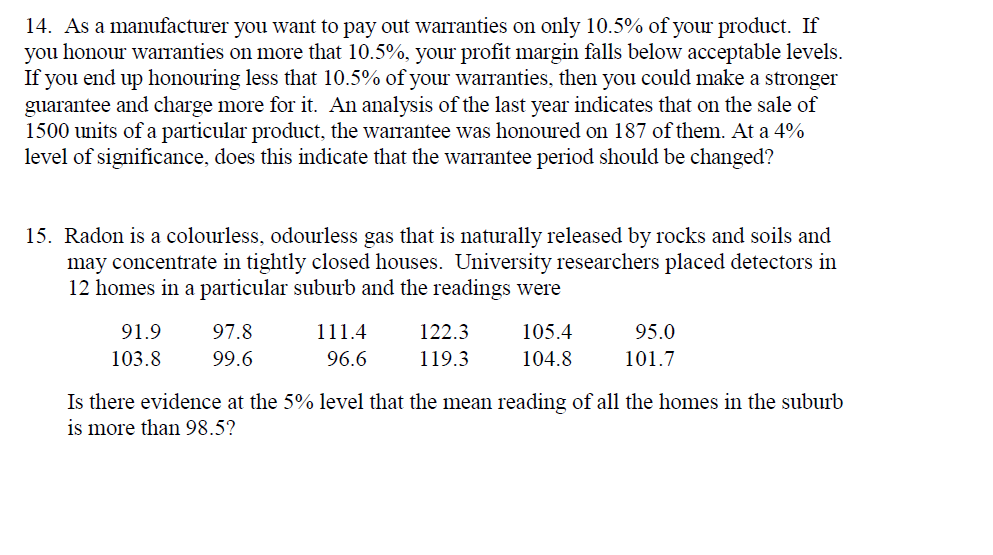
10. An engineer uses an analytical procedure for measuring reliability. This procedure produces results that exhibit a standard deviation of 0.04. It is desired that there be a 95% chance of obtaining an estimate within 0.01 of the true mean. What sample size is required? 11. The measurement process on the lengths of parts produced follows a normal distribution. A sample of ten parts produced a mean length of 1.001 mm. The population standard deviation is 0.0310 mm. Find a 98% confidence interval for the actual mean length of parts produced. 12. A random sample of 100 recorded deaths in the United States during the past year showed an average life span of 74.0 years. Assuming a population standard deviation of 8.91 years, does this seem to indicate that the average life span today is less than 75.0 years? Use a 0.05 level of significance. 13. Suppose that a study is to be conducted to determine the percentage of days on which a particular machine is likely to breakdown. This unknown percentage is to be estimated with the corresponding percentage in a sample of cases. a) How many cases should be studied in order to have a 90% chance that the estimate will be within two percentage points of the true percentage? b) If prior studies indicate that the percentage is approximately 10%, how many cases must be studied to have a 90% chance that the estimate will be within two percentage points of the true value? 14. As a manufacturer you want to pay out warranties on only 10.5% of your product. If you honour warranties on more that 10.5%, your profit margin falls below acceptable levels. If you end up honouring less that 10.5% of your warranties, then you could make a stronger guarantee and charge more for it. An analysis of the last year indicates that on the sale of 1500 units of a particular product, the warrantee was honoured on 187 of them. At a 4% level of significance, does this indicate that the warrantee period should be changed? 15. Radon is a colourless, odourless gas that is naturally released by rocks and soils and may concentrate in tightly closed houses. University researchers placed detectors in 12 homes in a particular suburb and the readings were 91.9 103.8 97.8 99.6 111.4 122.3 105.4 95.0 96.6 119.3 104.8 101.7 Is there evidence at the 5% level that the mean reading of all the homes in the suburb is more than 98.5?
Step by Step Solution
There are 3 Steps involved in it

Get step-by-step solutions from verified subject matter experts
 Study Help