







Question: 10. Comparing payments on instailment loans when using the simple-Interestor add-on methods to compute finance charges Comparing Loan Payments Using the Simple-Interest and Add-On Methods
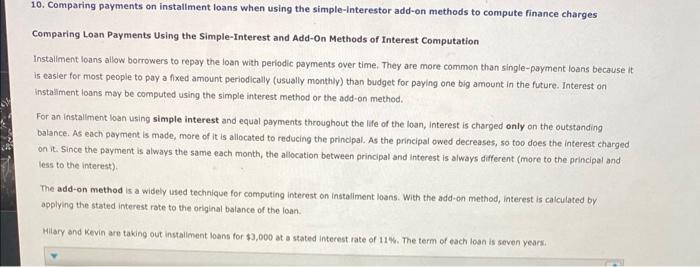
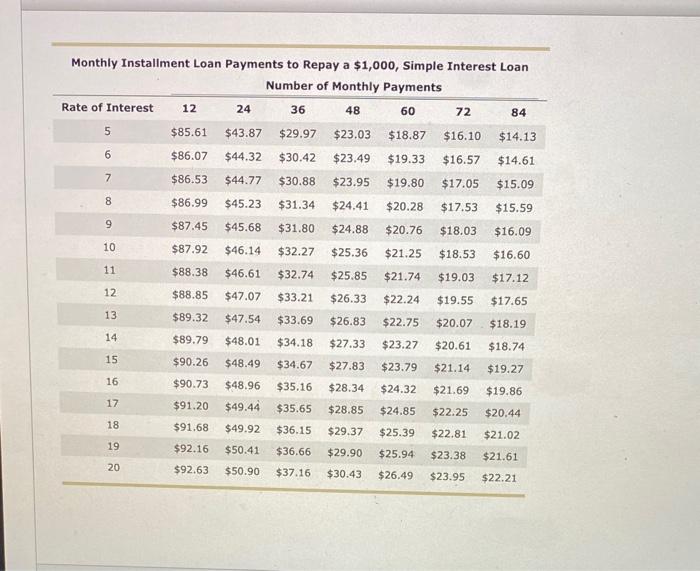
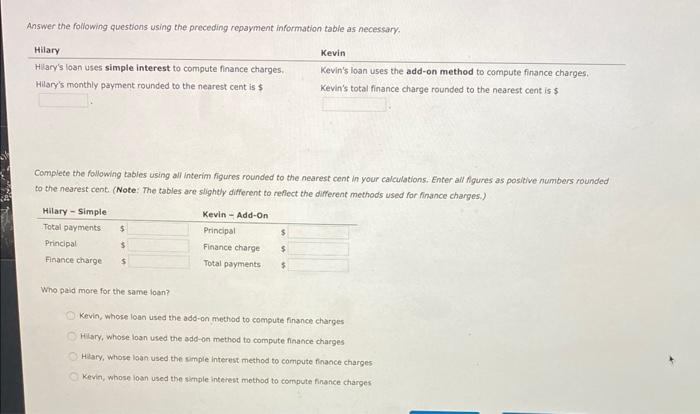
10. Comparing payments on instailment loans when using the simple-Interestor add-on methods to compute finance charges Comparing Loan Payments Using the Simple-Interest and Add-On Methods of Interest Computation Installment loans allow borrowers to repay the loan with periodic payments over time. They are more common than single-payment loans because it. is easier for most people to pay a fixed amount periodically (usually monthly) than budget for paying one big amount in the future. Interest on instaliment loans may be computed using the simple interest method or the add-an method. For an instaliment loan using simple interest and equal payments throughout the life of the loan, interest is charged only on the outstanding balance. As each payment is made, more of it is allocated to reducing the princlpal. As the principal owed decreases, so too does the interest charged on it. Since the payment is always the same each month, the allocation between principal and interest is always different (more to the principal and. less to the interest). The add-on method is a widely used technique for computing interest on instaliment loans. With the add-on method, interest is caiculated by applying the stated interest rate to the original balance of the loan. Miiary and Kevin are taking out instaliment loans for $3,000 at a stated interest rate of 11%. The term of each loan is seven years. Monthly Installment Loan Payments to Repay a $1,000, Simple Interest Loan Answer the following questions using the preceding repayment information tabie as neceseary. Complete the following tables using all interim Figures rounded to the nearest cent in your calculations. Enter all figures as posibive numbers rounded to the nearest cent. (Note: The tables are slightly different to refiect the different methods used for finance charges.) Who paid more for the same loan? Kevin, whore loan used the add-on method to compute finance charges Hilary, whose loan used the add-on method to compute finance charges HLary, whose loan used the simple interest method to compute finance charges: Kevin, whose loan used the smple inteirest method to compute finance charges: 10. Comparing payments on instailment loans when using the simple-Interestor add-on methods to compute finance charges Comparing Loan Payments Using the Simple-Interest and Add-On Methods of Interest Computation Installment loans allow borrowers to repay the loan with periodic payments over time. They are more common than single-payment loans because it. is easier for most people to pay a fixed amount periodically (usually monthly) than budget for paying one big amount in the future. Interest on instaliment loans may be computed using the simple interest method or the add-an method. For an instaliment loan using simple interest and equal payments throughout the life of the loan, interest is charged only on the outstanding balance. As each payment is made, more of it is allocated to reducing the princlpal. As the principal owed decreases, so too does the interest charged on it. Since the payment is always the same each month, the allocation between principal and interest is always different (more to the principal and. less to the interest). The add-on method is a widely used technique for computing interest on instaliment loans. With the add-on method, interest is caiculated by applying the stated interest rate to the original balance of the loan. Miiary and Kevin are taking out instaliment loans for $3,000 at a stated interest rate of 11%. The term of each loan is seven years. Monthly Installment Loan Payments to Repay a $1,000, Simple Interest Loan Answer the following questions using the preceding repayment information tabie as neceseary. Complete the following tables using all interim Figures rounded to the nearest cent in your calculations. Enter all figures as posibive numbers rounded to the nearest cent. (Note: The tables are slightly different to refiect the different methods used for finance charges.) Who paid more for the same loan? Kevin, whore loan used the add-on method to compute finance charges Hilary, whose loan used the add-on method to compute finance charges HLary, whose loan used the simple interest method to compute finance charges: Kevin, whose loan used the smple inteirest method to compute finance charges
Step by Step Solution
There are 3 Steps involved in it

Get step-by-step solutions from verified subject matter experts
 Study Help