







Question: 10. Consider the following instance of the knapsack problem. Let the knapsack size be K=14. There are n=6 items. Each item is represented by a
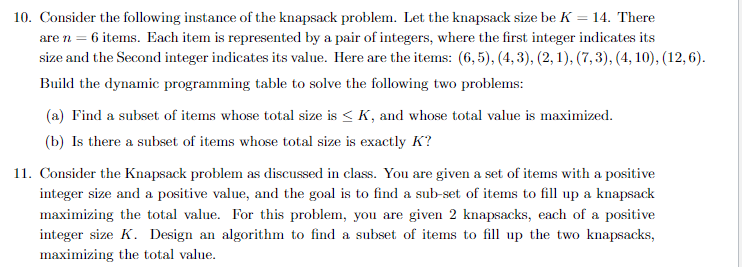
10. Consider the following instance of the knapsack problem. Let the knapsack size be K=14. There are n=6 items. Each item is represented by a pair of integers, where the first integer indicates its size and the Second integer indicates its value. Here are the items: (6,5),(4,3),(2,1),(7,3),(4,10),(12,6) Build the dynamic programming table to solve the following two problems: (a) Find a subset of items whose total size is K, and whose total value is maximized. (b) Is there a subset of items whose total size is exactly K ? 11. Consider the Knapsack problem as discussed in class. You are given a set of items with a positive integer size and a positive value, and the goal is to find a sub-set of items to fill up a knapsack maximizing the total value. For this problem, you are given 2 knapsacks, each of a positive integer size K. Design an algorithm to find a subset of items to fill up the two knapsacks, maximizing the total value
Step by Step Solution
There are 3 Steps involved in it

Get step-by-step solutions from verified subject matter experts
 Study Help