



Question: 10. Differenced equation with three time periods Consider the following general fixed effects model for use with a panel data set with three time periods
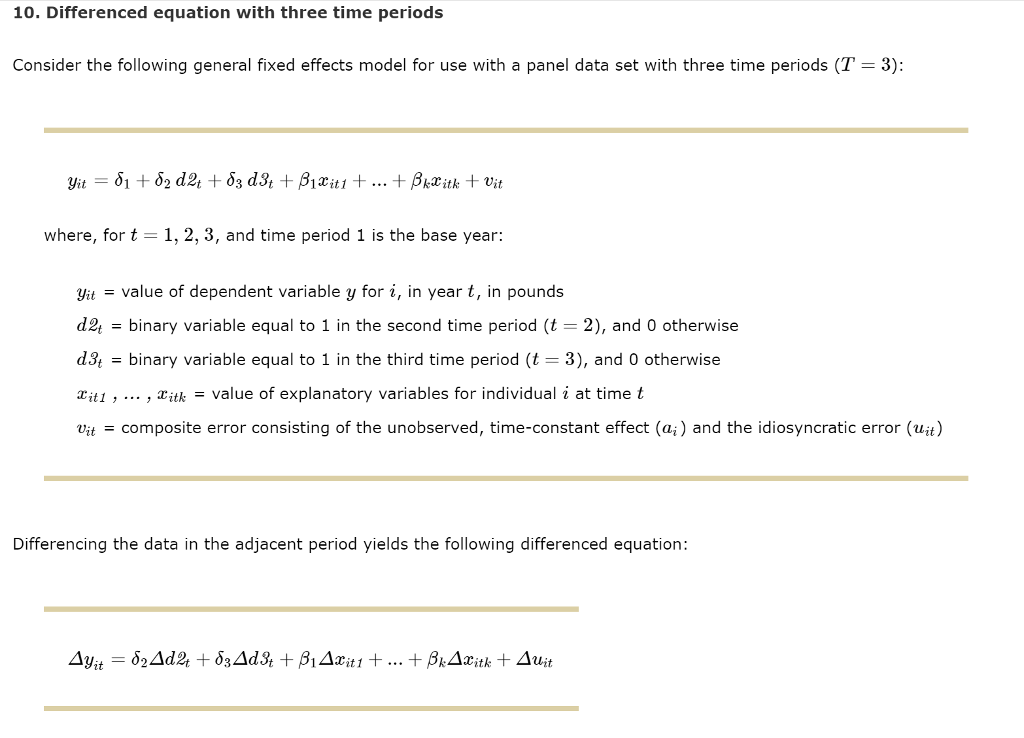
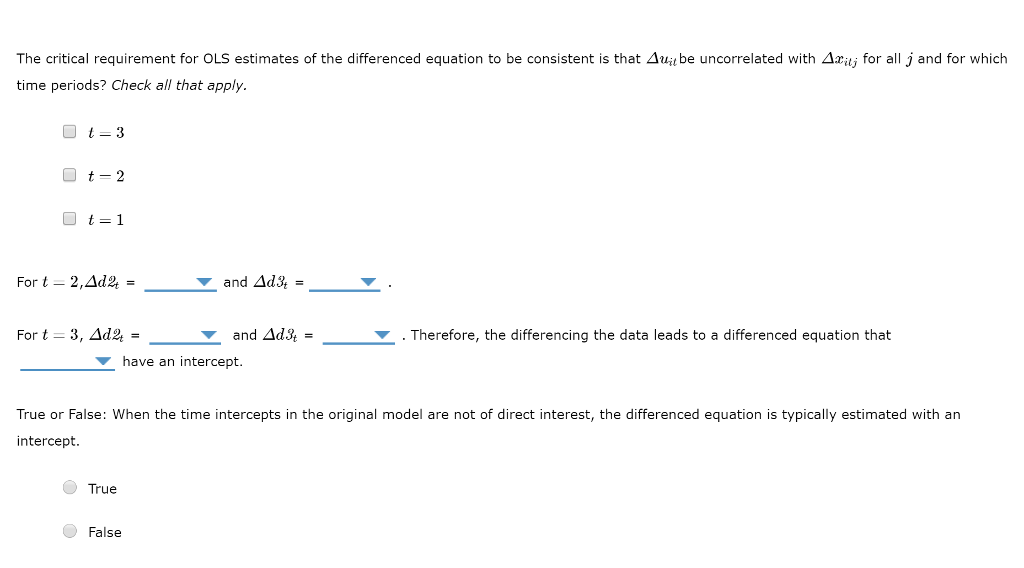
10. Differenced equation with three time periods Consider the following general fixed effects model for use with a panel data set with three time periods (T -3): where, for t 1, 2, 3, and time period 1 is the base year: itvalue of dependent variable y for i, in year t, in pounds d2binary variable equal to 1 otherwise dbinary variable equal to 1 in the third time period (t3), and 0 otherwise Titi , , Titk value of explanatory variables for individual i at time t itcomposite error consisting of the unobserved, time-constant effect (ai) and the idiosyncratic error (uit) in the second time period (t2), and O Differencing the data in the adjacent period yields the following differenced equation The critical requirement for OLS estimates of the differenced equation to be consistent is that t be uncorrelated with lj for all j and for which time periods? Check all that apply t -2 For t-2,Ad2- For t3, Ada " Therefore, the differencing the data leads to a differenced equation that have an intercept True or False: When the time intercepts in the original model are not of direct interest, the differenced equation is typically estimated with an ntercept. True False 10. Differenced equation with three time periods Consider the following general fixed effects model for use with a panel data set with three time periods (T -3): where, for t 1, 2, 3, and time period 1 is the base year: itvalue of dependent variable y for i, in year t, in pounds d2binary variable equal to 1 otherwise dbinary variable equal to 1 in the third time period (t3), and 0 otherwise Titi , , Titk value of explanatory variables for individual i at time t itcomposite error consisting of the unobserved, time-constant effect (ai) and the idiosyncratic error (uit) in the second time period (t2), and O Differencing the data in the adjacent period yields the following differenced equation The critical requirement for OLS estimates of the differenced equation to be consistent is that t be uncorrelated with lj for all j and for which time periods? Check all that apply t -2 For t-2,Ad2- For t3, Ada " Therefore, the differencing the data leads to a differenced equation that have an intercept True or False: When the time intercepts in the original model are not of direct interest, the differenced equation is typically estimated with an ntercept. True False
Step by Step Solution
There are 3 Steps involved in it

Get step-by-step solutions from verified subject matter experts