







Question: 10. Energy from garbage using a black hole Define an advanced civilization as one that can carry out any engineering task not forbidden by
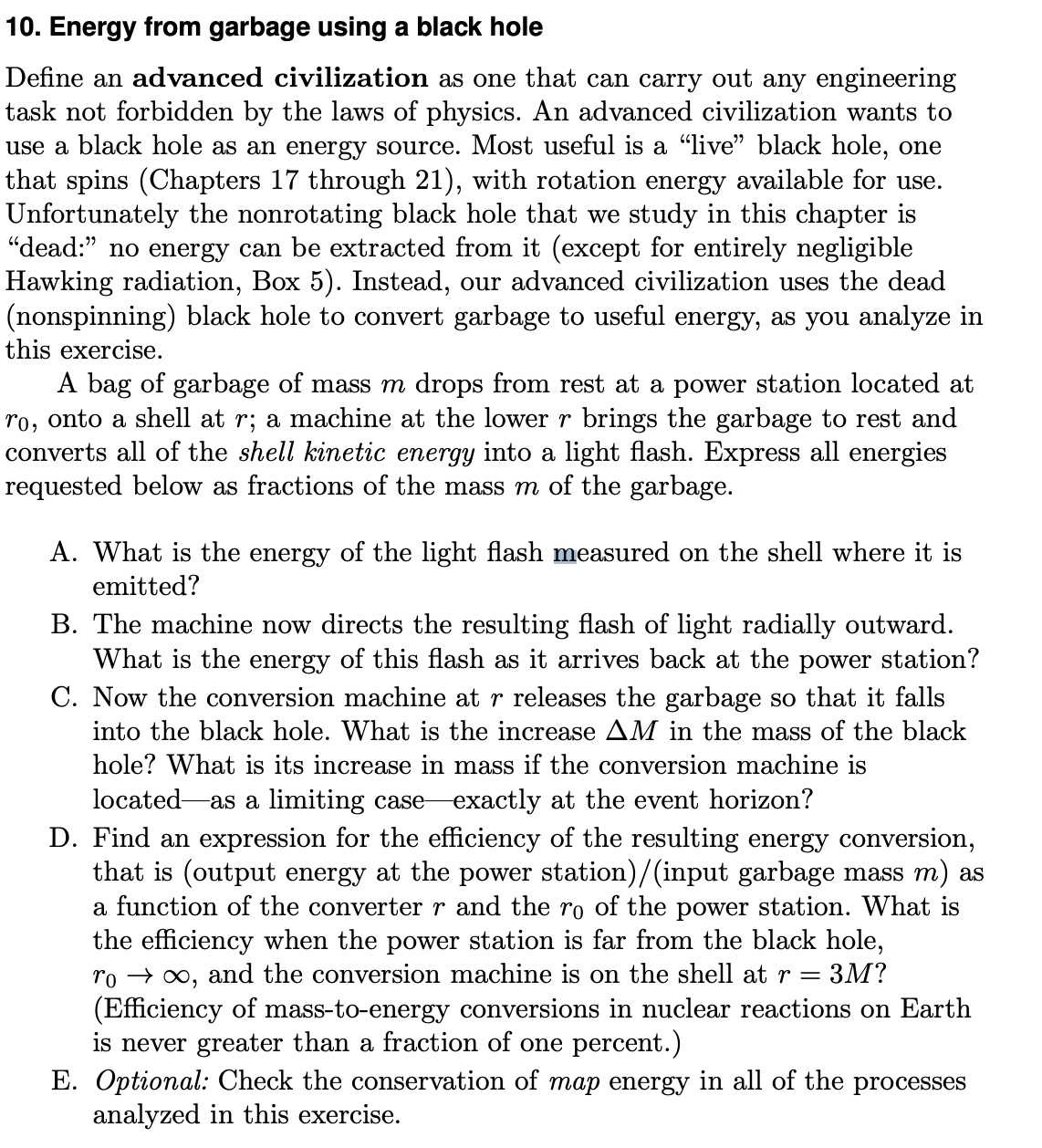
10. Energy from garbage using a black hole Define an advanced civilization as one that can carry out any engineering task not forbidden by the laws of physics. An advanced civilization wants to use a black hole as an energy source. Most useful is a live black hole, one that spins (Chapters 17 through 21), with rotation energy available for use. Unfortunately the nonrotating black hole that we study in this chapter is "dead:" no energy can be extracted from it (except for entirely negligible Hawking radiation, Box 5). Instead, our advanced civilization uses the dead (nonspinning) black hole to convert garbage to useful energy, as you analyze in this exercise. A bag of garbage of mass m drops from rest at a power station located at ro, onto a shell at r; a machine at the lower r brings the garbage to rest and converts all of the shell kinetic energy into a light flash. Express all energies requested below as fractions of the mass m of the garbage. A. What is the energy of the light flash measured on the shell where it is emitted? B. The machine now directs the resulting flash of light radially outward. What is the energy of this flash as it arrives back at the power station? C. Now the conversion machine at r releases the garbage so that it falls into the black hole. What is the increase AM in the mass of the black hole? What is its increase in mass if the conversion machine is located as a limiting case exactly at the event horizon? D. Find an expression for the efficiency of the resulting energy conversion, that is (output energy at the power station)/(input garbage mass m) as a function of the converter r and the ro of the power station. What is the efficiency when the power station is far from the black hole, To 700, and the conversion machine is on the shell at r = (Efficiency of mass-to-energy conversions in nuclear reactions on Earth is never greater than a fraction of one percent.) = 3M? E. Optional: Check the conservation of map energy in all of the processes analyzed in this exercise.
Step by Step Solution
There are 3 Steps involved in it

Get step-by-step solutions from verified subject matter experts
 Study Help