







Question: 1.0. Lab Goals - Define Classes and use Objects - Declare Instance Variables and practice their Default and Explicit Initialization - Define and use set
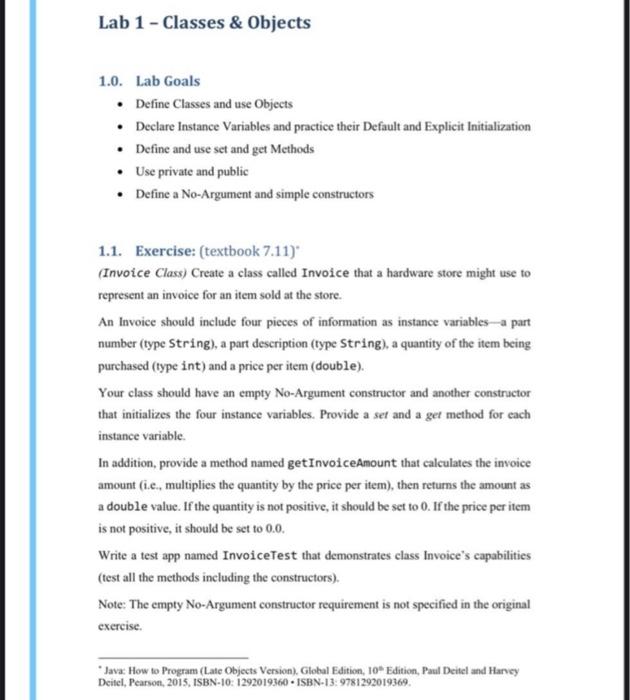
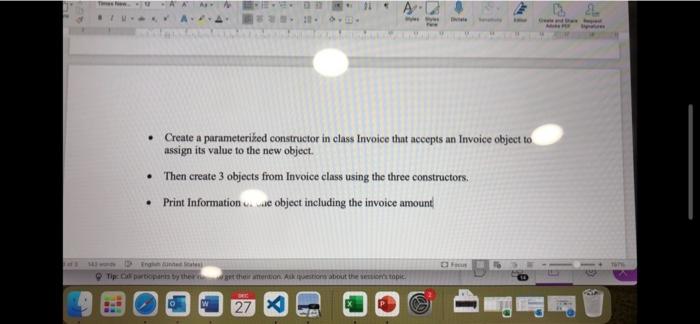
1.0. Lab Goals - Define Classes and use Objects - Declare Instance Variables and practice their Default and Explicit Initialization - Define and use set and get Methods - Use private and public - Define a No-Argument and simple constructors 1.1. Exercise: (textbook 7.11) (Invoice Class) Create a class called Invoice that a hardware store might use to represent an invoice for an item sold at the store. An Invoice should include four pieces of information as instance variables - a part number (type String), a part description (type String), a quantity of the item being purchased (type int) and a price per item (double). Your class should have an empty No-Argument constructor and another constructor that initializes the four instance variables. Provide a set and a get method for each instance variable. In addition, provide a method named get InvoiceAmount that calculates the invoice amount (i.e., multiplies the quantity by the price per item), then returns the amount as a double value. If the quantity is not positive, it should be set to 0 . If the price per item is not positive, it should be set to 0.0. Write a test app named InvoiceTest that demonstrates class Invoice's capabilities (test all the methods including the constructors). Note: The empty No-Argument constructor requirement is not specified in the original exercise. "Java: How to Program (Late Objects Version), Global Edition, 10 Bdition, Paul Deitel and Harvey - Create a parametered constructor in class Invoice that accepts an Invoice object to assign its value to the new object. - Then create 3 objects from Invoice class using the three constructors. - Print Information w. we object including the invoice amoune
Step by Step Solution
There are 3 Steps involved in it

Get step-by-step solutions from verified subject matter experts
 Study Help