







Question: (10 marks) For each part, interpret the bits according to the given context. If it is not possible to interpret the bits in the context,

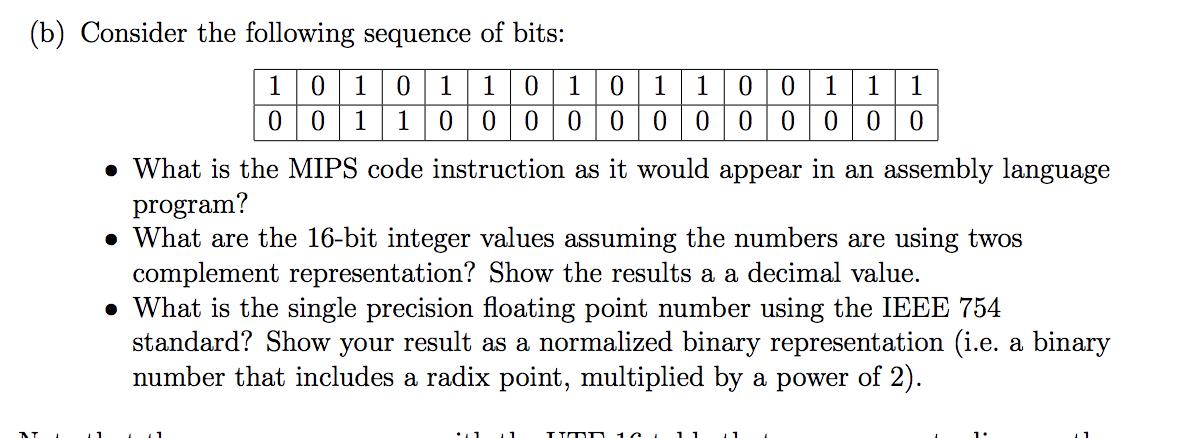
(10 marks) For each part, interpret the bits according to the given context. If it is not possible to interpret the bits in the context, give a brief explanation of the problem. You may have to search online to get more information to determine the actual characters represented by the UTF-16 sequence. (b) Consider the following sequence of bits: | 1 0 1 0 1 1 0 1 0 1 1 0 0 1 1 1 0 0 1 1 0 0 0 0 0 0 0 0 0 0 0 0 What is the MIPS code instruction as it would appear in an assembly language program? What are the 16-bit integer values assuming the numbers are using twos complement representation? Show the results a a decimal value. What is the single precision floating point number using the IEEE 754 standard? Show your result as a normalized binary representation (i.e. a binary number that includes a radix point, multiplied by a power of 2). 1 1 TTTT 1 1 1 (10 marks) For each part, interpret the bits according to the given context. If it is not possible to interpret the bits in the context, give a brief explanation of the problem. You may have to search online to get more information to determine the actual characters represented by the UTF-16 sequence. (b) Consider the following sequence of bits: | 1 0 1 0 1 1 0 1 0 1 1 0 0 1 1 1 0 0 1 1 0 0 0 0 0 0 0 0 0 0 0 0 What is the MIPS code instruction as it would appear in an assembly language program? What are the 16-bit integer values assuming the numbers are using twos complement representation? Show the results a a decimal value. What is the single precision floating point number using the IEEE 754 standard? Show your result as a normalized binary representation (i.e. a binary number that includes a radix point, multiplied by a power of 2). 1 1 TTTT 1 1 1
Step by Step Solution
There are 3 Steps involved in it

Get step-by-step solutions from verified subject matter experts
 Study Help