







Question: 10. Please Answer 1. Suppose a continuous random variable X has the following probability density function: f(x) + 2 X What is the probability P(OsXs1)
10. Please Answer
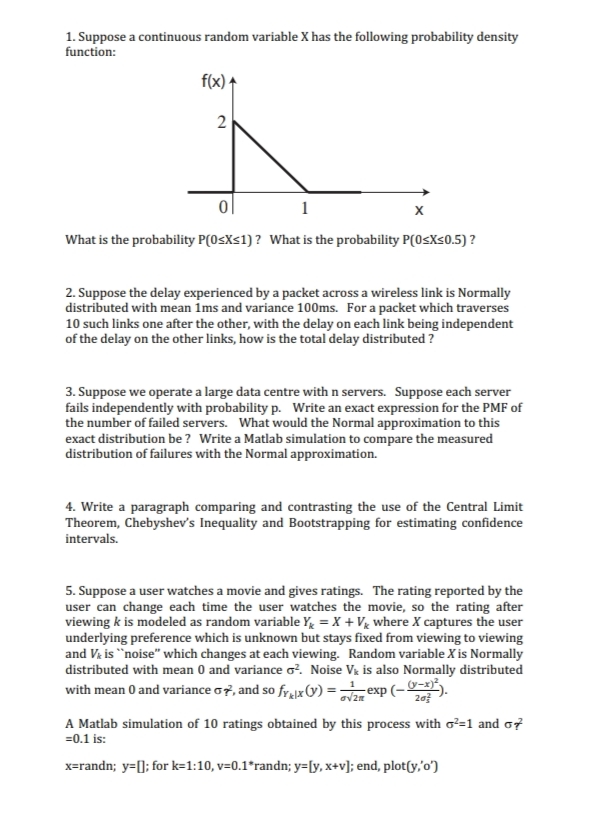
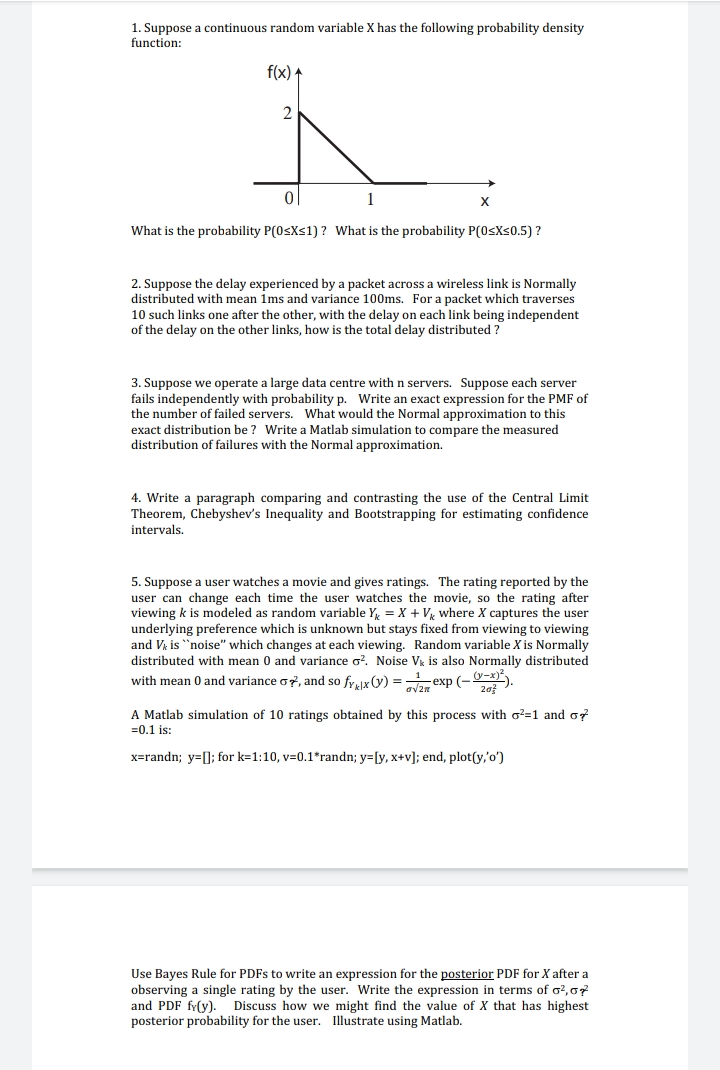
1. Suppose a continuous random variable X has the following probability density function: f(x) + 2 X What is the probability P(OsXs1) ? What is the probability P(OsX=0.5) ? 2. Suppose the delay experienced by a packet across a wireless link is Normally distributed with mean 1ms and variance 100ms. For a packet which traverses 10 such links one after the other, with the delay on each link being independent of the delay on the other links, how is the total delay distributed ? 3. Suppose we operate a large data centre with n servers. Suppose each server fails independently with probability p. Write an exact expression for the PMF of the number of failed servers. What would the Normal approximation to this exact distribution be ? Write a Matlab simulation to compare the measured distribution of failures with the Normal approximation. 4. Write a paragraph comparing and contrasting the use of the Central Limit Theorem, Chebyshev's Inequality and Bootstrapping for estimating confidence intervals. 5. Suppose a user watches a movie and gives ratings. The rating reported by the user can change each time the user watches the movie, so the rating after viewing k is modeled as random variable Y = X + V. where X captures the user underlying preference which is unknown but stays fixed from viewing to viewing and Ve is "noise" which changes at each viewing. Random variable X is Normally distributed with mean 0 and variance o'. Noise Ve is also Normally distributed with mean 0 and variance o7, and so freix (y) = -exp (-0-2)). A Matlab simulation of 10 ratings obtained by this process with o'=1 and of =0.1 is: x=randn; y=: for k=1:10, v=0.1*randn; y=[y, x+v]; end, plot(y,'o']1. Suppose a continuous random variable X has the following probability density function: f(x) + 2 X What is the probability P(OsXs1) ? What is the probability P(OsXs0.5) ? 2. Suppose the delay experienced by a packet across a wireless link is Normally distributed with mean 1ms and variance 100ms. For a packet which traverses 10 such links one after the other, with the delay on each link being independent of the delay on the other links, how is the total delay distributed ? 3. Suppose we operate a large data centre with n servers. Suppose each server fails independently with probability p. Write an exact expression for the PMF of the number of failed servers. What would the Normal approximation to this exact distribution be ? Write a Matlab simulation to compare the measured distribution of failures with the Normal approximation. 4. Write a paragraph comparing and contrasting the use of the Central Limit Theorem, Chebyshev's Inequality and Bootstrapping for estimating confidence intervals. 5. Suppose a user watches a movie and gives ratings. The rating reported by the user can change each time the user watches the movie, so the rating after viewing k is modeled as random variable Y = X + V. where X captures the user underlying preference which is unknown but stays fixed from viewing to viewing and V is "noise" which changes at each viewing. Random variable X is Normally distributed with mean 0 and variance of. Noise V is also Normally distributed with mean 0 and variance G?, and so frxx ()) = =-exp (-0-x)). A Matlab simulation of 10 ratings obtained by this process with of=1 and of =0.1 is: x=randn; y=; for k=1:10, v=0.1*randn; y=[y, x+v]; end, plot(y,'o') Use Bayes Rule for PDFs to write an expression for the posterior PDF for X after a observing a single rating by the user. Write the expression in terms of 6307 and PDF fy(y). Discuss how we might find the value of X that has highest posterior probability for the user. Illustrate using Matlab
Step by Step Solution
There are 3 Steps involved in it

Get step-by-step solutions from verified subject matter experts
 Study Help