





Question: (10 points) Consider a fictitious programming language containing only two numerical types integer and real), in which arbitrarily long (possibly empty) 1-dimensional arrays of numbers
 (10 points) Consider a fictitious programming language containing only two numerical

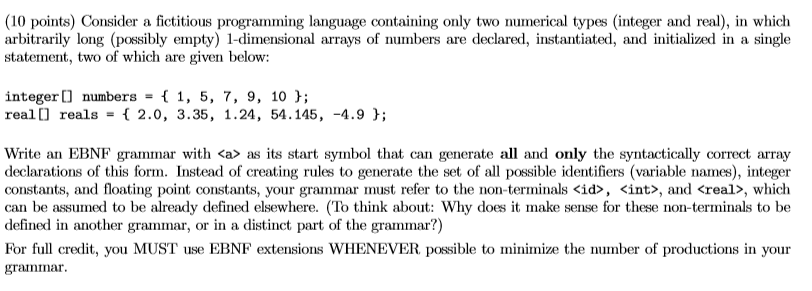
(10 points) Consider a fictitious programming language containing only two numerical types integer and real), in which arbitrarily long (possibly empty) 1-dimensional arrays of numbers are declared, instantiated, and initialized in a single statement, two of which are given below: integer [] numbers = { 1, 5, 7, 9, 10 }; reall) reals = { 2.0, 3.35, 1.24, 54.145, -4.9 }; Write an EBNF grammar with as its start symbol that can generate all and only the syntactically correct array declarations of this form. Instead of creating rules to generate the set of all possible identifiers (variable names), integer constants, and floating point constants, your grammar must refer to the non-terminals , , and , which can be assumed to be already defined elsewhere. (To think about: Why does it make sense for these non-terminals to be defined in another grammar, or in a distinct part of the grammar?) For full credit, you MUST use EBNF extensions WHENEVER possible to minimize the number of productions in your grammar (10 points) Consider a fictitious programming language containing only two numerical types integer and real), in which arbitrarily long (possibly empty) 1-dimensional arrays of numbers are declared, instantiated, and initialized in a single statement, two of which are given below: integer [] numbers = { 1, 5, 7, 9, 10 }; reall) reals = { 2.0, 3.35, 1.24, 54.145, -4.9 }; Write an EBNF grammar with as its start symbol that can generate all and only the syntactically correct array declarations of this form. Instead of creating rules to generate the set of all possible identifiers (variable names), integer constants, and floating point constants, your grammar must refer to the non-terminals , , and , which can be assumed to be already defined elsewhere. (To think about: Why does it make sense for these non-terminals to be defined in another grammar, or in a distinct part of the grammar?) For full credit, you MUST use EBNF extensions WHENEVER possible to minimize the number of productions in your grammar

Step by Step Solution

There are 3 Steps involved in it

1 Expert Approved Answer
Step: 1 Unlock blur-text-image
Question Has Been Solved by an Expert!

Get step-by-step solutions from verified subject matter experts

Step: 2 Unlock
Step: 3 Unlock

Students Have Also Explored These Related Databases Questions!