







Question: (10 points) For m e {10, 20, 50, 100, 500, 1000, 10000} and n {10, 20, 50, 100, 1000, 10000} generate matrices A ERmxn whose
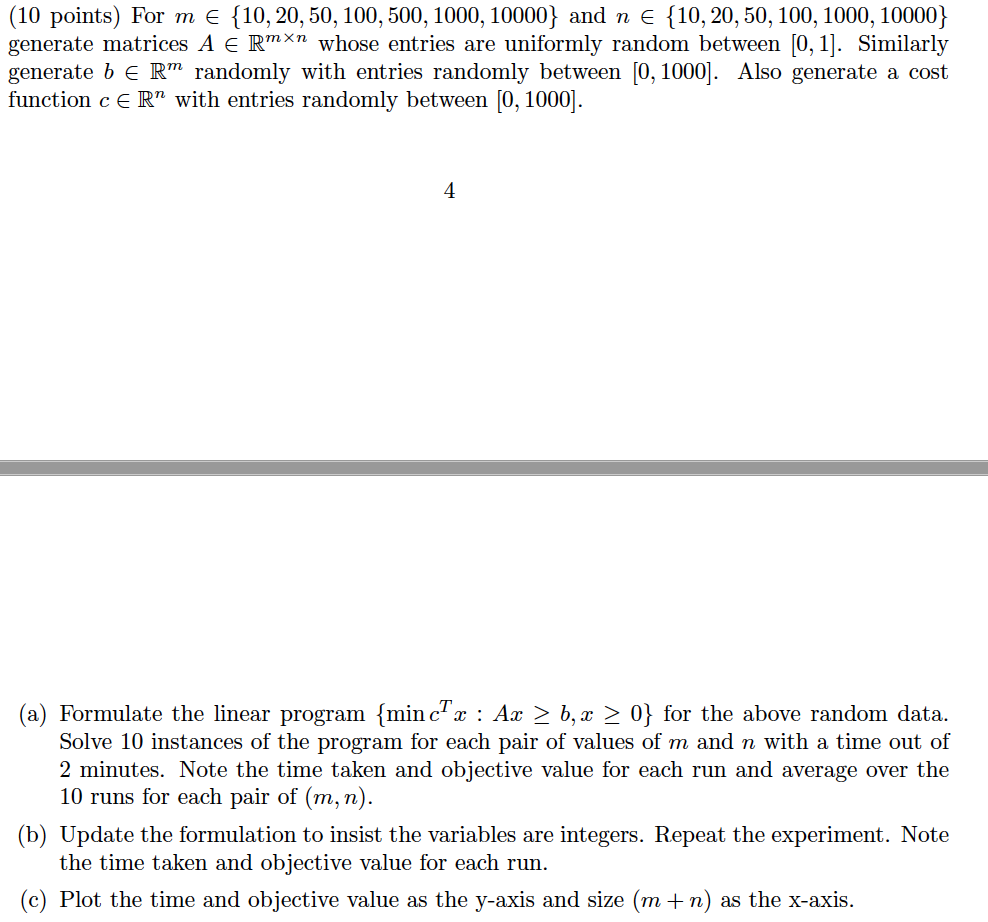
(10 points) For m e {10, 20, 50, 100, 500, 1000, 10000} and n {10, 20, 50, 100, 1000, 10000} generate matrices A ERmxn whose entries are uniformly random between [0, 1]. Similarly generate b E R randomly with entries randomly between [0, 1000). Also generate a cost function c ER" with entries randomly between [0, 1000). (a) Formulate the linear program min cx : Ax >b, x >0} for the above random data. Solve 10 instances of the program for each pair of values of m and n with a 2 minutes. Note the time taken and objective value for each run and average over the 10 runs for each pair of (m, n). (b) Update the formulation to insist the variables are integers. Repeat the experiment. Note the time taken and objective value for each run. (c) Plot the time and objective value as the y-axis and size (m+n) as the x-axis. (10 points) For m e {10, 20, 50, 100, 500, 1000, 10000} and n {10, 20, 50, 100, 1000, 10000} generate matrices A ERmxn whose entries are uniformly random between [0, 1]. Similarly generate b E R randomly with entries randomly between [0, 1000). Also generate a cost function c ER" with entries randomly between [0, 1000). (a) Formulate the linear program min cx : Ax >b, x >0} for the above random data. Solve 10 instances of the program for each pair of values of m and n with a 2 minutes. Note the time taken and objective value for each run and average over the 10 runs for each pair of (m, n). (b) Update the formulation to insist the variables are integers. Repeat the experiment. Note the time taken and objective value for each run. (c) Plot the time and objective value as the y-axis and size (m+n) as the x-axis
Step by Step Solution
There are 3 Steps involved in it

Get step-by-step solutions from verified subject matter experts
 Study Help