







Question: (10 points) In the rod cutting problem, we are given as input, P1.P2, Pn, where pi denotes the price of a rod/piece of length
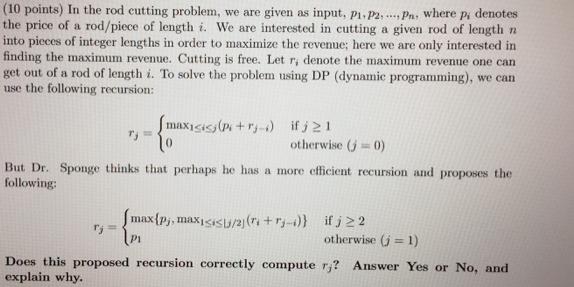
(10 points) In the rod cutting problem, we are given as input, P1.P2, Pn, where pi denotes the price of a rod/piece of length i. We are interested in cutting a given rod of length n into pieces of integer lengths in order to maximize the revenue; here we are only interested in finding the maximum revenue. Cutting is free. Let r, denote the maximum revenue one can get out of a rod of length i. To solve the problem using DP (dynamic programming), we can use the following recursion: [maxicisi (P + r-) ifj21 to But Dr. Sponge thinks that perhaps he has a more efficient recursion and proposes the following: Tj Tj = otherwise (0) [max (pj, maxisist/2j(r +rj-)} ifj2 PI otherwise (j= 1) Does this proposed recursion correctly compute rj? Answer Yes or No, and explain why.
Step by Step Solution
3.49 Rating (156 Votes )
There are 3 Steps involved in it
DP solution Rj MaxPiRji for 1 Ri Rji Pi Rj... View full answer

Get step-by-step solutions from verified subject matter experts
 Study Help