







Question: (10) Points) Let R be a sequential, ordered table with 100,000 tuples of 240 bytes each. Consider the following disk parameters: block size B is
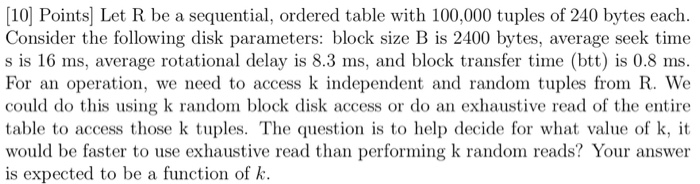
(10) Points) Let R be a sequential, ordered table with 100,000 tuples of 240 bytes each. Consider the following disk parameters: block size B is 2400 bytes, average seek time s is 16 ms, average rotational delay is 8.3 ms, and block transfer time (btt) is 0.8 ms. For an operation, we need to access k independent and random tuples from R. We could do this using k random block disk access or do an exhaustive read of the entire table to access those k tuples. The question is to help decide for what value of k, it would be faster to use exhaustive read than performing k random reads? Your answer is expected to be a function of k. (10) Points) Let R be a sequential, ordered table with 100,000 tuples of 240 bytes each. Consider the following disk parameters: block size B is 2400 bytes, average seek time s is 16 ms, average rotational delay is 8.3 ms, and block transfer time (btt) is 0.8 ms. For an operation, we need to access k independent and random tuples from R. We could do this using k random block disk access or do an exhaustive read of the entire table to access those k tuples. The question is to help decide for what value of k, it would be faster to use exhaustive read than performing k random reads? Your answer is expected to be a function of k
Step by Step Solution
There are 3 Steps involved in it

Get step-by-step solutions from verified subject matter experts
 Study Help