







Question: (10 points) We know that DFAS and NFAs are equivalent in power, but are they equivalent in representational efficiency? Let L3 = {x|x is
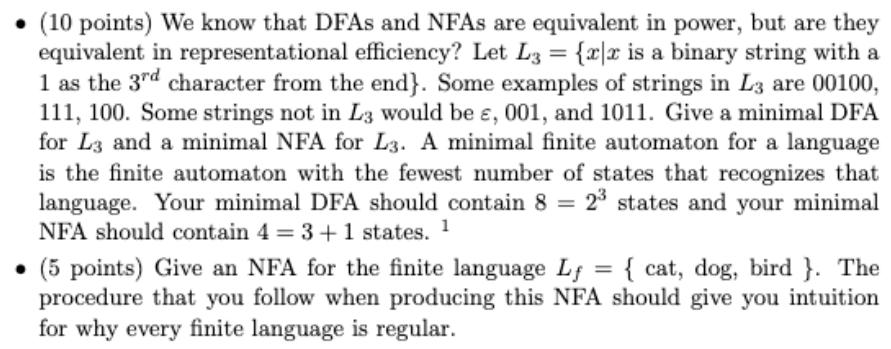
(10 points) We know that DFAS and NFAs are equivalent in power, but are they equivalent in representational efficiency? Let L3 = {x|x is a binary string with a 1 as the 3rd character from the end}. Some examples of strings in L3 are 00100, 111, 100. Some strings not in L3 would be , 001, and 1011. Give a minimal DFA for L3 and a minimal NFA for L3. A minimal finite automaton for a language is the finite automaton with the fewest number of states that recognizes that language. Your minimal DFA should contain 8 = 23 states and your minimal NFA should contain 4 = 3+1 states. 1 (5 points) Give an NFA for the finite language L = { cat, dog, bird }. The procedure that you follow when producing this NFA should give you intuition for why every finite language is regular.
Step by Step Solution
There are 3 Steps involved in it

Get step-by-step solutions from verified subject matter experts
 Study Help