



Question: 10) Public goods are in consumption. A) excludable but non-rival B) non-excludable and non-rival C) rival but non-excludable D) excludable and rival Chapter 10 11)
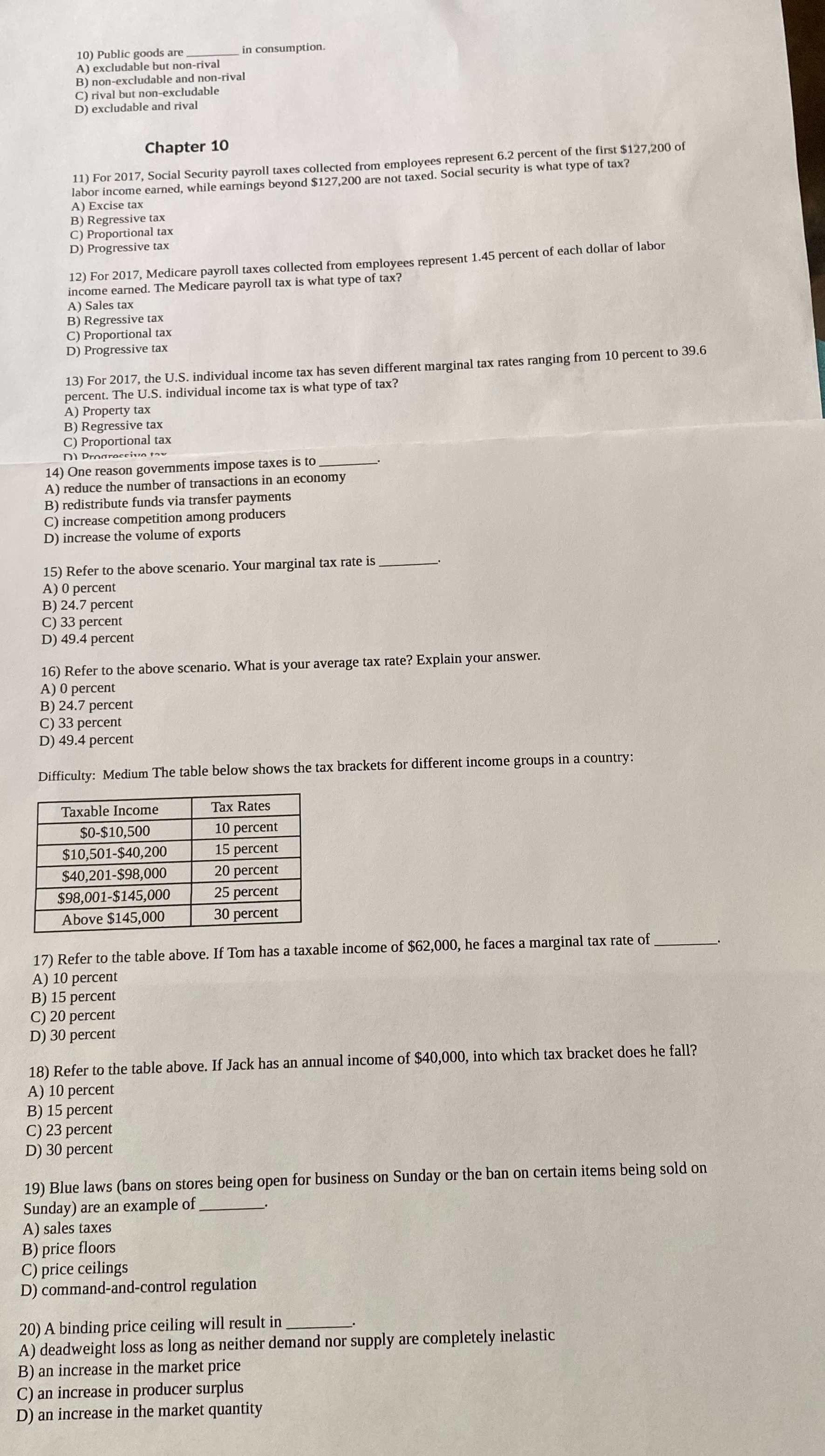
10) Public goods are in consumption. A) excludable but non-rival B) non-excludable and non-rival C) rival but non-excludable D) excludable and rival Chapter 10 11) For 2017, Social Security payroll taxes collected from employees represent 6.2 percent of the first $127,200 of labor income earned, while earnings beyond $127,200 are not taxed. Social security is what type of tax? A) Excise tax B) Regressive tax C) Proportional tax D) Progressive tax 12) For 2017, Medicare payroll taxes collected from employees represent 1.45 percent of each dollar of labor income earned. The Medicare payroll tax is what type of tax? A) Sales tax B) Regressive tax C) Proportional tax D) Progressive tax 13) For 2017, the U.S. individual income tax has seven different marginal tax rates ranging from 10 percent to 39.6 percent. The U.S. individual income tax is what type of tax? A) Property tax B) Regressive tax C) Proportional tax 14) One reason governments impose taxes is to A) reduce the number of transactions in an economy B) redistribute funds via transfer payments C) increase competition among producers D) increase the volume of exports 15) Refer to the above scenario. Your marginal tax rate is A) 0 percent B) 24.7 percent C) 33 percent D) 49.4 percent 16) Refer to the above scenario. What is your average tax rate? Explain your answer. A) 0 percent B) 24.7 percent C) 33 percent D) 49.4 percent Difficulty: Medium The table below shows the tax brackets for different income groups in a country: Taxable Income Tax Rates $0-$10,500 10 percent $10,501-$40,200 15 percent $40,201-$98,000 20 percent $98,001-$145,000 25 percent Above $145,000 30 percent 17) Refer to the table above. If Tom has a taxable income of $62,000, he faces a marginal tax rate of A) 10 percent B) 15 percent C) 20 percent D) 30 percent 18) Refer to the table above. If Jack has an annual income of $40,000, into which tax bracket does he fall? A) 10 percent B) 15 percent C) 23 percent D) 30 percent 19) Blue laws (bans on stores being open for business on Sunday or the ban on certain items being sold on Sunday) are an example of A) sales taxes B) price floors C) price ceilings D) command-and-control regulation 20) A binding price ceiling will result in _ A) deadweight loss as long as neither demand nor supply are completely inelastic B) an increase in the market price C) an increase in producer surplus D) an increase in the market quantity
Step by Step Solution
There are 3 Steps involved in it

Get step-by-step solutions from verified subject matter experts