







Question: 10. The decision-maker using Maximin criterion on the problem below would choose Alternative row maximum is: because the maximum of the States of Nature
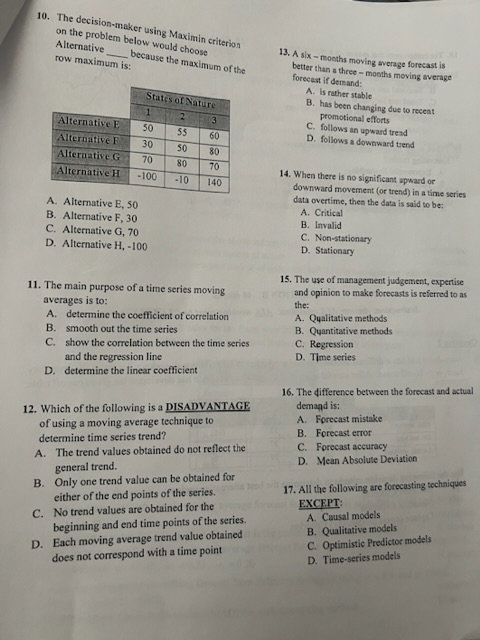
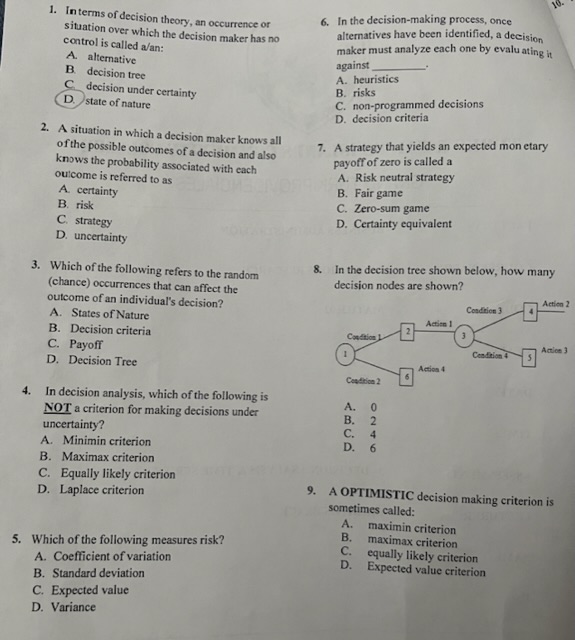
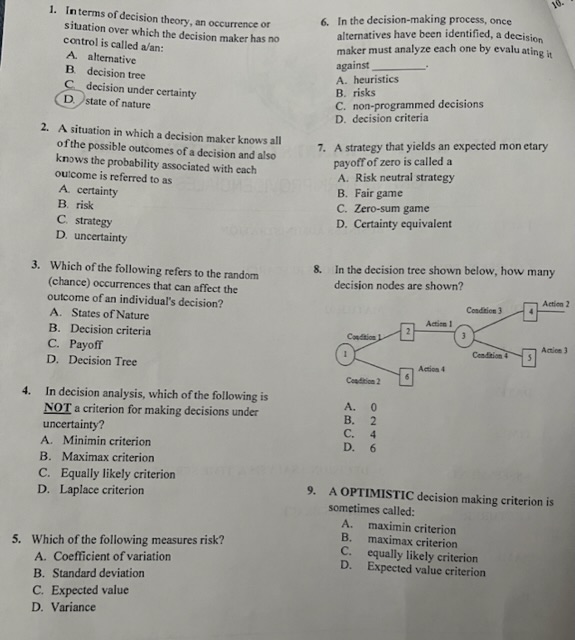
10. The decision-maker using Maximin criterion on the problem below would choose Alternative row maximum is: because the maximum of the States of Nature 2 3 Alternative E 50 55 60 Alternative F 30 50 80 Alternative G 70 80 70 -10 140 Alternative H -100 A. Alternative E, 50 B. Alternative F, 30 C. Alternative G, 70 D. Alternative H, -100 11. The main purpose of a time series moving averages is to: A. determine the coefficient of correlation B. smooth out the time series C. show the correlation between the time series and the regression line D. determine the linear coefficient 12. Which of the following is a DISADVANTAGE of using a moving average technique to determine time series trend? A. The trend values obtained do not reflect the general trend. B. Only one trend value can be obtained for either of the end points of the series. C. No trend values are obtained for the beginning and end time points of the series. D. Each moving average trend value obtained does not correspond with a time point 13. A six-months moving average forecast is better than a three-months moving average forecast if demand: A. is rather stable B. has been changing due to recent promotional efforts C. follows an upward tread D. follows a downward trend 14. When there is no significant upward or downward movement (or trend) in a time series data overtime, then the data is said to be: A. Critical B. Invalid C. Non-stationary D. Stationary 15. The use of management judgement, expertise and opinion to make forecasts is referred to as the: A. Qualitative methods B. Quantitative methods C. Regression D. Time series 16. The difference between the forecast and actual demand is: A. Forecast mistake B. Forecast error C. Forecast accuracy D. Mean Absolute Deviation 17. All the following are forecasting techniques EXCEPT: A. Causal models B. Qualitative models C. Optimistic Predictor models D. Time-series models 1. In terms of decision theory, an occurrence or situation over which the decision maker has no control is called a/an: A. alternative B. decision tree C decision under certainty D state of nature 2. A situation in which a decision maker knows all of the possible outcomes of a decision and also knows the probability associated with each outcome is referred to as A. certainty B. risk C. strategy 6. In the decision-making process, once alternatives have been identified, a decision maker must analyze each one by evaluating it against A. heuristics B. risks C. non-programmed decisions D. decision criteria 7. A strategy that yields an expected monetary payoff of zero is called a A. Risk neutral strategy B. Fair game C. Zero-sum game D. Certainty equivalent D. uncertainty 4. 3. Which of the following refers to the random (chance) occurrences that can affect the outcome of an individual's decision? A. States of Nature B. Decision criteria C. Payoff D. Decision Tree In decision analysis, which of the following is NOT a criterion for making decisions under uncertainty? A. Minimin criterion B. Maximax criterion C. Equally likely criterion D. Laplace criterion 8. In the decision tree shown below, how many decision nodes are shown? Action 2 Condition 3 4 Action 1 Condition L Condition Action 3 Action 4 Condition 2 A. 0 B. 2 C. 4 D. 6 5. Which of the following measures risk? A. Coefficient of variation B. Standard deviation C. Expected value D. Variance 9. A OPTIMISTIC decision making criterion is sometimes called: A. maximin criterion B. maximax criterion ABCD C. D. equally likely criterion Expected value criterion 1. In terms of decision theory, an occurrence or situation over which the decision maker has no control is called a/an: A. alternative B. decision tree C decision under certainty D state of nature 2. A situation in which a decision maker knows all of the possible outcomes of a decision and also knows the probability associated with each outcome is referred to as A. certainty B. risk C. strategy 6. In the decision-making process, once alternatives have been identified, a decision maker must analyze each one by evaluating it against A. heuristics B. risks C. non-programmed decisions D. decision criteria 7. A strategy that yields an expected monetary payoff of zero is called a A. Risk neutral strategy B. Fair game C. Zero-sum game D. Certainty equivalent D. uncertainty 4. 3. Which of the following refers to the random (chance) occurrences that can affect the outcome of an individual's decision? A. States of Nature B. Decision criteria C. Payoff D. Decision Tree In decision analysis, which of the following is NOT a criterion for making decisions under uncertainty? A. Minimin criterion B. Maximax criterion C. Equally likely criterion D. Laplace criterion 8. In the decision tree shown below, how many decision nodes are shown? Action 2 Condition 3 4 Action 1 Condition L Condition Action 3 Action 4 Condition 2 A. 0 B. 2 C. 4 D. 6 5. Which of the following measures risk? A. Coefficient of variation B. Standard deviation C. Expected value D. Variance 9. A OPTIMISTIC decision making criterion is sometimes called: A. maximin criterion B. maximax criterion ABCD C. D. equally likely criterion Expected value criterion
Step by Step Solution
There are 3 Steps involved in it
Lets go through the questions provided Question 10 Maximin Criterion The Maximin criterion involves choosing the alternative with the maximum of the m... View full answer

Get step-by-step solutions from verified subject matter experts
 Study Help