







Question: 10. When we derived the Hall constant in Section 4.10, we assumed that the carrier mass is isotropic; the mobility of the carrier is therefore
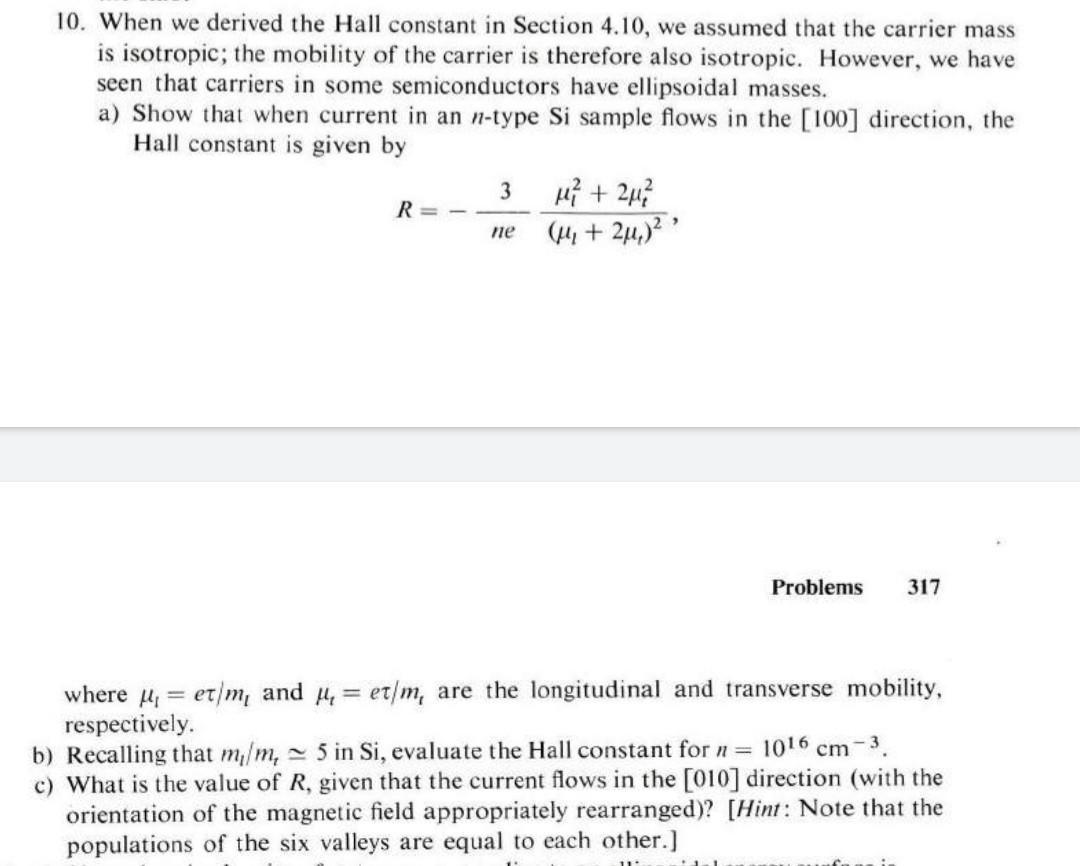
10. When we derived the Hall constant in Section 4.10, we assumed that the carrier mass is isotropic; the mobility of the carrier is therefore also isotropic. However, we have seen that carriers in some semiconductors have ellipsoidal masses. a) Show that when current in an n-type Si sample flows in the [100] direction, the Hall constant is given by R=ne3(l+2t)2l2+2t2, where l=e/ml and t=e/mt are the longitudinal and transverse mobility, respectively. b) Recalling that ml/mt5 in Si, evaluate the Hall constant for n=1016cm3. c) What is the value of R, given that the current flows in the [010] direction (with the orientation of the magnetic field appropriately rearranged)? [Hint: Note that the populations of the six valleys are equal to each other.] 10. When we derived the Hall constant in Section 4.10, we assumed that the carrier mass is isotropic; the mobility of the carrier is therefore also isotropic. However, we have seen that carriers in some semiconductors have ellipsoidal masses. a) Show that when current in an n-type Si sample flows in the [100] direction, the Hall constant is given by R=ne3(l+2t)2l2+2t2, where l=e/ml and t=e/mt are the longitudinal and transverse mobility, respectively. b) Recalling that ml/mt5 in Si, evaluate the Hall constant for n=1016cm3. c) What is the value of R, given that the current flows in the [010] direction (with the orientation of the magnetic field appropriately rearranged)? [Hint: Note that the populations of the six valleys are equal to each other.]
Step by Step Solution
There are 3 Steps involved in it

Get step-by-step solutions from verified subject matter experts
 Study Help